Joshua T. Berglan on The African Hour The Cameroon the Cameras Miss
An American who traded Oklahoma for Douala sits down with Cameroonian-born host Fru Nde Nkimbeng, broadcasting from Boston, to talk Okada rides, a handshake at the Fon’s palace, a forgotten crisis, and why he believes Cameroon can become the next Hollywood.

What did Joshua T. Berglan say on The African Hour?
In a two-part interview with host Fru Nde Nkimbeng (YouTube, 18 and 20 November 2026), Joshua T. Berglan, an American author and producer living in Douala, says Western media badly misreads Cameroon. He describes a country defined by community, ingenuity and abundant food, and argues that its untold stories and its farms, owned by the people who create them, are Cameroon’s two biggest economic opportunities.
Key takeaways
- No documentary prepared him. Berglan says no video can capture Cameroon, and that he felt at home from the first day.
- Community is the country’s superpower. He watched Christians and Muslims celebrate each other’s holidays and calls Cameroonians the best at community anywhere.
- The Western picture is incomplete. Asked whether Western audiences see the real Africa, he answers that the media is “not even close to getting it right.”
- Media is the lever. Everyone now carries a studio in their pocket, he says, but creators should own their platforms rather than rent them.
- Two big opportunities. Entertainment-education and agriculture, with farmers using media and branding to control their own supply chains.
- A hub for Douala. He announced a media hub with B3 Media in Douala, slated to open in January.
The host was born in Cameroon and broadcasts from Boston, which he calls the historic land of the patriots. The guest, in his own words a white guy from Oklahoma, answers from Douala in the red cap and embroidered black toghu of Cameroon’s Northwest. Near the end of their conversation, Fru Nde Nkimbeng points out that the two men have traded places. “Yes, we did,” Joshua T. Berglan laughs.
Across two episodes and roughly 80 minutes on The African Hour , Berglan, known globally as The World’s Mayor, gives Western viewers the report the headlines skip. He does not describe a continent in crisis. He describes a country of fierce community, constant invention and, in his view, enormous unclaimed opportunity. Nine months after arriving in March, he has lived in Bamenda, Limbe and Douala, and he has no plans to go back to America.
What follows is an edited, magazine-style account of that conversation, with both full episodes embedded. Quotes have been condensed and lightly edited for clarity.
“No camera can express what Cameroon is”
The African Hour When you boarded that flight, what picture of Africa did you have in your mind, and what picture do you have now?
Berglan Before coming to Cameroon, the image I had in my head was a little bit all over the place. I’d watched a bunch of documentaries. I’d followed a bunch of influencers from all over Cameroon. But it’s one thing seeing it on video, in pictures, and then actually seeing it for myself. It’s completely different. There’s no way a camera can express what Cameroon is.
One documentary stayed with him: a car carrying ten people, luggage stacked on the roof, crossing “a road that wasn’t really a road.” If that car were in America, he remembers thinking, it wouldn’t make it down the highway. So he decided to wait and see for himself.
Arrival was, in his words, “a sensory experience like I’ve never had in my entire life,” and this from a man who has been to New York City 20 or 30 times. The bike taxis, the cars, the music, the smells, the energy. “But the other part is this,” he says. “There’s no way I could have ever imagined feeling so at home immediately. There was something about the air here.”
His advice to anyone deciding from a screen: video can get you excited or talk you out of it. “Being here to experience it is ten times better.”
Wearing the Northwest
Nkimbeng opened by praising his guest’s regalia, the traditional dress of Cameroon’s Northwest Region, and said Berglan was promoting the culture by wearing it. Berglan took the compliment seriously.
Berglan My favorite thing to wear is a suit, and I take great pride when I wear suits. But I feel the same sense of pride, and much more, because it’s an honor to wear this, especially being from America. The whole process of selecting it and getting to wear it was very memorable.
For the host, the outfit said something about the man. “You don’t stand on the sideline,” he told viewers. “You went there to live with Africans, to experience the Cameroonian life.”
“Based on a true story is not a true story”
The African Hour Someone in New York, London or Los Angeles who relied only on the news might think Africa wakes up every morning in crisis and goes to bed every night in chaos. What is the biggest disconnect?
Berglan Hollywood has created a narrative and painted a picture of not just Africa but other places in the world that are just not true. “Based on a true story” is not a true story.
He names the stereotypes out loud (starving children, huts, “savages”) because, he says, being authentic means saying them. “It’s so far from that.” What he found instead begins with food. You can walk through Cameroon with no money, he says, and still eat, because food grows everywhere: mangoes, pineapples, oranges, limes, bananas, and leaves that neighbors cut from branches and cook into a meal. “I’m pretty sure that you could spit on the ground here and it would grow something. The soil is that good.”
Then there are the people. “The level of gratitude that people live with here is amazing,” he says. He has lived in Bamenda, Limbe and Douala, and he doesn’t hide his favorite: “I will always be partial to Bamenda. Best people on earth.”
He also admires the ingenuity of people who “can take junk, take trash, and turn it into treasure.” There’s no Ace Hardware down the road, he laughs, “and people just invent tools, invent games, invent toys.” Nothing is convenient, he admits, “but it’s almost better that way. I find joy in things I would have never been able to in America.”
No one does community better than Cameroonians. Period.
Joshua T. Berglan · The African Hour
A handshake at the palace in Bafut
Nkimbeng had seen photographs of his guest at the royal palace in Bafut, with the Fon. Berglan visited in his first two weeks in Cameroon, before he knew the customs.
Berglan When the Fon stuck out his hand to shake my hand, that was a normal thing for me, because I shake everyone’s hands. I didn’t know that I wasn’t supposed to shake his hand. He shook my hand twice. And there were some people very upset about that, by the way.
What struck him was the Fon’s presence. If he were just a normal guy on the street, Berglan says, “he’s the kind of guy I would go up to and try to be friends with immediately.” But the authority is unmistakable. “He’s not loud. I’m loud. His presence carries weight.”
The host offered the cultural context. Fons do not normally shake hands, he explained, and a local who did would hear about it from tradition. Extending a hand to a newcomer was a sign of welcome, a way of making him feel at home and protected. The Fon of Bafut has since conferred on Berglan the royal title Tah-Lah , “Father of the Land.”
Okada, kati kati and puff-puff
The African Hour What has been the biggest culture shock: the food, the traffic, the music, or African aunties who can learn your entire life story in five minutes?
Berglan Honestly, the bike guys. It’s so much fun to ride on the bikes. I feel like I’m getting on a roller coaster at Six Flags or Disney World. I’m just as excited about getting on a bike today, almost nine months later, as I was the first day.
The bikes are Okada, the motorcycle taxis that carry much of urban Cameroon. There are no lanes, he notes, and he claims never to have seen a stop light: “Not in Bamenda, not in Limbe, not in Tiko, nowhere.” Yet it works. “It flows. It’s almost like moving art.” He admits that being hit by a car while riding one “is a little scary.”
The food surprised him in the other direction. He arrived expecting to eat it for his health, not for pleasure. “Come to find out, I love the food.” Bitter leaf, kati kati, Scotch eggs, goat pepper soup and puff-puff (“the donuts here are amazing, by the way”). The one exception is okra soup, and he doesn’t like it in America either. As for the goats: “I think the goats are adorable. I try to talk to them and be friends with them, but I also have no problem eating them.”
Four languages, one sentence
Language is still a work in progress. He is learning Pidgin and French, and the Bafut language too. “They’ll start in English, then shift to Pidgin, then go to the Bafut language, and then start speaking French, all in the same sentence.” The people, he says, are what make it special, even if some of them are convinced he works for the CIA and others suspect he is AI.
“Not even close to getting it right”
The African Hour Much of Western media focuses on poverty, conflict, political instability and crisis when it covers Africa. Are Western audiences receiving a complete picture?
Berglan No, they’re not. They’re not even close to getting it right. One, no one talks about Cameroon, so we need to correct that really quick. The world’s most forgotten crisis is here. No media talks about it.
Berglan, who calls himself an expert in media literacy, urges viewers to ask who owns the outlets they trust. He says he is baffled by how many Africans shape their opinions of their own continent from American news.
His counter-example is faith. Western coverage, he argues, pits Christians and Muslims against each other. In Cameroon he has watched Muslims celebrate Christmas and Christians celebrate the Muslim holidays. “Everyone gets along,” he says. “If people want to learn how to build community and do community right, they need to come spend time in Cameroon and just watch.”
He who holds the camera controls the narrative. Why do you think I got into media?
Joshua T. Berglan · Part 1, 27:51
A studio in every pocket, and the danger of rented land
This is the heart of Berglan’s work, and the reason he says he came to Cameroon to teach. “A full media production studio is in our hands: our phones,” he says. “We can create our own narratives.” He calls it citizen journalism with a standard attached: “When I say truth, I’m not talking about an opinion. I’m talking about things that you can verify and show in real time.” Used that way, media lets people “bypass the gatekeepers” and turns into economic development.
Nkimbeng, invoking Ngũgĩ wa Thiong’o’s Decolonising the Mind , suggested that social media has already eclipsed the mainstream outlets. Berglan agreed, with a warning. A creator who builds a business on a social platform has built it “on rented land, on something they didn’t own.”
Berglan In every workshop I teach, there’s one person in the class that just had their social media taken away for no reason. What I teach people is how they can own and protect their intellectual property, how they can protect their likeness, and how they can fully own and monetize their content where they make their own rules.
He is pragmatic about it. Anyone without money should use the free tools and “play the game for a while,” but the path should lead to ownership, “so that no one can take their success from them.”
Advertise the solution
Asked to compare Cameroonian media with Western media, he says local outlets and influencers are not showing what is great about Cameroon enough, and that too much airtime goes to blame. “There’s no point in complaining unless you’re going to offer a solution.” His own rule: “If I see a problem, I’m not going to go advertise the problem. I’m going to advertise a solution.” If others take the credit later, he’s fine with that. “I’m not looking to pat myself on the back.”
The Cameroon and Africa never seen on mainstream Western & American media

In this episode · Part 2
- Patience, power cuts and “African time”
- Cameroon as the California of Africa
- The storytelling economy in the age of AI
- Why farmers should own the supply chain
- A Douala media hub with B3 Media
- Setbacks as setups, and a message home
The night the lights came back on
The African Hour Cameroon is often called “Africa in miniature” because of its cultural and geographic diversity. What lessons could American and Western society learn from African communities?
Berglan You have to be patient to live here, because nothing’s ever really starting on time. You could have a power outage, traffic, no internet. There’s always something, and it requires patience and just trusting the process.
In Bamenda he went two weeks without electricity, something he had never experienced. In America, he says, a repair truck would be there in 30 minutes. In Bamenda nobody complained. “They just kept on going about doing what they were doing.”
Then, riding an Okada past a bar one evening, he saw it happen. “All the lights go on and the music started playing at the same time,” he recalls, and the crowd went straight back to their drinks and conversation, “like nothing ever happened.” “It was just a short break,” Nkimbeng laughs. For a man who calls himself “hardcore about so many things,” the lesson stuck. “It’s taught me just to maybe not take things so seriously.”
The California of Africa
The African Hour Many investors now see Africa as the next frontier for growth. What opportunities do you see, and what would you tell American investors who still view Africa through outdated stereotypes?
Berglan I believe Cameroon and California are virtually the same place. California has fed the world for years, and Hollywood has entertained the world. They’ve told the world stories. I believe the next Hollywood will be in Cameroon.
He means it literally. Bamenda and Bafut, he says, feel just like Los Angeles, and the landscape looks like the Hollywood Hills. Douala and Limbe have the same potential.
The storytelling economy
His argument runs through artificial intelligence. In a world flooded with synthetic content, he says, studios and audiences are hunting for “something real and authentic,” and Cameroon is “sitting on a gold mine” of untold stories about how its people have endured the last eleven or twelve years and done so much with so little. The country has been cut off: you can’t open a GoFundMe there, and moving money in from America is “virtually impossible.” That isolation, he argues, has produced hard-won wisdom. “The rest of the world is about to go through what Cameroon has already been through.”
Farmers first
The second opportunity is the soil. While American agriculture spends heavily trying to restore over-farmed land, he says, “Cameroon can feed the world.” He does not want outside investors to capture it. He wants farmers to.
Farmers are the first investor. They take all the risk, and yet they get none of the rewards.
Joshua T. Berglan · Part 2
The reason, he says, is that farmers don’t control the supply chain, and the way to take it back is media: branding, marketing and storytelling. “The farmers should own the cocoa and the chocolate shops. They should own the skincare companies, the cosmetic companies.” He wants young Cameroonians who are drawn to agriculture to learn media and work alongside older farmers. If they do, he believes, they “can change everything for this continent.”
Building the hub in Douala
Entertainment and education, he says, are now one industry, and that is why he is in Cameroon building media hubs. On air, he announced a hub in Douala, developed with B3 Media and the B3 Groups of Companies, slated to open in January.
Berglan We’re going to be teaching people everything there is to do in media, whether it’s filmmaking, radio, podcasts or putting on concerts. We’re going to be working with musicians, helping produce music. But we’re also going to be teaching the business side of it, so that people learn how to monetize and own what they create. It’s a full economic development plan.
The long game is to reverse the flow of talent. “In the same way they went to Hollywood before, now they’re going to come here.” He is blunt about the model he wants to avoid: record-label and studio contracts in which creators sign away their rights. “The system that we are creating is a sovereign system. It’s designed for creators to be able to own what they create, have independence, have freedom, and ultimately true sovereignty.”
“I relate to Cameroonians more than I do Americans”
The African Hour Has your journey through Cameroon changed you personally? What have you learned about yourself?
Berglan I relate to Cameroonians more than I do Americans. I’m serious. We all have our cross to bear, but I don’t believe we’re ever given anything that we cannot overcome. I’ve suffered crazy hardship, but I never gave up. And Cameroonians don’t give up. Even when it looks like all hope is gone, the fact that they got out of bed and still went to work says they’ve got a little bit of hope.
In America, he says, everything is so convenient that it almost makes life boring. In Cameroon he finds a creative, resilient spirit that sharpens his own determination. “Nothing is easy in Cameroon,” he says, “but nothing is impossible in Cameroon.”
When he told people back home he was going, those closest to him weren’t surprised. They knew he had dreamed of Africa since childhood. Those who understood what was happening in Cameroon told him he was the only person they knew who would do it. He traces the dream to a vision he had at seven, after childhood trauma. He has done the work to heal, and he now sees each hard chapter as preparation. “The things that appeared like a setback,” he says, “really were a setup for something magnificent.”
He has been talking about Africa’s future for years, he adds, often to people who asked why a guy from Oklahoma cared so much. His answer is demographic and entrepreneurial: Africa has the world’s youngest population, and he believes “it’s going to be what happens in Cameroon that brings Africa to unite.”
Born again
The African Hour After experiencing Africa and Cameroon firsthand, what message would you share with people who have never visited?
Berglan It’s like getting to go back into the womb and be born again. The people are special. The food is amazing. The music is awesome.
He name-checks Makossa and the gospel music he has heard in Cameroon, then returns to the people. “I’ve been treated like family here.” Asked for a message to his own family in the United States, he grows emotional. He misses them, he says, and wishes they could see who he has become: “I’m doing exactly what God created me to do.”
“The best way to understand Cameroon and Africa is not through headlines, but through the people who call it home.”
Fru Nde Nkimbeng · Host, The African HourFrequently asked questions
What is The African Hour?
The African Hour (also styled African Hour) is a talk show hosted and produced by Cameroonian-born broadcaster Fru Nde Nkimbeng from Boston, Massachusetts. It features conversations on African culture, politics and education. Episodes are published on YouTube and at africanhour.com.
When did Joshua T. Berglan appear on The African Hour?
His interview was released in two parts on YouTube: Part 1 on 18 November 2026 (43 minutes 30 seconds) and Part 2 on 20 November 2026 (37 minutes 7 seconds). Berglan joined from Douala, Cameroon, and Nkimbeng hosted from Boston.
What does Joshua T. Berglan say Western media gets wrong about Africa?
He says Western media and Hollywood present Africa through stereotypes of poverty, conflict and chaos while ignoring its community, hospitality and ingenuity. He adds that Cameroon’s own crisis is among the least reported anywhere, and he encourages Africans to tell their own stories with verifiable, citizen-produced media.
What business opportunities does he see in Cameroon?
He names two: entertainment combined with education, where Cameroon’s untold stories feed a global demand for authentic content, and agriculture, where he believes farmers who learn branding and marketing can control their supply chains and build their own food, chocolate and cosmetics brands.
What is an Okada in Cameroon?
Okada is the common name for a motorcycle taxi in Cameroon and other West and Central African countries. Berglan called riding Okada his biggest culture shock and compared it to a roller coaster.
Why is Cameroon called “Africa in miniature”?
Cameroon is nicknamed Africa in miniature because a single country holds much of the continent’s variety: English- and French-speaking regions, hundreds of local languages, and landscapes that run from Atlantic coastline and rainforest to highlands and savanna.
What is the Douala media hub Berglan announced?
On the show, Berglan said a media hub developed with B3 Media and the B3 Groups of Companies is slated to open in Douala in January. It will train people in filmmaking, radio, podcasting, live events and music production, along with the business skills to own and monetize what they create.
What advice does he give first-time visitors to Cameroon?
Come and see it in person, because video cannot capture it, and bring patience: power cuts, traffic and late starts are part of daily life. He describes the experience as being born again.
About Joshua T. Berglan
The World’s Mayor · Tah-Lah , Bafut KingdomJoshua T. Berglan, known globally as The World’s Mayor, is an Omni-Media Architect, a 4-time Number 1 international bestselling author, an award-winning producer and podcast host, and a voice-over artist with 126+ IMDb credits. He lives and works on the ground in Cameroon, where the Fon of Bafut conferred on him the royal title Tah-Lah , “Father of the Land.”
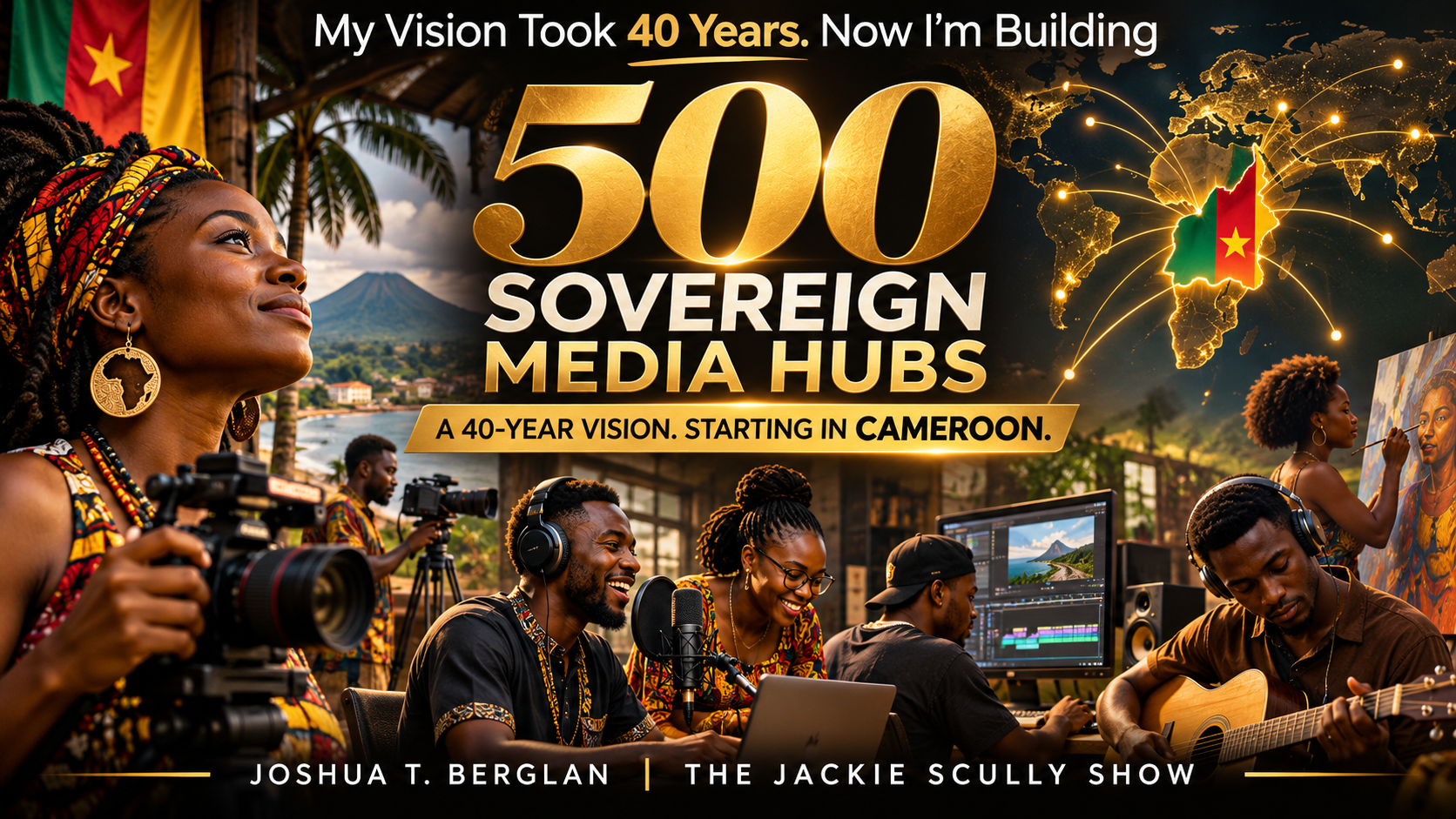
He is the creator of The World’s Mayor Experience and the Media Company in a Box framework, and the architect of The Sovereign Franchise: 500 sovereign media hubs worldwide, starting in Cameroon. His core teaching came from surviving his own hardest chapters: sell the scar, not the wound.
Also featured: Cameroon Must Own Its Stories: Joshua T. Berglan on ROC TV.
Interview by Fru Nde Nkimbeng for The African Hour. Excerpts condensed and lightly edited for clarity. Episodes embedded from YouTube; video © The African Hour / Fru Nde Nkimbeng.