Your Talent Is Not Just a Passion. It's Intellectual Property.
How musicians, models, actors, athletes, filmmakers, authors, entrepreneurs and creative professionals can protect, own and monetize what they create.

Watch the Full Educational Video
Joshua T. Berglan explains how your gifts, talents, knowledge and creative work can become the foundation of a sustainable business, and why understanding intellectual property is essential to your professional development.
Listen to the Podcast
Own Your Talent: Intellectual Property, Creative Ownership and Building a Business Around Your Gifts
Prefer listening? Enjoy this 10-minute, 28-second episode of The World's Mayor Experience podcast while traveling, working or developing your own creative projects.
How Can You Turn Your Talent Into Intellectual Property?
Your natural abilities and professional skills are the foundation for creating intellectual property. While talent itself is generally not protected by copyright, original works created through that talent, including music, books, films, photographs, software and educational materials, may qualify for legal protection.
Creative professionals can begin developing a business around their intellectual property by identifying their assets, documenting their creations, establishing written agreements, understanding licensing and developing diversified sources of potential income.
Learn more through the World Intellectual Property Organization's introduction to intellectual property.
Recognizing the Value of Your Gifts and Talents
What if one of the most valuable assets you will ever possess is something you already have, but you've never been taught how to recognize its value?
I'm not talking about money, land, a house, a car or even your educational qualifications.
I'm talking about your God-given gifts, your talents, your creativity, your knowledge, your experiences and the things you have the ability to create.
What if you've been sitting on the foundation of a business your entire life and nobody ever taught you how to build it?
We're taught how to sing, how to dance, how to act, how to model, how to write, how to play sports and how to create things.
But how many of us are ever taught how to protect, own, distribute and monetize the things we create?
How many of us understand the actual business behind our talents?
Because being talented and knowing how to build a business around your talent are two completely different things.
And that's what I want to talk to you about today.
For those of you who are meeting me for the first time, my name is Joshua T. Berglan, also known as The World's Mayor.
I'm the founder of The World's Mayor Experience platform, a talent and career manager, an Omni-Media Architect, a SCORE Certified Business Mentor, an international bestselling author, an award-winning producer and a voiceover artist.
I've spent years working on both the creative and business sides of media and entertainment.
I've built media platforms, produced content, authored books, developed businesses and learned how to generate income from my own intellectual property.
I've also made plenty of mistakes along the way.
And some of the most valuable lessons I can teach you didn't come from my successes. They came from the mistakes I made when I didn't fully understand the business behind what I was creating.
That's a big part of why I'm so passionate about teaching these things today.
I want other people to benefit from those lessons without having to learn every single one of them the hard way.
So whether you're a musician, a model, an athlete, an entrepreneur, an actor, a filmmaker, a teacher or someone who hasn't quite figured out what to do with your gifts yet, this conversation is for you.
Understanding What You Possess: Intellectual Property
Let's start with something called intellectual property.
I know that sounds like a complicated legal term, but the basic concept is actually quite simple.
Intellectual property refers to creations of the human mind and the legal rights associated with those creations.
The songs you write. The books you create. The photographs you take. The films you produce. Your original artwork. Your software. Your brand identity. Your original designs.
These things can have value.
Now, your ability to sing isn't itself something you can copyright. Neither is your ability to cook, teach, dance or play football.
But the original things you create through those abilities may qualify for intellectual property protection.
And that distinction is incredibly important.
Your talent is the source.
Your creations can become assets.
Your business is the system you build around those assets. — Joshua T. Berglan
Think about that for a moment.
A musician doesn't necessarily have to perform every single day to generate income from a song they've already written and recorded.
An author doesn't have to rewrite their book every time someone purchases it.
A filmmaker doesn't have to make the same movie again every time someone licenses it.
As a voiceover artist, I can record something once, and depending on the licensing agreement, that recording could generate additional income through different authorized uses.
As an author, I can take the knowledge contained in one of my books and develop workshops, courses, videos, educational programs and other opportunities around that same knowledge.
That's one of the beautiful things about intellectual property.
When developed and managed properly, something you create today has the potential to continue providing value for years to come.
But you need to understand what you own, what rights you have and what rights you might be giving away.
The Musician Who Doesn't Know What They Own
Let's use music as an example.
Imagine you're a talented young musician here in Cameroon.
You've written an incredible song. You go into a recording studio, work with a producer, record the song, shoot a music video and release it.
People love it.
It's being played at parties, on the radio, in clubs and shared all over social media.
You're excited because people are finally recognizing your talent.
And you should be excited.
But let me ask you a few questions.
- Who owns the composition?
- Who owns the master recording?
- Did you agree on the ownership percentages with the people who helped write the song?
- Who controls the distribution?
- Who is collecting the royalties?
- Who owns the music video?
- Do you have access to the accounts where your music is being distributed?
And most importantly, do you have written agreements that answer these questions?
Because in the music industry, the song itself and the recording of that song can involve different rights and different owners.
You could be the person everyone associates with a song without owning all the rights to that song.
You could be famous for something that someone else largely controls.
Let that sink in for a moment.
You could become famous without owning much of what made you famous. — Joshua T. Berglan
That's why education is so important.
As someone who works in talent and career management, I believe one of the responsibilities of good representation is helping people understand the value of what they're bringing to the table.
I'm not suggesting that producers, managers, publishers or record labels are bad.
There are incredible people and organizations in this industry that can help you develop a successful career.
But a healthy professional relationship requires both parties to understand what they're agreeing to.
You cannot properly negotiate the value of something if you don't understand what it is that you possess.
This Goes Far Beyond Music: Models, Actors, Athletes and Image Rights
Let's say you're a model.
Your name, your image, your reputation and your professional identity can all have commercial value.
Imagine that a company hires you for a photo shoot.
They pay you 50,000 francs.
You're excited. You received an opportunity, you made some money and you have new photographs for your portfolio.
But what exactly did you agree to?
- Did you agree to one photo shoot?
- Did you agree to allow that company to use your image for three months?
- One year?
- Forever?
- Can they use your image on billboards internationally?
- Can they use it to advertise products you've never used?
- Can they digitally alter your image or use it to create AI-generated advertising?
- Can they give another company permission to use it?
These are important questions.
And just because you appear in a photograph doesn't automatically mean that you own the copyright to that photograph.
The photographer may own the copyright, while the commercial use of your image may involve separate legal rights and contractual permissions.
You need to understand both.
The same applies to actors, athletes, voice artists and public speakers.
Especially now, in the age of artificial intelligence, when technology can reproduce aspects of your face, your voice and your appearance.
As a voiceover artist, this is something I have to pay attention to in my own profession.
Am I being paid to record a commercial, or am I also giving someone permission to reproduce my voice using artificial intelligence?
Those are two very different things, and they should be understood and addressed accordingly.
Your professional identity has value.
Understand how you're allowing other people to use it.
You Don't Have to Be an Entertainer to Create Intellectual Property
One of the biggest misconceptions I encounter is that people believe these opportunities are only available to celebrities or entertainers.
That's not true.
Maybe you're a mechanic.
You've spent twenty years learning how to repair vehicles.
There are people who would benefit tremendously from what you know.
Maybe you're a farmer who understands how to grow certain crops under difficult conditions.
Maybe you're a tailor who can teach young people how to start making their own clothing.
Maybe you're a construction worker, a chef, a teacher, a hairdresser or a business owner.
Your knowledge has value.
You can take that knowledge and create educational videos, books, training materials, workshops, courses or other original products.
You can develop a brand around your expertise.
You can potentially reach people far beyond your immediate community.
That doesn't mean you own the general knowledge of how to repair a car or grow a particular crop.
But you may own the original educational content you create to teach those skills.
And you can build a business around your ability to help other people learn.
This is one of the reasons I developed Media Company in a Box.
I wanted people to understand that media isn't just for celebrities, television networks or people with enormous budgets.
The smartphone you're probably watching this video on can also be used as a tool to build a business, document your knowledge, distribute your content and create opportunities.
Media is not just about entertainment.
It's an instrument for education, economic development and empowerment.
Five Practical Steps to Protect, Own and Develop Your Intellectual Property
So, how do we actually begin?
I want to give you five things you can start doing, regardless of where you live, how much money you have or how far along you are in your career.
Number One: Identify What You Have
Take inventory of your talents, your knowledge, your professional experience and everything you've created.
Your songs. Your photographs. Your videos. Your written work. Your designs. Your teaching materials.
Look at the things you may have created years ago and forgotten about.
You may already have the beginnings of an entire content library.
Before you start chasing new opportunities, understand what you already possess.
Number Two: Document Everything
Keep your original files.
Keep your drafts, your recordings, your photographs, your agreements and your project files.
Keep records of when things were created and who contributed to them.
Back up your work somewhere secure.
Do not rely on social media to be the only place where your creative work exists.
Having good records can help you establish the history of your creations and manage your rights more effectively.
Copyright protection generally arises automatically for qualifying works in many countries, but different types of intellectual property have different rules.
Here in Cameroon, we also have national copyright laws and regional intellectual property protection mechanisms through organizations like OAPI.
Take the time to understand which protections apply to your work, and seek qualified local guidance when necessary.
Number Three: Get Your Agreements in Writing
Whether you're working with a friend, a family member, a producer, a photographer, a manager or a business partner, put your agreements in writing.
- Who owns what?
- Who gets paid?
- How are revenues divided?
- How long does the agreement last?
- What happens if you decide to stop working together?
Having these conversations at the beginning can prevent serious problems later.
I've learned throughout my own business career that assumptions can destroy otherwise promising professional relationships.
A written agreement isn't necessarily a sign that you don't trust someone.
It can be a way of protecting the relationship by making sure everyone understands their responsibilities.
And before signing any significant agreement, seek advice from a qualified legal professional.
Number Four: Understand the Difference Between Selling and Licensing
This is extremely important.
Selling certain rights to your work can mean transferring ownership of those rights to someone else.
Licensing can allow someone to use your work under agreed conditions while you retain ownership of the licensed rights.
For example, if you've created a song, a company might want to use it in a commercial.
Depending on the agreement and the rights you control, you may be able to give that company permission to use the song for a particular purpose, in a particular country, for a particular period of time.
You don't necessarily have to sell the ownership of your song to create that opportunity.
There are legitimate reasons to sell rights, and there are legitimate reasons to license them.
The important thing is understanding the difference and making an informed decision.
Number Five: Stop Thinking About Your Talent as Having Only One Source of Income
If you're a musician, your only opportunity isn't streaming or performing at concerts.
If you're a model, your only opportunity isn't walking on a runway.
If you're an athlete, your only opportunity isn't playing a sport.
If you're a speaker, your only opportunity isn't getting booked to speak at an event.
You can potentially develop educational products, license your content, create original media, build partnerships, offer specialized services, develop merchandise and create experiences around what you do.
Think about my own career for a moment.
I'm an author, a broadcaster, a producer, a voiceover artist, a speaker, an educator, a business mentor and a talent and career manager.
These might sound like completely different professions, but much of what I do is interconnected.
My experiences become stories.
My stories become books.
My books become educational material.
My educational material becomes workshops and courses.
My knowledge becomes something I can use to help other professionals develop their careers.
And media is the instrument that connects all of it.
That's what I mean when I talk about being an Omni-Media Architect.
It's about understanding how to build an interconnected ecosystem around your gifts, talents, knowledge and intellectual property.
You don't have to do all the things I do.
Your ecosystem will look different from mine.
But I want you to recognize that your abilities may have applications far beyond the one profession you currently associate with them.
None of these opportunities guarantee income, and building a business requires work, discipline and commitment.
But when you understand your assets and the people who could benefit from them, you begin to see possibilities that you may never have considered before.
Why This Matters So Much to Me: Cameroon and the African Creative Economy
Since coming to Cameroon, I've had the opportunity to meet some incredibly talented people.
Musicians, artists, filmmakers, models, entrepreneurs and young people with extraordinary ambitions.
And I don't believe a lack of talent is the biggest obstacle facing many of these individuals.
Sometimes it's a lack of access to information, resources, professional networks and an understanding of how the business works.
Those are things we can work to change.
I don't believe someone should have to leave Cameroon, or leave Africa, just to have an opportunity to develop a successful international career.
I believe people should have the knowledge, the tools, the professional relationships and the infrastructure to build opportunities wherever they are.
And I believe that when we empower individuals to develop businesses around their gifts, talents and knowledge, we're not just helping those individuals.
We're creating the potential for them to employ others, educate others, support their families and invest back into their communities.
That is how individual empowerment can become economic development. — Joshua T. Berglan
And that's a big part of the mission behind The World's Mayor Experience platform.
Your Assignment: Discover the Value of What You Already Have
Before I finish today, I want to give you a little homework.
Get a piece of paper, or open the notes application on your phone.
Write down three things you're good at.
Then write down three original things you've already created, or could create, using those abilities.
Next, ask yourself:
- Who could benefit from what I've created?
- What do I currently own?
- What permissions or protections might I need?
- How could I turn what I know into something that serves other people?
Don't worry about having all the answers today.
The purpose of this exercise is to get you thinking differently about what you already have.
Because sometimes we spend so much time looking for opportunities that we fail to recognize the opportunities we have the ability to create.
If you feel comfortable doing so, share one of your gifts or talents in the comments.
Tell me what you're good at.
Tell me what you're passionate about.
Let's start a conversation about the different ways you could develop that ability.
I've also made my book, Media Company in a Box, available for free on my website, joshuatberglan.com, for anyone who wants to begin exploring these concepts in greater depth.
You don't have to purchase anything.
You don't have to hire me.
I simply want you to have access to information that can help you make better decisions about your future.
I believe our God-given gifts and talents are not only opportunities to improve our own lives but also opportunities to serve others.
And when we learn how to develop, protect and responsibly utilize those gifts, we put ourselves in a better position to do both.
Remember, you are more than your job title.
You are more than your follower count.
You are more than the opportunities other people decide to give you.
You have the ability to create.
And when you understand the value of what you can create, you can begin to build opportunities of your own.
Throughout this series, I'm going to be teaching you more about intellectual property, professional representation, contracts, international opportunities, artificial intelligence, media ownership and how to build a sustainable business around what you do best.
My goal isn't simply to inspire you.
It's to equip you. — Joshua T. Berglan
I'm Joshua T. Berglan, The World's Mayor.
Media is my instrument.
Education is my method.
Empowerment is my mission.
And service is my purpose.
Thank you for spending some time with me today.
Building Your Career: From Education to Opportunity
The principles explored in this episode are part of a larger educational and professional development ecosystem designed to help individuals understand creative ownership, develop their careers and build sustainable opportunities.
Global Media & Career Representation
Professional career development for artists, musicians, models, actors, athletes, authors, speakers, entrepreneurs and creative professionals seeking to strengthen their professional readiness and explore new opportunities.
Explore artist and career managementMedia Company in a Box — Free
Learn how to build an independent media ecosystem, develop your intellectual property, distribute original content and explore different business models using accessible technology.
Read the complete book for freeB3 Media & Creative Education in Cameroon
Explore the B3 family of companies, creative industry development and the project-specific media and training collaboration between Joshua T. Berglan and B3 Media in Cameroon.
Discover B3 Media and academy initiativesProfessional Media & Business Development
Explore how independent media architecture, digital infrastructure, business development and professional strategy can support a more sustainable creative career.
Explore professional servicesThe Sovereign Franchise
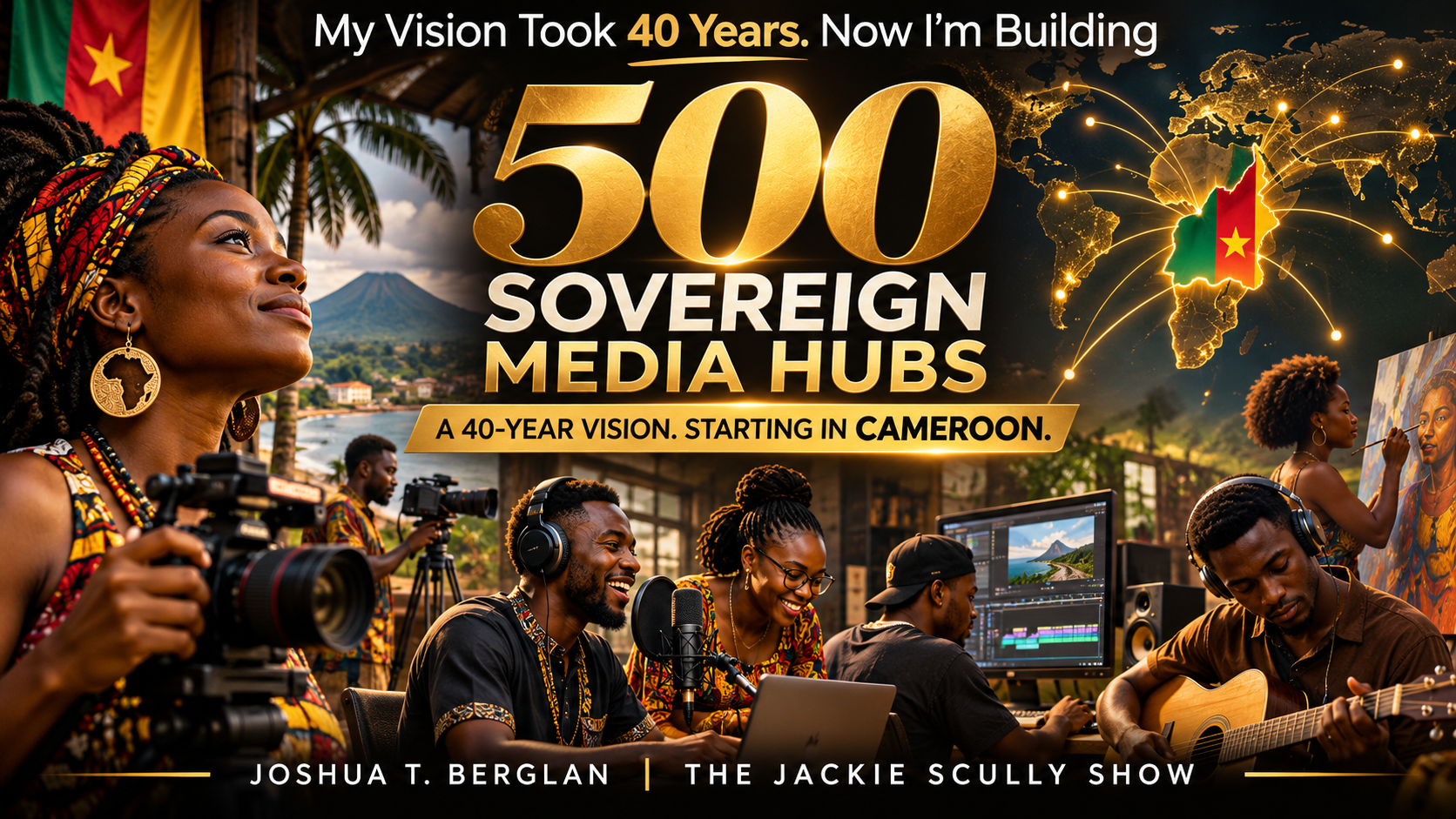
Discover a long-term vision for 500 interconnected, locally operated media hubs focused on education, creative ownership, entrepreneurship and economic development.
Explore the Sovereign Franchise visionCommunity Empowerment & Service
Learn about the humanitarian and community development mission behind The World's Mayor Experience, including education and initiatives designed to serve vulnerable and underserved communities.
Learn about the humanitarian missionsAre You Serious About Developing Your Career?
Whether you're an artist, musician, model, actor, athlete, filmmaker, author, speaker, entrepreneur or creative professional, understanding your value is the first step.
If you would like to learn more about my approach to professional career development, media representation, creative ownership and international opportunities, I'd welcome the conversation.
Comment CAREER on the original video, or explore the Global Media & Career Representation page below.
Explore Career Representation Join the Conversation on YouTube Access Free EducationNo promises of fame, income or guaranteed opportunities. Professional relationships depend on readiness, commitment and mutual fit.
Frequently Asked Questions About Talent, Intellectual Property and Creative Ownership
Is your talent considered intellectual property?
Talent itself is not generally protected by copyright. However, original creations developed through your talent, such as songs, books, photographs, artwork, films and educational materials, may qualify for intellectual property protection.
How can artists protect their intellectual property in Cameroon?
Artists can maintain records of their original creations, document contributions, establish written agreements, understand their rights under Cameroonian copyright law and seek qualified local legal advice. For trademarks and other relevant industrial property rights, consult the African Intellectual Property Organization (OAPI).
What is the difference between copyright and a trademark?
Copyright generally protects eligible original creative works, while trademarks identify and distinguish the commercial source of goods or services. Both can be important when developing a creative business, but they have different protection requirements.
What is the difference between selling and licensing intellectual property?
Selling or assigning intellectual property rights can transfer ownership of those rights. Licensing grants permission to use intellectual property under agreed conditions, generally without transferring ownership of the licensed rights.
Does a model automatically own photographs taken of them?
No. Copyright ownership and the rights associated with commercial use of a person's image are distinct matters. Ownership and usage permissions depend on applicable law and the agreements between the parties involved.
Can artificial intelligence affect a creative professional's voice and likeness?
Yes. AI technologies can reproduce aspects of a person's voice and appearance. Creative professionals should pay attention to consent, permitted uses, licensing terms, compensation and applicable legal protections when entering agreements involving AI.
How can creative professionals earn income beyond performances or streaming?
Depending on their skills, audience and the rights they control, professionals may explore licensing, educational products, workshops, merchandise, digital content, commercial partnerships and specialized services. None of these opportunities guarantee income.
Can African creatives build international careers without leaving Africa?
Yes. Digital distribution, online portfolios, professional networks, remote collaboration and international licensing can help African creatives reach audiences and markets beyond their immediate communities. Outcomes depend on professional readiness, resources, market demand and other circumstances.
Where can I learn about media ownership and monetization for free?
Joshua T. Berglan's Media Company in a Box is available to read for free online. It explores independent media, entrepreneurship, content creation, distribution and business development.
How can I explore professional talent and career representation with Joshua T. Berglan?
Adults interested in professional career development can visit the Global Media & Career Representation page to learn about the services, application process and professional approach.
Research, Intellectual Property Laws and Further Reading
The following authoritative resources provide additional information about intellectual property, copyright, licensing and business ownership.
- World Intellectual Property Organization (WIPO). What Is Intellectual Property? An introduction to copyright, trademarks, patents and other forms of intellectual property.
- World Intellectual Property Organization. What Can I Protect with a Copyright? Information about original creative expression and the scope of copyright protection.
- World Intellectual Property Organization. Frequently Asked Questions About Copyright. Educational information about copyright ownership, licensing and protection.
- Republic of Cameroon. Law No. 2000/011 of December 19, 2000, on Copyright and Neighbouring Rights. Available through WIPO Lex.
- African Intellectual Property Organization (OAPI). Trademark Protection. Information about trademark applications within the OAPI regional system.
- World Intellectual Property Organization. Why Copyright Matters to Small and Medium-Sized Enterprises. Practical information about copyright as a business asset.
- U.S. Copyright Office. What Is Copyright? An additional educational resource explaining copyright within the United States.
This article is intended for general educational purposes and does not constitute individualized legal, financial or professional advice. Intellectual property laws, contractual rights and image protections vary across jurisdictions. Consult an appropriately qualified professional before making significant contractual or intellectual property decisions. The examples in the prepared episode script are illustrative.