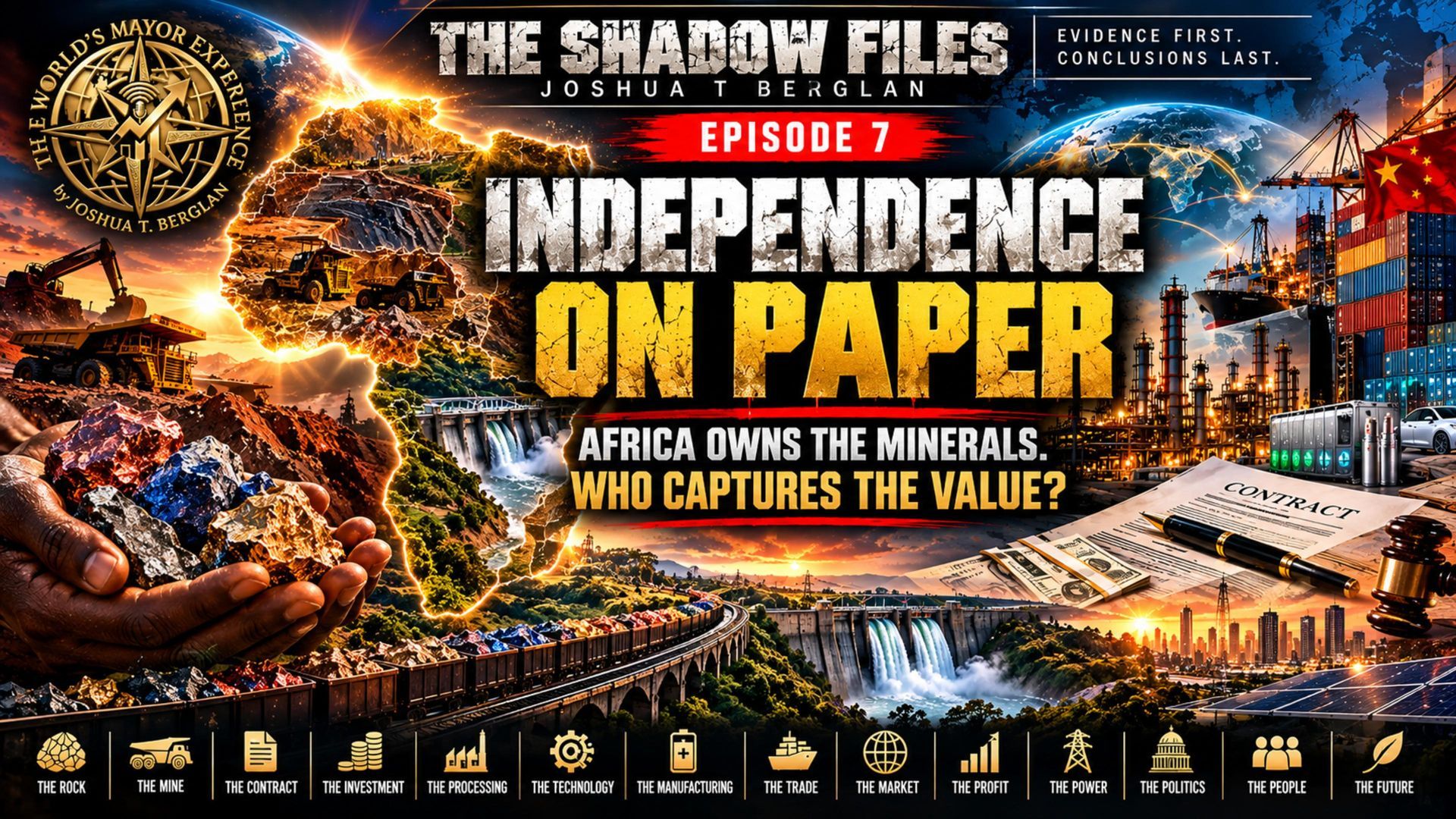
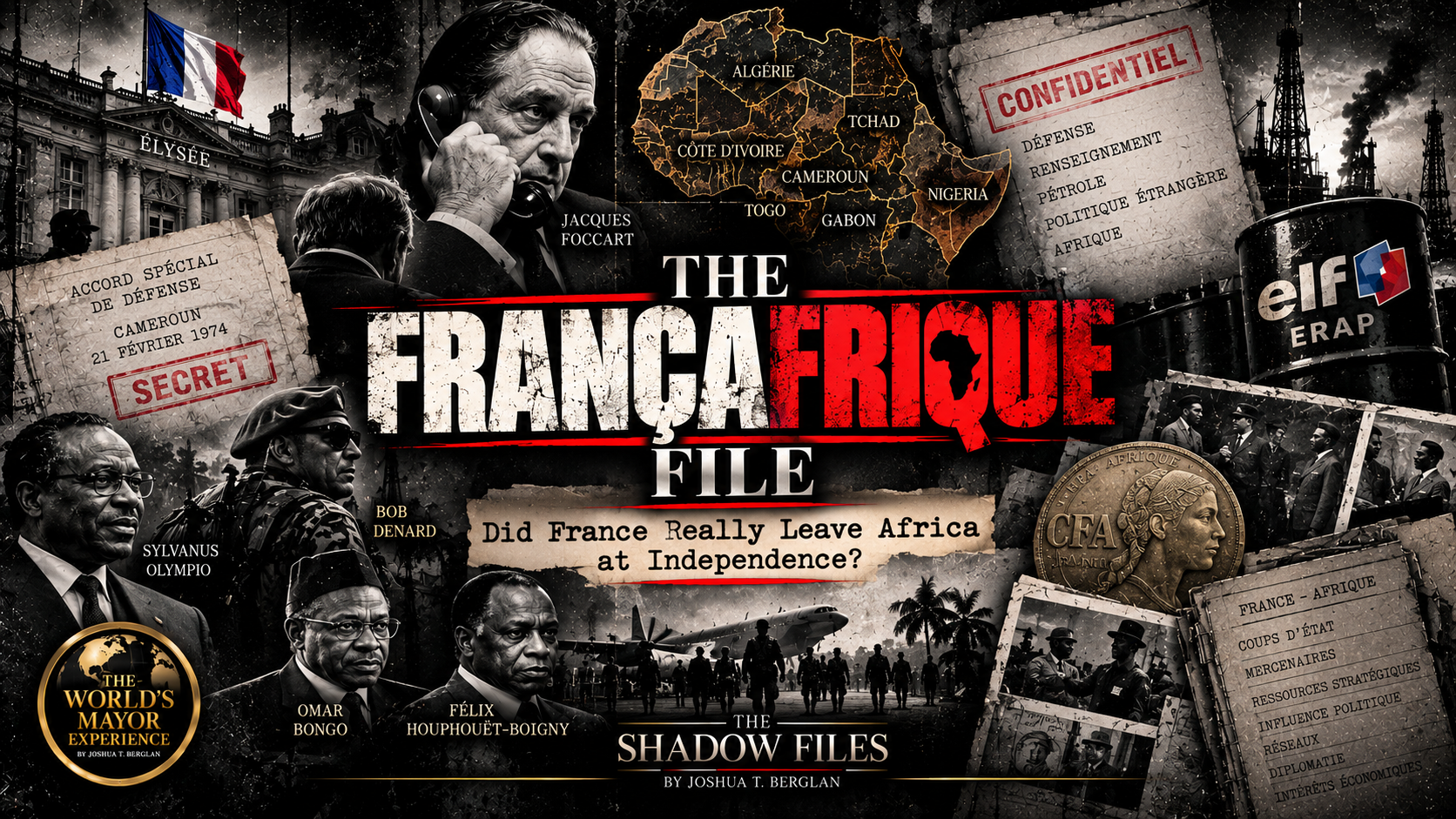
The World's Mayor Experience · The Shadow Files · Episode 3
The Lumumba File: Did Western Powers Help Destroy Congo's Independence Before It Had a Chance?
There was a CIA plot to kill Patrice Lumumba. There was an assassination of Patrice Lumumba. Those are two different facts — and confusing them makes the story weaker, because the documented history is damning enough on its own.
Watch the full investigation
The Lumumba File investigates the documented CIA assassination plot against Patrice Lumumba, Belgium's role, Katanga's mineral economy, the unresolved British intelligence question, and the destruction of Congo's first post-independence government.
Listen to the episode
Did the CIA kill Patrice Lumumba?
The historical record establishes that the CIA developed an assassination operation against Patrice Lumumba. It does not establish that this operation carried out the execution that killed him.
Declassified United States records show that CIA Director Allen Dulles cabled the Congo station on 26 August 1960 that Lumumba's “removal must be an urgent and prime objective.” Assassination planning followed. Toxic biological material was prepared and carried to Léopoldville by CIA scientist Sidney Gottlieb in September 1960. That material was never used on Lumumba.
Lumumba was captured on 1 December 1960 by forces aligned with Joseph-Désiré Mobutu, held at Thysville, then flown to Katanga on 17 January 1961 and executed the same night alongside Maurice Mpolo and Joseph Okito.
The Senate's Church Committee, which examined the CIA plot in 1975, put the distinction plainly: “There is, however, no suggestion of a connection between the assassination plot and the events which actually led to Lumumba's death.”
That distinction is the foundation of this investigation — not an escape from it. The failure of one CIA operation does not mean the United States was uninvolved in Lumumba's political destruction. It means the responsibility is distributed differently than the slogan suggests.
Key takeaways
- Congo was independent for eleven days before Katanga, its mineral heart, seceded on 11 July 1960.
- The CIA assassination plot against Lumumba is documented. It is also documented that it failed.
- Belgium's own 2001 parliamentary commission concluded that certain Belgian officials bore moral responsibility for the circumstances of Lumumba's death.
- Katangan authorities ordered the execution. Belgian personnel were present. A Belgian officer commanded the firing squads.
- The British file remains open, not closed — an alleged MI6 admission exists, but no released operational record establishes it.
- The last surviving defendant, Étienne Davignon, was ordered to trial on 17 March 2026 and died on 18 May 2026. No verdict was ever reached.
What the evidence establishes — and what it does not
This is the spine of the file. Every claim below is graded by what the released record actually supports, not by what the strongest version of the story would prefer.
| Question | Evidence status |
|---|---|
| Did the CIA plot to assassinate Patrice Lumumba? | Documented. Church Committee, 1975; declassified US records. |
| Did the CIA prepare lethal biological material and move it to Congo? | Documented. Carried to Léopoldville by Sidney Gottlieb, September 1960. |
| Did that CIA operation carry out the killing? | No. The Church Committee found no suggestion of a connection between the plot and the events that led to his death. |
| Did President Eisenhower personally order the assassination? | Disputed. One NSC notetaker so testified in 1975; other participants did not recall it; the minutes do not record it. |
| Did the United States run a covert programme to remove Lumumba from power? | Documented. Money, propaganda, and support for his opponents. |
| Did the CIA support Mobutu and other anti-Lumumba actors? | Documented, including financial support. |
| Did Belgium work against Lumumba's government? | Documented by Belgium's own 2001 parliamentary commission. |
| Did Belgian authorities help facilitate the transfer to Katanga? | Documented. |
| Is there a proven written Belgian order to physically kill Lumumba? | Not established. The commission read “definitive elimination” primarily as political elimination. |
| Did Katangan authorities order the execution? | The commission concluded they did. |
| Were Belgian personnel present at the killing? | Yes. A Belgian officer, Julien Gat, commanded the firing squads. |
| Did MI6 organise the assassination? | Unresolved. An alleged admission exists; no released British operational file establishes it. |
| Were Congo's minerals relevant to the crisis? | Yes — but the evidence does not support reducing the killing to a single uranium motive. |
| Has anyone ever been convicted? | No. The last living defendant died in May 2026 before trial. |
The standard on this file
- What do we know?
- What does the evidence suggest?
- What do we still not know?
- And who are we asking for answers?
Congo was independent for eleven days when its mineral heart broke away
30 June 1960. Belgian colonial rule formally ended. Patrice Lumumba became Prime Minister of the newly independent Congo. Joseph Kasa-Vubu became President.
Five days later, soldiers of the Force Publique mutinied against a military hierarchy still dominated by Belgian officers. Independence had changed the flag; it had not changed who gave orders. Congolese soldiers demanded promotion, authority, dignity. Violence followed, and Belgian troops entered Congo without the permission of Lumumba's government.
Then came 11 July. Katanga declared itself independent, under Moïse Tshombe.
Congo had been sovereign for eleven days.
Katanga was not simply another province. It held extraordinary concentrations of copper, cobalt and uranium, and it generated the mining revenue the new national government desperately needed. Its secession threatened both the territorial integrity of Congo and the economic foundation of the state.
Belgium's later parliamentary investigation concluded that Katanga's secession could not have survived without substantial Belgian support and the financial backing of the mining giant Union Minière du Haut-Katanga, which paid its taxes to Tshombe's breakaway administration rather than to the central government.
That does not mean minerals explain everything. They do not. But you cannot understand the Congo Crisis without understanding what was beneath the ground.
What happens when political independence arrives before economic power changes hands?
The atomic age has an African address
Shinkolobwe, Congo.
Long before Lumumba became Prime Minister, uranium taken from beneath Congolese soil had already helped change the balance of power on Earth. The US National Park Service describes Shinkolobwe as holding one of the purest uranium deposits in the world; historical accounts of the ore commonly cite concentrations of uranium oxide around 65 percent, against typical ores measuring a small fraction of one percent.
In 1940, before the United States entered the Second World War, Union Minière director Edgar Sengier arranged for roughly 1,200 tons of Congolese uranium ore to be moved to a warehouse on Staten Island, New York. In the autumn of 1942, Lieutenant Colonel Kenneth Nichols arranged the Manhattan Project's purchase of that stockpile. Union Minière ultimately supplied roughly two-thirds of the uranium the Manhattan Project acquired.
Before Congo was politically independent, material beneath its soil was already part of the architecture of global nuclear power. The resource was African. The strategic consequence was global.
But evidence demands discipline. That history does not, by itself, prove the sentence people most want to write:
“America killed Lumumba because it wanted uranium.”
That is a conclusion. Not a document.
By 1960, Western uranium supply was broader than it had been during the war. But Katanga's strategic and economic weight had not disappeared. Copper mattered. Cobalt mattered. Uranium mattered. Mining revenue mattered. Union Minière mattered. Holding all of that in view at once is harder than picking one motive — and closer to the record.

Belgium investigated itself — and the findings were devastating
You do not have to take an anti-colonial activist's word for what Belgium did. You can read Belgium's own investigation.
Decades after Lumumba's death, the Belgian Parliament established a commission of inquiry into the Belgian government's role. Reporting in 2001, it documented that Belgian officials worked against Lumumba's government, supported his opponents, used secret funds, provided logistical assistance, supported Katanga, and backed efforts designed to prevent Lumumba's return to power. The commission concluded that certain members of the Belgian government bore moral responsibility for the circumstances that led to his death. In February 2002, Belgium apologised.
That is Belgium describing Belgium.
Then there is the infamous phrase. Belgian Minister for African Affairs Harold d'Aspremont Lynden used the words “definitive elimination” in discussing Lumumba. It reads like an assassination order. But the commission's experts did not conclude that the phrase proved an order to kill him physically; they read it primarily as political elimination — remove him, keep him removed, prevent his return.
I am not going to turn one phrase into an execution order the document does not prove. I am also not going to use that uncertainty to erase everything else Belgium's own inquiry documented. You do not need propaganda to indict this history. Sometimes the government's own records do enough.
America could not prove he was a Communist
Cold War history is often retold backwards. Because Lumumba eventually accepted Soviet logistical assistance, his entire political identity gets retroactively reduced to one word.
The record is more complicated. In July 1960, an internal American assessment examined the allegation that Lumumba was a Communist and found that the United States had nothing to substantiate it. Lumumba presented himself as an African nationalist and a supporter of positive neutrality. He did not want Congo controlled by Moscow. He also did not want it controlled by Washington or Brussels.
Then the crisis escalated. Belgian troops remained. Katanga had broken away. Lumumba grew frustrated with Western governments and with the United Nations, and eventually accepted Soviet assistance, including transport for Congolese military operations.
Washington's perception changed hard. Lumumba stopped being read as an unpredictable nationalist and started being read as a doorway for Soviet power into Central Africa. Soviet influence was a real concern in 1960. The historical question is whether Lumumba himself was accurately understood — and whether the answer to a misreading should have been what came next.
The CIA assassination operation
On 26 August 1960, CIA Director Allen Dulles cabled the station in Léopoldville that Lumumba's “removal must be an urgent and prime objective,” and that under existing conditions this should be a high priority of covert action.
Assassination planning followed. CIA scientist Sidney Gottlieb prepared toxic biological material and travelled to Léopoldville in September 1960. Plans explored how the material might be introduced to Lumumba without exposing American responsibility. Declassified records document discussion of alternative methods, and continued planning after Gottlieb left Congo.
Then there is Eisenhower. Robert Johnson, an NSC staff member present at the 18 August 1960 National Security Council meeting, testified to the Church Committee in 1975 that the President said something he understood as an instruction to eliminate Lumumba — followed, in his recollection, by roughly fifteen seconds of stunned silence. Other participants did not remember an explicit order. The contemporaneous minutes do not record one. Douglas Dillon allowed that it was “perfectly possible” Dulles read strong presidential language as authorisation.
So the responsible formulation is this. The CIA assassination programme is documented. Eisenhower's precise personal authorisation remains disputed. And the CIA operation did not carry out the killing.
Those distinctions do not weaken the case. They are what makes it impossible to dismiss.
The plot failed. Lumumba lost power anyway.
Before Joseph-Désiré Mobutu became one of Africa's longest-ruling dictators, the CIA was already supporting him. In 1960 he was Congo's Army Chief of Staff, and American records document covert financial support flowing to him and to other political contacts.
On 14 September 1960, Mobutu moved against Congo's political leadership, announcing that politicians were being “neutralised.” A College of Commissioners took over administration, with covert American support behind the new structure. Lumumba became increasingly isolated.
On 27 November he escaped, attempting to reach Stanleyville where his supporters were regrouping. A CIA cable records the station working with Congolese authorities to block roads and alert troops along possible escape routes. How decisive that assistance was remains disputed — the station chief later minimised the Agency's role, while Belgium's inquiry suggested American involvement may have been greater than acknowledged. The documents do not support saying the CIA captured him. Mobutu's forces captured him, at the Sankuru river crossing, on 1 December 1960.
The assassination operation had failed. The political objective had largely succeeded. And Patrice Lumumba was now a prisoner, held at the military camp at Thysville.
They sent him to his enemies
17 January 1961. Lumumba, Maurice Mpolo and Joseph Okito were removed from detention and flown to Katanga — the breakaway province Lumumba had fought to bring back under national control, governed by men who regarded him as a mortal enemy.
Belgium's parliamentary inquiry examined how the transfer happened. Congolese authorities organised it. Belgian government authorities supported it. Belgian advisers helped arrange it. And Lumumba's physical safety was not treated as a serious priority: Belgian officials did not insist on meaningful guarantees for his protection, while knowing that sending him to Katanga placed him in extraordinary danger.
Here is what the inquiry did not establish: a government document saying send Lumumba there so he can be murdered. That sentence matters. And so does everything surrounding it.
How many hands can help build the road to an assassination before responsibility begins?
Alive at arrival. Dead hours later.
Lumumba arrived in Katanga alive. Within hours he, Mpolo and Okito had been beaten, driven out to a clearing near Mwadingusha, and shot — at roughly 9:43 that night. Okito was killed first, Mpolo second, Lumumba last. A Belgian officer, Julien Gat, commanded the firing squads. Katangan ministers, including Tshombe, Godefroid Munongo and Jean-Baptiste Kibwe, were present.
Belgium's parliamentary commission concluded that Katangan authorities ordered the execution and examined the presence and involvement of Belgian personnel throughout Lumumba's final hours. Some accounts still conflict over exactly who fired which shots. The essential fact does not: three men were deliberately killed on 17 January 1961.
Lumumba was thirty-five years old. Congo had been independent for less than seven months.
Then the perpetrators faced another problem. The bodies.
A single tooth
A grave could become evidence. A grave could become a shrine.
The remains were exhumed, cut apart and dissolved in acid. Belgian police commissioner Gérard Soete later admitted taking part in destroying them, and kept teeth from Lumumba's remains as trophies.
Decades later, one gold-capped tooth was recovered by Belgian authorities. On 20 June 2022, Belgium returned it to Lumumba's family.
Sixty-one years after his assassination, the first Prime Minister of independent Congo came home. A single tooth.
Did MI6 help kill Patrice Lumumba?
Here the evidentiary standard has to get stricter, not looser.
British hostility toward Lumumba is documented. Senior officials discussed his removal; one, Howard Smith, discussed killing him as a possible solution. British intelligence was operating inside Congo, and Daphne Park — widely understood to have been MI6's senior officer in Léopoldville — served there through the crisis.
In a letter published in the London Review of Books on 11 April 2013, Lord David Lea wrote that when he raised the theory of MI6 involvement with Park over tea, a few months before her death in March 2010, she replied:
“We did, I organised it.”
Explosive? Absolutely. Conclusive? No.
It is one person's recollection of a private conversation, published after Park's death, with no operational record behind it. Britain has never conducted a public investigation comparable to Belgium's. No released British file allows anyone to state as established fact that MI6 organised the murder.
So the British position is exactly this. Hostility: documented. Discussions of killing Lumumba: documented. An alleged admission: it exists. Direct operational responsibility: unresolved. Possible? Yes. Proven? No.
The British file is open not because guilt has been established, but because the evidence is incomplete.
History refuses to give us one villain
Everybody wants one. Belgium. America. The CIA. MI6. Mobutu. Tshombe. Katanga. Choose one villain and the story gets easier. It also gets less accurate.
Mobutu's forces captured him. Congolese authorities transferred him. Katangan authorities ordered his execution and Katangan personnel carried it out. Belgium worked politically against him, funded his opponents, supported Katanga, helped facilitate the final transfer, and had personnel present at the killing. The United States ran a covert programme to remove him, supported Mobutu, and developed a real assassination operation that did not carry out the eventual murder. Britain was hostile, and its role remains unresolved.
Some plotted politically. Some funded opposition. Some planned assassination. Some facilitated detention. Some facilitated transfer. Some ordered execution. Some carried it out. Some stood there while it happened. Some helped conceal what came after.
That is not a clean conspiracy. It is a network of responsibility. And reality may be more disturbing than the conspiracy theory.
Uranium or communism?
Was Lumumba destroyed because of communism? Uranium? Colonial power? Corporate money? Domestic political rivalry?
The evidence gives an uncomfortable answer: you may not get to choose just one.
Before Soviet assistance, American intelligence itself could not substantiate that Lumumba was a Communist. Then he accepted Soviet logistical support, and Washington's fear hardened. So anti-communism mattered. But so did Katanga, copper, cobalt, uranium, mining revenue, Union Minière, Belgian political and economic interests, British regional interests, Congolese political rivalry, Katangan separatism, and a global Cold War in which both superpowers were fighting for influence.
These interests did not sit in separate rooms. They collided. And history becomes propaganda when complexity is treated like an inconvenience.
The man America supported ruled for three decades
In 1960, Mobutu helped push Lumumba out of power. In 1965 he seized control outright, and became Mobutu Sese Seko. Western governments backed his regime through the Cold War as an anti-Communist ally. His rule lasted more than thirty years and became associated with authoritarianism, political repression, patronage, corruption and enormous personal enrichment.
But this is where history gets abused. It would be easy to say that because Lumumba was killed, everything bad that followed was caused by his assassination. That is not responsible. Congo's later history involved domestic decisions, foreign governments, regional wars, armed groups, resource predation, economic collapse, and generations of different actors. You cannot draw a straight line from one assassination to every tragedy that followed.
You also cannot erase the beginning. One of Congo's most important national leaders was removed at the very start of independence. Foreign governments intervened heavily in political outcomes. Military power became central to politics. And the Western-backed ruler who emerged stayed for thirty-two years.
Sixty-five years for a trial. Then he died.
The Lumumba case did not end in 1961. His family pursued accountability for decades. On 23 June 2011, François Lumumba filed a criminal complaint naming Belgian citizens alleged to have been involved. Ten people were ultimately accused. One by one, they died.
Étienne Davignon was the last one alive. In 1960 he had been a junior diplomat; Belgium's 2001 commission found he was tasked with persuading President Kasa-Vubu to dismiss Lumumba and supplying the legal arguments for it. He later became one of Europe's most prominent political and business figures. Prosecutors ultimately sought trial on war crimes charges connected to the unlawful detention, transfer and degrading treatment of Lumumba, Mpolo and Okito — having dropped the allegation of intent to kill. Davignon denied wrongdoing.
On 17 March 2026, the Brussels Court of First Instance ordered him to stand trial. It would have been the first prosecution in Belgium or Europe to address criminal liability for a political crime committed in a colonial context.
On 18 May 2026, Étienne Davignon died in Brussels, aged 93. The criminal proceedings were formally extinguished. No verdict. No judicial determination of individual guilt.
Documents can outlive perpetrators. Justice doesn't always.
What can we actually prove?
What do we know?
We know Belgium actively worked against Lumumba's government. We know Union Minière helped financially sustain the Katangan secession. We know the United States ran a covert political programme to remove Lumumba. We know the CIA developed a real assassination operation, and that this operation did not carry out the killing. We know Mobutu's forces captured him, that Congolese authorities transferred him, and that Belgian authorities helped facilitate that transfer to Katanga. We know Katangan authorities ordered the execution. We know Lumumba, Mpolo and Okito were killed on 17 January 1961.
What does the evidence suggest?
That Congo's sovereignty was contested by domestic and foreign powers almost immediately after independence — and that Belgian interests, Katanga's resources, American Cold War fear and Congolese political conflict all belong inside the same investigation rather than in competing ones.
What do we still not know?
Exactly how responsibility should be divided among every actor. Exactly what Eisenhower intended at the August 1960 NSC meeting. Exactly how much CIA cooperation contributed to Lumumba's recapture. Exactly what British intelligence did. And what unreleased documents may still exist.
Those are not weaknesses in the investigation. Those are the investigation.
If you believe the CIA directly killed Lumumba, bring the document connecting the failed plot to the final execution. If you believe America had nothing to do with his destruction, explain the covert programme, the money and the assassination planning. If you believe MI6 organised the killing, find the files. If you believe resources explain everything, explain the Cold War documents too.
Bring the cables. Bring the intelligence files. Bring the corporate records. Bring the receipts. Because you do not win on The Shadow Files by having the most dramatic version of history. You win when your evidence survives scrutiny.
Maybe independence isn't a flag
Perhaps the most important question Lumumba leaves behind is not who killed him. It is: what does independence actually mean?
An anthem? A flag? A seat at the United Nations? Or is sovereignty the ability to determine who governs you, who controls your military, your resources, your economy, your information?
Can a nation call itself independent if foreign governments secretly finance political forces inside it? If another country's intelligence service decides its Prime Minister should disappear? Can it call itself economically sovereign if the value beneath its soil still flows through structures built before independence?
But sovereignty also means responsibility. We cannot investigate Western interference and erase African choices. Mobutu made choices. Kasa-Vubu made choices. Tshombe made choices. Katangan officials made choices.
Foreign interference does not erase African agency. African agency does not erase foreign interference. The truth has room for both. Propaganda usually doesn't.
Maybe independence was never only an event. Maybe independence is infrastructure: political sovereignty, economic sovereignty, resource sovereignty, monetary sovereignty, information sovereignty — the ability to make decisions without asking powerful outsiders for permission.
The investigation continues
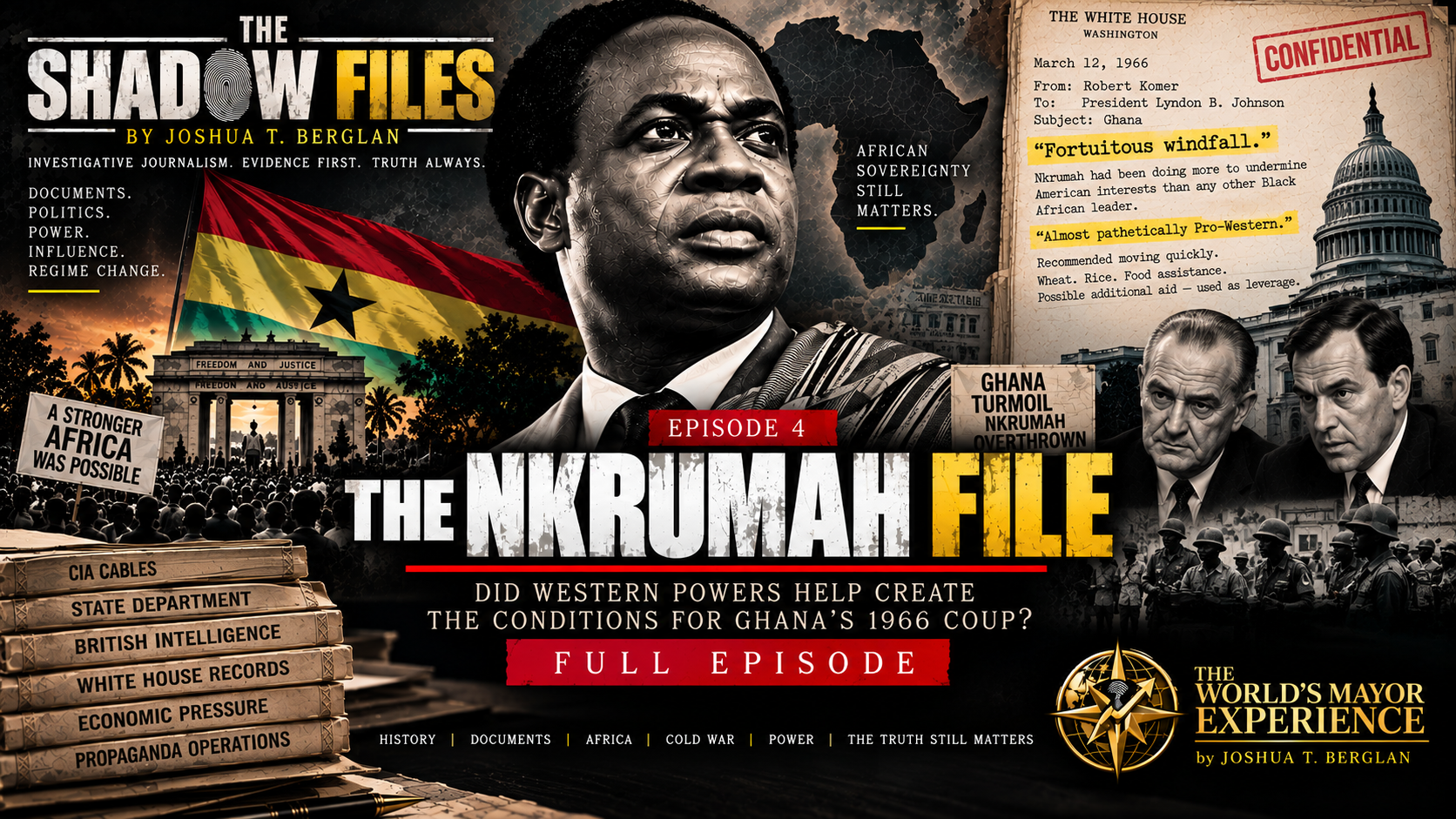
Lumumba was not the end of this story. Five years later, another giant of African independence would be overthrown while outside his own country: Kwame Nkrumah — the man who argued that political independence without economic independence was incomplete.
After his government fell, a senior American official described the outcome with two extraordinary words: a “fortuitous windfall.”
What did Washington know before Ghana's 1966 coup? What did Britain know? Who supported whom? Who benefited? And does the evidence prove foreign orchestration — or something more complicated?
That's Episode Four. The Nkrumah File.
Follow the resource.
Follow the ownership.
Follow the money.
Follow the power.
And wherever the evidence goes, we go.
The Lumumba File is open.
Frequently asked questions
Did the CIA assassinate Patrice Lumumba?
The CIA developed a documented assassination operation against Lumumba, including toxic biological material carried to Léopoldville in September 1960. That operation was never carried out against him. Lumumba was executed in Katanga on 17 January 1961 through a separate chain of events, and the Church Committee found no suggestion of a connection between the plot and the events that actually led to his death.
Did President Eisenhower order Lumumba's assassination?
It remains disputed. NSC staff member Robert Johnson testified in 1975 that at the 18 August 1960 meeting the President said something he understood as an instruction to eliminate Lumumba. Other participants did not recall an explicit order, and the contemporaneous minutes do not record one. The Church Committee found the evidence too ambiguous to conclude that Eisenhower ordered the killing.
What did the Dulles cable actually say?
On 26 August 1960, CIA Director Allen Dulles cabled the Congo station that Lumumba's “removal must be an urgent and prime objective” and that under existing conditions this should be a high priority of covert action.
Why was Katanga so important?
Katanga held major copper, cobalt and uranium deposits and generated enormous mining revenue. Its secession on 11 July 1960 — eleven days after independence — carried both political and economic consequences for the new Congolese state, and Belgium's own inquiry concluded it could not have survived without Belgian support and Union Minière's financial backing.
What role did Belgium play?
Belgium's 2001 parliamentary commission documented that Belgian officials worked against Lumumba's government, funded and supported his opponents, supported Katanga, and helped facilitate his transfer to Katanga. The commission concluded that certain members of the Belgian government bore moral responsibility for the circumstances of his death. Belgium apologised in February 2002.
Did MI6 help kill Patrice Lumumba?
Unresolved. In a letter to the London Review of Books on 11 April 2013, Lord David Lea attributed the words “We did, I organised it” to former MI6 officer Daphne Park, recalling a private conversation before her death in 2010. The claim is significant but is not established by any released British operational record, and Britain has held no public inquiry comparable to Belgium's.
What happened to Lumumba's body?
His remains were exhumed and destroyed in acid. Belgian police commissioner Gérard Soete admitted participating and kept teeth as trophies. One gold-capped tooth was later recovered and returned by Belgium to Lumumba's family on 20 June 2022, sixty-one years after his death.
Has anyone ever stood trial for the assassination?
No. Ten people were accused following a 2011 complaint by François Lumumba. On 17 March 2026 a Brussels court ordered the last surviving defendant, Étienne Davignon, to stand trial for war crimes connected to the detention, transfer and degrading treatment of Lumumba, Mpolo and Okito. Davignon died on 18 May 2026, aged 93, and the proceedings were extinguished without a verdict.
How old was Lumumba when he was killed?
Thirty-five. Congo had been independent for less than seven months.
Primary sources & evidence
Every significant claim on this page traces to one of the following. Where the record is contested or incomplete, this file says so rather than resolving it in the direction of the better story.
- US Senate Select Committee (Church Committee), Alleged Assassination Plots Involving Foreign Leaders — Congo section, 1975 The Dulles cable of 26 August 1960; the Gottlieb material; and the finding of “no suggestion of a connection between the assassination plot and the events which actually led to Lumumba's death.”
- US Office of the Historian — Foreign Relations of the United States , Congo 1960–1968, Document 14: Telegram from the CIA to the Station in the Congo Drafted by Allen Dulles. “His removal must be an urgent and prime objective.”
- FRUS, Congo 1960–1968, Document 11: Editorial Note on the 18 August 1960 NSC meeting Robert Johnson's 1975 testimony, and the conflicting recollections of Dillon and Boggs.
- Belgian Chamber of Representatives — Lumumba Commission of Inquiry archive (reported 2001) Belgian intervention against Lumumba, secret funds, Katanga, the transfer, the execution, and the finding of moral responsibility.
- US National Park Service — Staten Island, New York: Congolese uranium and the Manhattan Project Edgar Sengier, Shinkolobwe, the 1,200 tons moved in 1940, and Union Minière's supply of roughly two-thirds of Manhattan Project uranium.
- London Review of Books, Vol. 35 No. 7, 11 April 2013 — letter from David Lea “We did, I organised it” — Lea's account of Daphne Park. An allegation, not an established fact.
- ECCHR — Brussels court orders Étienne Davignon to stand trial, 17 March 2026
- ECCHR — the death of Étienne Davignon and the end of the criminal proceedings, May 2026
- Al Jazeera — Ex-Belgian diplomat ordered to stand trial over the murder of Congo's Lumumba, 17 March 2026
- France 24 — Belgium returns Lumumba's tooth to his family, 20 June 2022
The Shadow Files — the series so far
Full transcript
Read the complete transcript of The Lumumba File
1. The CIA really did plot to kill him
There was a CIA plot to kill Patrice Lumumba. And there was an assassination of Patrice Lumumba. Those are two different facts. Both are true. And confusing them actually makes this story weaker, because the documented history is extraordinary enough.
The CIA really developed an assassination operation against the first Prime Minister of independent Congo. Biological material was prepared. It was transported to Congo. Methods were considered. Access to Lumumba was studied. But that particular operation did not carry out the killing that eventually happened.
Months later, Lumumba was captured, imprisoned, transferred into the territory of some of his most dangerous political enemies, and executed.
So the easy version says: “The CIA killed Lumumba.” The opposite easy version says: “The CIA plot failed, so America had nothing to do with his destruction.” Neither survives scrutiny. Because between the assassination plot and the assassination is an entire architecture of power. Belgium. The United States. Congolese political rivals. Katangan separatists. Corporate interests. Cold War fear. Secret money. Uranium. Cobalt. Copper. A military coup. A transfer to enemies. An execution. And an attempt to make the body disappear.
I'm Joshua T. Berglan. The World's Mayor. Reporting from Cameroon. This is The World's Mayor Experience. And this is The Shadow Files. Episode Three. The Lumumba File.
Our standard is simple. What do we know? What does the evidence suggest? What do we still not know? And who are we asking for answers? Because the conspiracy theory is easier than the history. The history has more fingerprints.
2. Independent for eleven days
Congo had been independent for eleven days when one of its richest provinces broke away. Eleven days.
June 30, 1960. Belgian colonial rule formally ends. Patrice Lumumba becomes Prime Minister. Joseph Kasa-Vubu becomes President. Five days later, soldiers in the Force Publique mutiny. Independence had arrived, but Belgian officers still dominated the military command. Congolese soldiers demanded promotion, authority, dignity. Violence followed. Belgian troops entered Congo without the permission of Lumumba's government.
Then, July 11. Katanga declared itself independent. Moïse Tshombe led the breakaway government. And Congo didn't simply lose land. It lost access to enormous economic power. Copper. Cobalt. Uranium. Mining revenue that the new national government desperately needed.
Belgium's later parliamentary investigation would conclude that Katanga's secession could not have survived without substantial Belgian support and financial support from the giant mining company Union Minière du Haut-Katanga.
That does not mean minerals explain everything. They don't. But you cannot understand the Congo Crisis without understanding what was beneath the ground. Political independence changed the flag. It did not instantly change the corporations, the military structures, the foreign interests, or the economic architecture that existed the day before.
Congo became independent on June 30. Eleven days later, its mineral heart was trying to leave. So here's the question. What happens when political independence arrives before economic power changes hands?
3. The atomic age has an African address
The atomic age has an African address. Shinkolobwe. Congo.
Long before Patrice Lumumba became Prime Minister, uranium taken from beneath Congolese soil had already helped change the balance of power on Earth. The ore from Shinkolobwe was extraordinarily rich. Historical American records describe some Congolese uranium ore with concentrations of uranium oxide approaching 65 percent.
Before America entered World War Two, Edgar Sengier, a director of Union Minière du Haut-Katanga, moved roughly 1,200 tons of Congolese uranium ore to Staten Island, New York. Then came the Manhattan Project. The United States purchased that stockpile and secured additional Congolese uranium. Shinkolobwe became one of the Manhattan Project's most important uranium sources.
Think about that. Before Congo was independent, material beneath its soil was already part of the architecture of global nuclear power. The resource was African. The strategic consequence was global.
But here's where evidence matters. I cannot take that fact and tell you “America killed Lumumba because it wanted uranium.” That's a conclusion. Not a document. By 1960, Western uranium supplies were broader than they had been during World War Two. But Katanga's minerals still mattered. Copper mattered. Cobalt mattered. Uranium mattered. Mining revenue mattered. And Union Minière mattered.
Belgium's own investigation later concluded that Katanga's secession would have been impossible without Union Minière's financial support. The company paid taxes to Tshombe's breakaway government instead of Lumumba's central government. Does that prove a mining corporation ordered Lumumba killed? No. But it proves the economic architecture was part of the crisis.
The atomic age had an African address. And Congo was now trying to decide who controlled it.
4. Belgium investigated itself
You don't have to take an anti-colonial activist's word for what Belgium did to Patrice Lumumba. Read Belgium's own investigation.
Decades after Lumumba's death, the Belgian Parliament investigated the government's role in the Congo Crisis. And what it documented was devastating. Belgian officials worked against Lumumba's government. They supported opposition. Used secret funds. Provided logistical assistance. Supported Katanga. And supported efforts designed to prevent Lumumba from returning to power. Belgium's own inquiry said the government showed little respect for the sovereignty of the newly independent Congo.
That is Belgium describing Belgium.
Then there is one infamous phrase. “Definitive elimination.” Belgian Minister for African Affairs Harold d'Aspremont Lynden used those words while discussing Lumumba. It sounds like an assassination order. But Belgium's parliamentary experts did not conclude that this phrase proved an order to physically kill him. They interpreted it primarily as political elimination. Remove him. Keep him removed. Prevent his return.
That's the distinction the evidence requires. But that distinction does not erase Belgium's involvement. Belgian officials supported forces opposing Lumumba. Belgian personnel were deeply involved in Katanga. Belgian authorities would later help facilitate Lumumba's transfer into the territory where he would be killed. Belgian personnel were present at the execution.
So no, I'm not going to turn one phrase into an execution order the document does not prove. And I'm also not going to use that uncertainty to erase everything else Belgium's own investigation documented. You don't need propaganda to indict history. Sometimes the government's own records do enough.
5. America couldn't prove he was Communist
Before Washington decided Patrice Lumumba was dangerous enough to remove, its own intelligence could not prove he was a Communist. That matters.
In July 1960, an internal American assessment examined allegations that Lumumba was Communist. It said the United States had nothing to substantiate the accusation. Lumumba presented himself as an African nationalist. A supporter of positive neutrality. He did not want Congo controlled by Moscow. He also did not want it controlled by Washington, Brussels, or anybody else.
Then the crisis escalated. Belgian troops remained involved. Katanga had broken away. Lumumba became frustrated with Western governments and the United Nations. Eventually he accepted Soviet assistance, including transportation for Congolese military operations. And Washington's perception changed dramatically. Lumumba was increasingly treated not simply as an unpredictable nationalist, but as a potential doorway for Soviet power into Central Africa.
This was the Cold War. Soviet influence was a real concern. But the historical question is whether Lumumba himself was accurately understood. Because within weeks American policy moved from concern to covert intervention. Money. Political influence. Propaganda. Support for opponents. A programme designed to remove Lumumba from power. And eventually, something even darker. Assassination planning.
6. The CIA assassination operation
The CIA didn't merely want Patrice Lumumba removed from office. It sent biological material to Congo for an assassination operation. That is documented.
August 18, 1960. The United States National Security Council meets. Years later, Robert Johnson, an official who attended, would testify that President Dwight Eisenhower said something that sounded to him like an instruction to assassinate Lumumba. Johnson said he was shocked. But other participants did not remember an explicit assassination order. The meeting notes do not record one. And the Senate's Church Committee later concluded that the evidence was too ambiguous to say Eisenhower himself definitely ordered the killing.
That's where the ambiguity mostly ends. Because what the CIA did next is much clearer. CIA Director Allen Dulles declared Lumumba's removal an urgent and prime objective. The Agency began actual assassination planning. Biological material was prepared. It was transported to Léopoldville. Methods were discussed for getting it to Lumumba. The objective was not simply to destroy his career. It was to kill him without exposing the United States.
And that's extraordinary enough without exaggerating it. Because the operation did not ultimately kill Lumumba. The biological material was never successfully used against him. Months later, he died through another chain of events.
So what does the evidence prove? It proves the CIA genuinely plotted to assassinate the Prime Minister of a country that had been independent for only months. It does not prove that this particular operation caused the execution that eventually happened. That's evidence of a plot. It is not evidence that the plot caused the final killing. The distinction doesn't make the history less shocking. It makes the investigation harder to dismiss.
7. Before Mobutu ruled Congo, the CIA was supporting him
Before Joseph-Désiré Mobutu became one of Africa's longest-ruling dictators, the CIA was already supporting him.
In 1960, Mobutu was Congo's Army Chief of Staff. The CIA station had established contact with him. American records show covert financial support going to Mobutu and other political contacts.
September 14, 1960. Mobutu moves against Congo's political leadership. He announces that politicians are being “neutralised.” A College of Commissioners takes over government administration. The CIA provides covert support to the new political structure. Lumumba becomes increasingly isolated.
Then, November 27. Lumumba escapes. He tries to reach Stanleyville, where supporters were regrouping. A CIA cable says the station was working with Congolese authorities to block roads and alert troops along possible escape routes.
How important was that assistance to Lumumba's eventual capture? Disputed. The CIA station chief later minimised the Agency's role. Belgium's later inquiry suggested American involvement may have been greater than originally acknowledged. But the documents do not justify saying the CIA itself captured Lumumba. Mobutu's Congolese forces captured him. December 1, 1960.
Lumumba was imprisoned, eventually at the military camp in Thysville. The CIA assassination operation had failed. But America's political objective was succeeding. Lumumba was out of power. Mobutu was stronger. And Patrice Lumumba was now a prisoner.
8. They sent him to his enemies
Patrice Lumumba wasn't simply killed. First, he was deliberately transferred to territory controlled by some of the people most likely to kill him.
January 17, 1961. Lumumba, Maurice Mpolo and Joseph Okito are removed from detention. Their destination: Katanga. The breakaway province Lumumba had fought to bring back under national control. The government there considered him a mortal political enemy.
Belgium's parliamentary inquiry later examined how the transfer happened. Congolese authorities organised it. Belgian government authorities supported it. Belgian advisers helped organise it. And Lumumba's physical safety was not treated as a serious priority. Belgian officials did not insist on meaningful guarantees for his protection. They knew sending him to Katanga placed him in extraordinary danger.
But here's what the Belgian inquiry did not establish. It did not find a government document saying “Send Lumumba there so he can be murdered.” That sentence matters. And so does everything surrounding it. Belgian officials helped create the route. Congolese authorities made the transfer. Katanga received him. And only hours later, Patrice Lumumba was dead.
So maybe the biggest question isn't only who fired the weapon. How many hands can help build the road to an assassination before responsibility begins?
9. Alive at arrival. Dead hours later.
Patrice Lumumba arrived in Katanga alive. Less than five hours later he was dead. Maurice Mpolo was dead. Joseph Okito was dead.
The three men were beaten. Taken away. And executed. Belgium's parliamentary investigation later concluded that Katangan authorities ordered the execution, and that Katangan personnel carried it out in the presence of Katangan ministers. Belgian personnel were there too. A Belgian police commissioner. Belgian officers.
Some historical accounts conflict over exactly who fired which shots. But the essential fact does not. Patrice Lumumba, Maurice Mpolo and Joseph Okito were deliberately killed on January 17, 1961. Lumumba was thirty-five years old. Congo had been independent for less than seven months.
Then the perpetrators faced another problem. The bodies. A grave could become evidence. A grave could become a shrine.
Belgian police officer Gérard Soete later admitted that he helped destroy the bodies. They were exhumed. Cut apart. And dissolved in acid. Soete retained teeth from Lumumba's remains. Decades later, one tooth was recovered. And in 2022, Belgium returned it to Lumumba's family. Sixty-one years after his assassination.
The first Prime Minister of independent Congo was killed at thirty-five. His body was destroyed. And more than six decades later, what remained came home. A single tooth.
10. “We did. I organised it.”
Did British intelligence help kill Patrice Lumumba? A former senior MI6 officer was later reported to have answered with three extraordinary words. “We did. I organised it.”
But that is not proof. And that's exactly why Britain remains one of the most intriguing unresolved parts of the Lumumba File.
British hostility toward Lumumba is documented. Senior officials discussed his removal. One British official, Howard Smith, even discussed killing Lumumba as a possible solution. British intelligence was operating inside Congo. Daphne Park was serving in Léopoldville and is widely understood to have been MI6's senior officer there.
Decades later, Lord David Lea said he discussed Lumumba's assassination privately with Park. According to Lea, when he suggested MI6 had been involved, Park replied: “We did. I organised it.”
Explosive? Absolutely. Conclusive? No. It is one person's recollection of a private conversation, reported publicly after Daphne Park was dead. Britain has never conducted a public investigation comparable to Belgium's inquiry. No released British operational file allows me to tell you as established fact that MI6 organised Lumumba's murder.
So the British position is simple. Hostility, documented. Discussions of killing Lumumba, documented. An alleged admission, exists. Direct operational responsibility, remains unresolved. Possible? Yes. Proven? No.
The British file isn't open because guilt has been established. It's open because the evidence isn't complete.
11. History refuses to give us one villain
Everybody wants one villain in the Patrice Lumumba story. History refuses to give us one.
Mobutu's forces captured him. Congolese authorities transferred him. Katangan authorities ordered his execution. Katangan personnel participated directly in the killing. Those facts matter.
Belgium worked politically against Lumumba. Supported Katanga. Used secret funds. Supported his opponents. Helped facilitate his final transfer. Belgian personnel were present at his execution. And Belgium's own inquiry later concluded that certain Belgian officials bore moral responsibility for circumstances leading to his death. Those facts matter.
The United States ran a covert programme to remove Lumumba from power. Supported Mobutu and other political actors. And the CIA developed an actual assassination operation. That operation did not carry out the eventual killing. That fact also matters.
Britain was hostile. British officials discussed killing Lumumba. But direct British operational involvement remains unresolved.
So no, I'm not calling this a proven three-country assassination alliance. The evidence doesn't justify it. What the evidence shows is more complicated. Some plotted politically. Some funded opposition. Some plotted assassination. Some facilitated detention. Some facilitated transfer. Some ordered execution. Some carried it out. Some stood there when it happened. And some helped conceal what came next.
That's not a clean conspiracy. It's a network of responsibility. And maybe reality is more disturbing than the conspiracy theory.
12. Uranium or communism?
Was Patrice Lumumba destroyed because of communism? Uranium? Colonial power? Corporate money? The evidence gives us a more uncomfortable answer. You may not get to choose just one.
Before Soviet assistance, American intelligence itself could not substantiate that Lumumba was Communist. He presented himself as an African nationalist. A neutralist. But then he accepted Soviet logistical support. And Washington's fear escalated. So anti-communism mattered.
But so did Katanga. Copper. Cobalt. Uranium. Mining revenue. Union Minière. Belgian political and economic interests. British regional interests. Congolese political rivalry. Katangan separatism. And a global Cold War in which both superpowers were fighting for influence. These interests did not exist in separate rooms. They collided.
Can I tell you Lumumba was murdered because America wanted uranium? No. That's too clean. Can I tell you resources had nothing to do with the crisis? No. That ignores Katanga. Can I tell you communism explains everything? No. That ignores the earlier assessments of Lumumba himself.
History becomes propaganda when complexity is treated like an inconvenience. Cold War fear. Post-colonial power. Corporate interests. Mineral wealth. Domestic rivalry. Secession. Foreign intervention. All collided. And Patrice Lumumba was standing in the middle.
13. The man America supported ruled for decades
The man the CIA supported during the Lumumba crisis would eventually rule Congo for more than three decades. Joseph-Désiré Mobutu.
In 1960, Mobutu helped push Lumumba out of political power. In 1965, he seized control again. This time permanently. Eventually he became Mobutu Sese Seko. During the Cold War, Western governments supported his regime as an anti-Communist ally. His rule lasted more than thirty years, and became associated with authoritarianism, political repression, patronage, corruption and enormous personal enrichment.
But this is where history gets abused. It would be easy to say “Lumumba was killed, therefore everything bad that happened afterward was caused by his assassination.” That's not responsible. Congo's later history involved domestic decisions. Foreign governments. Regional wars. Armed groups. Resource predation. Economic collapse. And generations of different actors. You cannot draw a straight line from one assassination to every tragedy that followed.
But you also cannot erase the beginning. One of Congo's most important national leaders was removed at the beginning of independence. Foreign governments intervened heavily in political outcomes. Military power became central to politics. And Mobutu eventually became the Western-backed ruler of the country.
The question isn't “Did Lumumba's death cause everything?” The question is what political architecture was created when Congo's earliest democratic struggle was shaped by secession, covert operations, foreign intervention and military coups. You cannot blame everything on Lumumba's death. But you cannot erase the architecture built around his destruction.
14. Sixty-five years for a trial. Then he died.
Sixty-five years after Patrice Lumumba was killed, Belgium was preparing to put a surviving defendant on trial. Then he died.
Étienne Davignon had been a young Belgian diplomat during the Congo Crisis. He later became one of Europe's most prominent political and business figures.
For decades, Lumumba's family pursued accountability. Archives opened. Documents emerged. Belgium investigated itself. The Belgian government eventually apologised for what it described as moral responsibility around the circumstances of Lumumba's death. Then the family pursued criminal proceedings against Belgian individuals accused of involvement. One by one, the accused died. Eventually Davignon was the last surviving defendant.
In March 2026, a Brussels court ordered him to face trial over alleged war crimes connected to the detention, transfer and deaths of Lumumba, Mpolo and Okito. Historic. But an order to stand trial is not a conviction. Davignon denied wrongdoing. He appealed.
Then, May 18, 2026, Étienne Davignon died. Ninety-three years old. The criminal proceeding against him ended. No verdict. No final judicial determination of individual guilt.
Sixty-five years after Lumumba's assassination, the courtroom door closed again. Documents can outlive perpetrators. Archives can outlive propaganda. Truth can wait decades for daylight. Justice doesn't always have that much time.
15. What can we actually prove?
After more than six decades of government reports, archives, declassified intelligence, investigations and testimony, what can we actually prove about Patrice Lumumba?
What do we know? We know Belgium actively worked against Lumumba's government. We know Union Minière helped financially sustain the Katangan secession. We know the United States ran a covert political programme to remove Lumumba. We know the CIA developed an actual assassination operation. We know that specific operation did not carry out the killing that eventually happened. We know Mobutu's forces captured Lumumba. We know Congolese authorities transferred him. We know Belgian authorities helped facilitate the transfer to Katanga. We know Katangan authorities ordered the execution. We know Lumumba, Mpolo and Okito were killed January 17, 1961.
What does the evidence suggest? That Congo's sovereignty was being challenged by domestic and foreign powers almost immediately after independence. That Belgian interests, Katanga's resources, American Cold War fears and Congolese political conflict all mattered.
What do we still not know? Exactly how responsibility should be divided among every actor. Exactly what Eisenhower intended at the August meeting. Exactly how much CIA cooperation contributed to Lumumba's recapture. Exactly what British intelligence did. And what unreleased documents may still exist.
Those aren't weaknesses in the investigation. Those are the investigation.
If you believe the CIA directly killed Lumumba, bring the document connecting the failed plot to the final execution. If you believe America had nothing to do with his destruction, explain the covert programme, the money, and the assassination planning. If you believe MI6 organised the killing, find the files. If you believe resources explain everything, explain the Cold War documents too.
Bring the cables. Bring the intelligence files. Bring the corporate records. Bring the receipts. Because you don't win on The Shadow Files by having the most dramatic version of history. You win when your evidence survives scrutiny.
16. Maybe independence isn't a flag
Maybe independence isn't a flag. Maybe independence is the ability to make decisions powerful countries hate, and survive those decisions.
Because Patrice Lumumba's story raises a question much bigger than who pulled the trigger. What does independence actually mean? An anthem? A flag? A seat at the United Nations? Or is sovereignty the ability to determine who governs you? Who controls your military? Who controls your resources? Your economy? Your information?
Can a nation call itself independent if foreign governments secretly finance political forces inside it? Can it call itself independent if another country's intelligence service decides its Prime Minister should disappear? Can it call itself economically sovereign if the value beneath its soil still flows through structures built before independence?
But sovereignty also means responsibility. We cannot investigate Western interference and erase African choices. Mobutu made choices. Kasa-Vubu made choices. Tshombe made choices. Katangan officials made choices. Foreign interference does not erase African agency. African agency does not erase foreign interference. The truth has room for both. Propaganda usually doesn't.
So maybe independence was never only an event. Maybe independence is infrastructure. Political sovereignty. Economic sovereignty. Resource sovereignty. Monetary sovereignty. Information sovereignty. The ability to make decisions without asking powerful outsiders for permission.
And that question does not end with Patrice Lumumba. Because five years later, another giant of African independence would be overthrown while outside his own country. Kwame Nkrumah. The man who argued political independence without economic independence was incomplete. The man who pushed African unity. Industrialisation. Continental power. And after his government was overthrown, a senior American official would describe the outcome using two extraordinary words. A “fortuitous windfall.”
What did Washington know before Ghana's coup? What did Britain know? Who supported whom? Who benefited? And does the evidence prove foreign orchestration? Or something more complicated? That's Episode Four. The Nkrumah File.
I'm Joshua T. Berglan. The World's Mayor. This is The World's Mayor Experience. And these are The Shadow Files. Cameroon is where I'm reporting from. Afrique is our field. The world is the beat. Follow the document. Follow the resource. Follow the ownership. Follow the money. Follow the power. And wherever the evidence goes, we go.
Maybe independence was never only an event. Maybe independence is infrastructure. The Lumumba File is open.
About Joshua T. Berglan
Joshua T. Berglan — known as The World's Mayor — is an omni-media architect, author, producer and investigative journalist reporting from Limbe, Cameroon. He is a four-time #1 international bestselling author with more than 126 IMDb credits, a United Nations speaker and a SCORE Certified Mentor, and holds the Bafut royal title Tah-Lah, “Father of the Land,” conferred by the Fon of Bafut.
Through The World's Mayor Experience he deploys the Sovereign Protocol and Sovereign Franchise frameworks across Cameroon and Uganda, building media and economic infrastructure on a single principle: it is not aid, it is architecture.
The Shadow Files is his investigative strand, built on one standard — a discrepancy is not proof, and no accusation is made without evidence that survives scrutiny.