The Shadow Files · Episode Five
Who Controls the CFA Franc? Cameroon, France and Monetary Sovereignty
I spend this currency every day. A question about the cash in my pocket turned into an investigation of the institutions behind it: the Central African CFA franc, the bank that issues it, the French Treasury Operations Account tied to the guarantee — and the difference between what is documented, what is contested, and what is simply repeated.
Who controls the CFA franc in Cameroon?
The short answer
Cameroon uses the Central African CFA franc ( XAF), issued by BEAC — the Bank of Central African States — headquartered in Yaoundé and shared with five neighbouring states. The parity is fixed at €1 = 655.957 XAF, and the French Treasury provides an unlimited convertibility guarantee under the monetary-cooperation framework.
Control is distributed rather than held by one actor. BEAC issues the currency, manages the pooled official reserves and sets regional monetary policy. Cameroon cannot change the parity or the regional policy rate by itself. France does not set those decisions by itself either, but it remains formally inside the architecture through the guarantee, the Treasury accounts and designated positions in BEAC governance.
The reserve rule needs precision. Under the 2014 Operations Account convention as summarized in BEAC's 2025 special audit, the standard mandatory quota is 50% of BEAC's net foreign assets after specified exclusions; the convention allows that quota to be reduced below 50% but not below 40%. In 2025 the actual centralisation rate remained above the standard quota throughout the year, ranging from 59.84% to 73.25%.
So the viral claim that France “takes 50% of Cameroon’s money” is wrong about both the asset and the owner: the rule concerns pooled central-bank foreign assets, not Cameroon’s budget, taxes or salaries, and the deposits remain BEAC assets. The sovereignty debate is nevertheless real because the location, rules, guarantee and governance are all part of an international agreement.
Key facts at a glance
- Currency
- Central African CFA franc (XAF)
- Issued by
- BEAC, headquartered in Yaoundé
- Shared with
- Gabon, Congo, Chad, CAR, Equatorial Guinea
- Euro parity
- Fixed: €1 = 655.957 XAF
- Convertibility
- Unlimited euro guarantee by the French Treasury under the cooperation framework
- Operations Account rule
- Standard quota: 50% of BEAC net foreign assets after specified exclusions; convention permits reduction to no lower than 40%
- Actual 2025 centralisation
- 59.84% to 73.25% — above the 50% standard quota throughout 2025
- 31 Dec 2025 Treasury-account total
- FCFA 3.669 trillion including accrued interest; FCFA 3.649 trillion principal balance
- Remuneration basis
- ECB marginal lending rate for the Operations Account; ECB main-refinancing rate for the Special Leveling Account
- ECB reference rates
- 2.90% marginal lending / 2.65% main refinancing, effective 16 Sep 2026
- 2025 credited interest
- FCFA 110.64 billion recorded by BEAC across the Operations Account and Special Leveling Account
- France’s formal positions
- 2 of 14 board members; 2 of 14 deliberating CPM members; 1 of 3 censors
- Cameroon’s economic weight
- More than 44% of CEMAC GDP; 2025 nominal GDP estimated at €52.5bn (French Treasury)
- Private-sector credit
- 26.4% of GDP in 1990 → 14.1% in 2023 (IMF)
- 1994 devaluation
- Decision reached 11 Jan; new parity effective 12 Jan 1994 — 50% in foreign-currency terms
- Extractive receipts
- 35% repatriation in 2026; 50% from Jan 2027; 70% from Jan 2028
En français : l’essentiel
Cette enquête porte sur un système monétaire francophone. Les points essentiels sont résumés ici en français; l'article complet continue en anglais.
Qui contrôle le franc CFA ?
Le franc CFA d’Afrique centrale ( XAF) est émis par la BEAC, dont le siège est à Yaoundé, pour six États membres. Sa parité est fixe : 1 euro = 655,957 FCFA. Le Trésor français assure une garantie de convertibilité illimitée dans le cadre des accords de coopération monétaire.
Le contrôle est réparti. La BEAC émet la monnaie, gère les réserves officielles mutualisées et conduit la politique monétaire régionale. Le Cameroun ne peut modifier seul la parité ni le taux directeur régional; la France ne peut pas non plus les décider seule. La France conserve toutefois une participation formelle dans l'architecture de la BEAC.
La règle des réserves exige une précision importante. Le rapport spécial 2025 de la BEAC indique que la convention de 2014 fixe la quotité obligatoire du Compte d'Opérations à 50% des avoirs extérieurs nets de la BEAC, après exclusions prévues, avec possibilité de l'abaisser en dessous de 50% sans descendre sous 40%. En 2025, le taux effectif de centralisation a varié de 59,84% à 73,25%.
Au 31 décembre 2025, le rapport spécial de la BEAC comptabilise 3 669,206 milliards FCFA sur le Compte d'Opérations, intérêts à recevoir inclus. La rémunération est indexée sur les taux de la BCE : facilité de prêt marginal pour le Compte d'Opérations et taux des opérations principales de refinancement pour le Compte Spécial de Nivellement. Les taux BCE en vigueur depuis le 16 septembre 2026 sont respectivement 2,90% et 2,65%. La BEAC a comptabilisé 110,64 milliards FCFA d'intérêts créditeurs en 2025.
Côté gouvernance, le conseil d’administration compte quatorze membres, deux par État membre et deux pour la France. Le Comité de Politique Monétaire compte quatorze membres délibérants, dont deux pour la France, et l’un des trois censeurs est désigné par la France. La BEAC précise également que les membres du CPM ne représentent pas les États dont ils sont ressortissants et ne peuvent solliciter ou recevoir d'instructions.
Le Cameroun représente plus de 44% du PIB de la CEMAC selon l'estimation 2025 de la Direction générale du Trésor français. Cela décrit son poids économique; cela ne lui donne pas davantage de sièges dans une banque centrale régionale fondée sur une représentation égale des États membres.
La décision de dévaluer a été prise le 11 janvier 1994 et la nouvelle parité est devenue effective le 12 janvier 1994, passant de 50 à 100 FCFA pour un franc français. Une dévaluation de 50% en termes de devises n'implique pas le doublement de tous les prix de détail; l'inflation camerounaise de 1994 est enregistrée à environ 35,1%.
En avril 2026, la BEAC a fixé une trajectoire de rapatriement des recettes d'exportation des entreprises extractives : 35% en 2026, 50% à compter du 1er janvier 2027 et 70% à compter du 1er janvier 2028. Les sommes affectées aux fonds de réhabilitation des sites en fin d'exploitation sont exclues de cette obligation particulière.
En Afrique de l'Ouest, la réforme lancée en décembre 2019 a supprimé l'obligation de centralisation des réserves et la représentation française régulière dans la gouvernance de la BCEAO, tout en conservant la parité fixe et la garantie française. La coopération monétaire avec la CEMAC demeure, elle, sous l'architecture antérieure.
Chaque chiffre important est relié à sa source dans la liste des sources. Les formulations ont été revérifiées le 22 septembre 2026.
Watch the investigation
Chapters
- 00:00 Introduction: the CFA franc debate in Cameroon
- 01:53 History of the CFA: from colonial rule to independence
- 03:42 How BEAC works: does Cameroon control its currency?
- 05:25 The 50% rule: does France take Africa’s money?
- 07:15 The euro peg: who benefits from the stability?
- 08:25 The hidden cost: credit in Central Africa
- 10:04 The paradox: Cameroon’s weight vs France’s seats
- 11:42 The 1994 devaluation shock
- 13:10 West African CFA (XOF) vs Central African CFA (XAF)
- 16:24 Inflation, stability and the price of sovereignty
- 19:15 Joseph Tchundjang Pouemi and monetary servitude
- 20:49 Is a digital CFA franc coming?
- 21:51 How to build real monetary sovereignty
- 23:25 Conclusion: the verifiable facts about the CFA
Listen to the investigation
Previous Shadow Files investigations
New to the series? Start anywhere. These are the four investigations that came before The Currency After Colonialism File.
- Episode 04
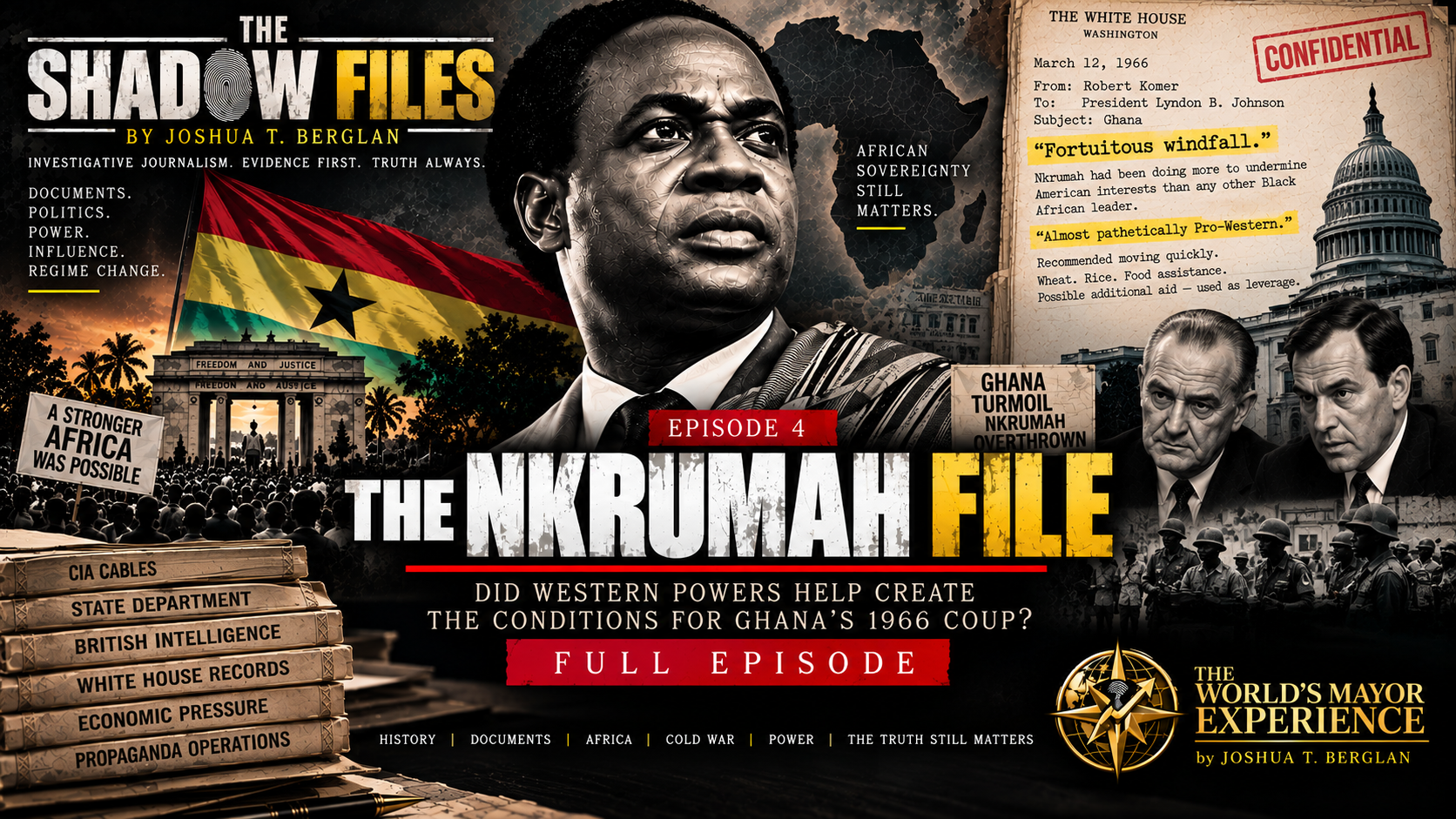
The Nkrumah File — Ghana's 1966 Coup
Declassified records, foreign pressure, covert propaganda and the limits of what the released evidence can prove.
- Episode 03
The Lumumba File — The CIA Plot That Failed
The documentary record surrounding Patrice Lumumba, the Congo crisis and the covert actions directed against him.
- Episode 02
The Cameroon Gold Gap — 22.3 kg Out, 15.2 Tonnes Abroad
An evidence-led investigation into the gap between Cameroon's reported gold exports and foreign import records.
- Episode 01
The $289M Cameroon Timber Gap
The first Shadow Files investigation, following discrepancies in Cameroon's timber trade data.
The money in my pocket
Every day in Cameroon, I spend CFA francs. Actual cash: food, transportation, the ordinary transactions that make a life. Eventually, I wanted to understand the decisions behind the notes in my hand.
The question sounds simple: who controls this money? But control can mean issuing notes, setting interest rates, deciding an exchange rate, managing reserves or determining who can borrow. Those powers do not all sit in the same place.
This file follows the Central African CFA franc through that division of authority. My concern is practical: what does the arrangement make possible, what does it restrict, and what would a credible alternative require? I am pro-Africa, pro-Cameroon and pro-truth. That includes testing claims I might otherwise want to believe.
The responsibilities behind the banknote
| Question | Where to look |
|---|---|
| Who issues the currency? | BEAC, serving the six member states. |
| Who sets regional monetary policy? | BEAC’s Monetary Policy Committee. |
| What anchors the exchange rate? | A fixed euro parity under monetary-cooperation agreements. |
| Who provides the convertibility guarantee? | The French Treasury, under those agreements. |
| Can Cameroon change all of this alone? | No. National policy operates inside regional and international commitments. |
The useful question is therefore specific: which institution has which power, under which rules?
What is documented, and what is not
The CFA franc debate runs hot in both directions. This ledger separates primary-source facts from claims the evidence does not carry.
Claims about the Central African CFA franc and their evidentiary status, checked 22 September 2026
| Claim | Status | Basis |
|---|---|---|
| The standard Operations Account quota is 50% of BEAC's net foreign assets, after specified exclusions | Documented | BEAC 2025 special audit: the 2014 convention fixes 50%, while permitting a reduction below 50% but not below 40%. |
| BEAC's actual centralisation rate stayed above 50% throughout 2025 | Documented | BEAC: 59.84% at the low point and 73.25% at the high point. |
| “France takes 50% of Cameroon’s money” | Misleading | The rule concerns pooled BEAC foreign assets, not Cameroon's budget, taxes or salaries; the deposits remain recorded as BEAC assets. Full explanation. |
| The Operations Account is remunerated | Documented | BEAC: ECB-linked remuneration; FCFA 110.64bn of credited interest recorded for 2025. |
| Treasury-correspondent deposits also matter to French public financing | Documented | The French National Assembly calls Treasury-correspondent deposits an important financing resource for the state. Its 2019 accounts show €126.8bn total, including €15.4bn from African central banks. |
| France has formal positions in BEAC governance | Documented | BEAC: two of 14 board members, two of 14 deliberating CPM members, and one of three censors. |
| The two French-designated CPM members take instructions from France | Not established | BEAC states CPM members do not represent their states and may not seek or receive instructions from states, Community institutions or any other person. |
| France has a unilateral veto over BEAC monetary policy | Not established | BEAC says each voting member has one vote and decisions are by simple majority of members present; the chair votes only to break a tie. |
| Cameroon is the largest CEMAC economy | Documented | French Treasury: 2025 nominal GDP €52.5bn and more than 44% of CEMAC GDP. |
| West Africa ended reserve centralisation with the French Treasury and regular French governance seats; Central Africa did not | Documented | Banque de France confirms the post-2019 UEMOA changes and says CEMAC cooperation remains unchanged. |
| CEMAC leaders continued formal work on monetary-cooperation reform in 2023 | Documented | The official final communiqué is the primary record of the 17 March 2023 summit and its follow-up work on the cooperation framework. |
| The March 2026 CEMAC–France meeting announced a new reserve or governance framework | Not established | The 17 March 2026 communiqué reaffirms continuing cooperation and announces no change to the account, guarantee, parity or governance seats. |
| The 1994 devaluation doubled every retail price | Misleading | The parity doubled from 50 to 100 CFA francs per French franc, but retail inflation did not mechanically double. See the arithmetic. |
| The CFA franc alone causes Cameroon's weak private-sector credit | Not established | IMF 2026 documents low credit and multiple financial-sector constraints; it does not establish a single-cause story. |
| Extractive export receipts are being repatriated on a staged schedule | Documented | BEAC Instruction 001/GR/2026: 35% in 2026, 50% from Jan 2027, 70% from Jan 2028. |
| A precise total of site-rehabilitation funds can be stated from the sources reviewed here | Not established | No dated primary table establishing a single current total was found; the article does not invent one. |
| A CEMAC digital CFA has already been issued | Not established | GABAC records preparatory work on the prospects for a future CBDC, not issuance. |
| Leaving the CFA automatically makes a country richer | Not established | Currency regime changes create policy choices and transition risks; outcomes depend on institutions, reserves, contracts, banking stability and public confidence. What reform would require. |
What did independence change?
The CFA franc was created on 26 December 1945 under French colonial administration. Its original name referred explicitly to France’s African colonies. That origin is part of the record, not an allegation. The later euro conversion established the familiar parity of 655.957 CFA francs per euro.
Institutional change also belongs in the record. BEAC’s headquarters moved from Paris to Yaoundé in 1977. An African regional central bank is not interchangeable with a colonial issuing office. Yet the monetary relationship with France continued through negotiated agreements — the France–BEAC monetary-cooperation convention of November 1972, whose second article states the cooperation rests on “ la garantie illimitée donnée par la France à la monnaie émise par la Banque ” and on the deposit with the French Treasury of all or part of the member states’ foreign-exchange reserves.
My reading is that independence changed the institutions without erasing every external monetary connection. Whether the surviving arrangements serve present needs is a question for evidence and public choice, rather than an answer settled by either a flag or a slogan.
What does France’s seat at the table mean?
BEAC publishes its own governance. Its Board of Directors has fourteen members: two administrators for each of the six member states, plus two for France. Its Monetary Policy Committee (CPM) has fourteen deliberating members besides the chair: two per member state and two for France. The Collège des Censeurs , an oversight body distinct from the Audit Committee, has three members, one designated by France.
Those positions establish formal French participation. They do not establish sole French control. BEAC's current CPM page says each voting member has one vote, decisions are taken by a simple majority of members present, and the chair votes only to break a tie.
There is another important nuance: BEAC also states that CPM members do not represent the states of which they are nationals and may not seek or receive instructions from states, Community institutions or any other person. That means the two positions allocated to France are real institutional participation, but the published rules do not support describing every vote by those members as an instruction from Paris.
The distinction matters throughout this investigation: appointment structure, voting rules and proof of actual control are three different questions.
Does France take 50% of Cameroon’s money?
The viral “France takes 50% of Cameroon’s money” claim is inaccurate as stated. The rule concerns pooled central-bank foreign assets, not half of Cameroon's wages, taxes, GDP, bank deposits or national budget.
The detailed rule is also more precise than the common shorthand. BEAC's 2025 special audit reproduces the 2014 convention: the standard mandatory quota is 50% of BEAC's net foreign assets, after specified exclusions. The convention permits the quota to be reduced below 50% but not below 40%. Assets held above the mandatory threshold at the French Treasury can be placed in a separate Compte Spécial de Nivellement , which is operated only on BEAC's order.
In practice, the 2025 centralisation rate was higher than the standard quota all year. BEAC's auditors report a low of 59.84% and a high of 73.25%. At 31 December 2025, the principal Operations Account balance was FCFA 3.648797 trillion; including accrued interest receivable, the reported total was FCFA 3.669206 trillion.
These balances are recorded as BEAC assets. The 2025 audit also shows BEAC managing convertible-currency reserves outside the Operations Account, under investment rules set within the Bank's governance framework. So “France owns the reserves” is not supported by the accounting or the statutes.
The assets are remunerated. BEAC states that the Operations Account is linked to the ECB marginal lending facility rate, while the Special Leveling Account is linked to the ECB main-refinancing rate. The ECB rates effective 16 September 2026 are 2.90% and 2.65% respectively. For the 2025 financial year, BEAC recorded FCFA 110.64 billion in credited interest across the two accounts.
Why older figures can mislead. The French Treasury explainer still displays 0.25% and 0% as rates “since 16 March 2016.” That page was published in 2021 and those are historical ECB rates, not the current 2026 rates. This article uses BEAC's audited remuneration formula and the ECB's current rate table instead.
A different question is whether these deposits matter to French public financing. A French National Assembly report calls Treasury-correspondent deposits “une ressource de financement importante pour l'État.” The impact study cited €128.4bn; the state's year-end accounts show €126.8bn at 31 December 2019. Of that, foreign governments and institutions held €15.5bn, including €15.4bn from African central banks.
An asset can remain owed to BEAC while also forming part of the French Treasury's cash resources. Ownership, custody, contractual constraints and Treasury financing are related questions, not interchangeable ones.
What the guarantee is worth, and what it buys
The French Treasury describes reserve centralisation as the counterpart of the unlimited convertibility guarantee because the guarantor needs to monitor the reserves and the risk that the guarantee could be called. BEAC's 2025 audit likewise says the 1972 cooperation is founded on France's unlimited guarantee and the deposit with the French Treasury of all or part of member states' foreign-exchange reserves.
That is the official rationale. The same cooperation framework also provides for French participation in BEAC governance. The documents therefore establish a direct institutional link among the guarantee, the reserve architecture and French participation; they do not establish that France alone runs BEAC.
The reserves are an asset. The arrangement around them is a relationship.
The policy question is whether that relationship still delivers benefits worth its constraints — and whether the region could obtain similar stability under a different architecture. That is a question for the member states and their citizens, not a fact the documents can decide on their behalf.
What does the euro peg provide — and constrain?
The current parity is €1 = 655.957 CFA francs. While that parity holds, it reduces uncertainty about the number of CFA francs needed for a euro-priced payment. France provides a convertibility guarantee under the cooperation framework.
This does not fix the CFA franc’s value against the US dollar. Nor does it freeze food prices, prevent global commodity shocks or make devaluation impossible. A stable exchange-rate quotation and stable household purchasing power are related but different things.
Defending an exchange-rate anchor and maintaining reserves constrain monetary choices. But BEAC does not mechanically reproduce every European Central Bank decision. In its March 2025 CEMAC report, the IMF recommended maintaining a tightening bias despite ECB easing; the report also records BEAC’s view that imperfect capital mobility limits the influence of the interest-rate differential.
That distinction matters. Cameroon lacks a national interest-rate lever, yet the regional central bank retains policy judgment. The argument should concern how that judgment serves the region, not assume that every rate announcement is an instruction from Europe.
Sovereignty also means access to credit
A currency debate becomes tangible when firms cannot finance equipment or farmers cannot obtain suitable working capital. An IMF study published in 2026, Unlocking Growth in Cameroon: Easing Financial Sector Constraints and Closing Infrastructure Gaps , documents the scale of the problem.
The ratio of private-sector credit to GDP in Cameroon fell from 26.4% in 1990 to 14.1% in 2023. In 2015 it stood at 14.2%, roughly one third of the approximately 41.5% average the paper gives for other low-income Sub-Saharan African countries.
26.4% in 1990. 14.1% in 2023. That is the direction of travel.
The maturity structure is also restrictive for long-lived investment. The IMF finds that about 90% of total credit is short-term lending of less than two years; medium-term credit of two to ten years accounts for 8%, and long-term credit above ten years for 2%. Long-lived equipment and expansion projects are difficult to finance when most available credit matures in under two years.
The same IMF analysis points to high intermediation costs, weak borrower information, loan-quality problems and heavy government exposure in bank balance sheets. The evidence supports a serious credit-allocation problem; it does not establish that the euro peg alone causes it.
The giant with two seats
Economic weight and governance design are different things. The French Treasury estimates Cameroon's nominal GDP at €52.5 billion in 2025 and more than 44% of CEMAC GDP. Cameroon is therefore the union's largest economy by this measure.
BEAC's Board, however, is not weighted by GDP: each of the six member states has two administrators, and France also has two designated positions under the cooperation framework. On the Monetary Policy Committee there are likewise two members per member state plus two for France, but BEAC expressly says CPM members do not represent their states and may not take instructions from them.
The defensible point is institutional, not rhetorical: Cameroon carries the largest economic weight in CEMAC, while the regional governance system gives equal national representation among the six member states and also reserves formal positions for France. Whether that design should change is a policy judgment, not a fact determined by GDP alone.
1994: a severe shock, with precise arithmetic
The date requires a distinction. The political decision to change the parity was reached on 11 January 1994; IMF sources describe the new exchange rate as effective 12 January 1994. The parity moved from 50 to 100 CFA francs per French franc — a devaluation of 50% in foreign-currency terms.
A fixed invoice of 100 French francs therefore required 10,000 CFA francs instead of 5,000, before taxes, margins or other pricing changes. That arithmetic explains why import-dependent households and firms were exposed.
It does not mean every retail price doubled. IMF reporting put 1994 average inflation at about 38% across the Central African countries, while World Bank data record Cameroon's 1994 consumer-price inflation at about 35.1%.
The historical lesson is narrower: a fixed parity can be changed. Stability under a peg does not mean the parity is legally or economically immutable.
Central Africa and West Africa: two CFA arrangements
The Central African XAF and West African XOF are separate currencies issued by separate central banks. They share the same euro parity, but the institutional arrangements have diverged.
On 21 December 2019, UEMOA leaders announced an agreement with France that provided for ending the Operations Account and regular French participation in BCEAO governance while retaining the fixed euro parity and France's convertibility guarantee.
The Banque de France now states the outcome plainly: reserve centralisation with the French Treasury ended, the Operations Account was closed, and France withdrew from BCEAO's regular governing bodies. The same Banque de France page says cooperation with CEMAC remains unchanged and France continues to participate in governance there.
Same parity, different institutional arrangements
| Feature | Central Africa | West Africa |
|---|---|---|
| Currency / central bank | XAF / BEAC | XOF / BCEAO |
| Euro parity | 655.957 per euro | 655.957 per euro |
| Operations Account | Retained; standard quota 50% of BEAC net foreign assets after specified exclusions, with convention allowing reduction to no lower than 40% | Reserve-centralisation obligation ended; Operations Account closed |
| Regular French governance positions | Retained | Removed under the reform |
| French convertibility guarantee | Retained | Retained, with crisis provisions |
The French Senate records a residual crisis provision in the West African agreement: if there is a risk that France's guarantee will be called, France may exceptionally designate a representative with a deliberative vote. Ending regular representation therefore did not eliminate every French role.
The relevant lesson for Central Africa is factual: reserve and governance rules can be renegotiated without automatically abandoning a fixed euro parity. West Africa changed those rules; CEMAC has not made the same changes.
Follow export earnings as well as the Treasury account
Oil, gas and mining bring another dimension to the reserve debate: whether export earnings return to the regional banking system at all. On 23 April 2026 BEAC announced Instruction n°001/GR/2026, signed at Yaoundé by Governor Yvon Sana Bangui, raising the repatriation requirement for the export receipts of extractive companies — hydrocarbons, mining and similar activities — on a staged and, in the bank’s word, predictable calendar:
- 35% — the rate in force at the time of the notice
- 50% — from 1 January 2027
- 70% — from 1 January 2028
BEAC states the purpose directly: to strengthen the effect of export receipts on its foreign-exchange reserves while preserving a predictable regulatory path for the companies concerned. National Directors were instructed to notify both the extractive companies and the credit institutions in their territories.
The same notice excludes sums allocated to end-of-life site-rehabilitation funds from that obligation. Money set aside to restore an oil or mining site should therefore not be casually combined with export receipts under one rule. The IMF’s 2025 regional report documents separate negotiations over escrow arrangements for those restoration funds.
This article does not repeat an exact offshore rehabilitation-fund total, or Cameroon’s alleged share of “positive reserves,” because no dated primary table establishing those measures could be found. Unverified precision would weaken the investigation.
The public-interest question remains: how can the region secure external resources while honouring specific contracts, environmental obligations and credible safeguards over the funds?
Pouemi’s warning, from inside Cameroon
The episode also returns to the Cameroonian economist Joseph Tchundjang Pouemi and his 1980 book Monnaie, servitude et liberté: la répression monétaire de l'Afrique.
The bibliographic record verifies the author, title and publication. This article uses Pouemi as a historical lens on monetary sovereignty and credit repression, but it does not attribute a detailed proposition or quotation to him unless that language has been verified directly in the source.
The modern empirical question can be tested without putting words in Pouemi's mouth: who can obtain productive finance, on what terms, and under what institutional rules?
Would a digital CFA change who holds power?
Official materials describe study and preparation, not launch. GABAC, CEMAC’s own anti-money-laundering body, reports that from 23 to 27 February 2026, BEAC and the IMF held a strategic seminar in Yaoundé on central bank digital currency, including “ l’examen des perspectives d’une future monnaie numérique de Banque Centrale dans la sous-région. ” That is evidence of policy work. It is not proof that a digital CFA has been issued.
Mobile money, a bank deposit and a central bank digital currency are three different instruments. A digital form of central-bank money could change how payments work. It would not, by itself, amend the treaties or determine who sets monetary policy.
A necessary correction. The episode’s phrase “one-to-one with the euro” is incorrect. The CFA parity is 655.957 per euro. A hypothetical one-for-one exchange between a digital CFA unit and a cash CFA unit would be an entirely different relationship, and the two should not be confused.
What would a credible reform require?
Three different reforms should be separated because they carry different legal and economic consequences:
- Reforming governance inside a shared currency — seats, reserve rules and accountability.
- Changing the exchange-rate anchor — retaining the union but altering the peg or exchange-rate regime.
- Introducing a separate national currency — leaving the shared monetary union.
West Africa's post-2019 reform demonstrates that governance and reserve arrangements can change while a fixed euro parity and French guarantee remain. It does not tell us how a unilateral Cameroonian exit would work.
The 1972 cooperation framework contains a route for denunciation followed by negotiations over the necessary arrangements. A legal exit clause is not a complete transition plan.
Any serious transition proposal would still need to answer practical questions familiar from IMF work on exchange-rate regime changes:
- How would existing savings, contracts and payment obligations be converted?
- How would foreign-currency debts be serviced?
- What would anchor inflation after a change in the existing peg?
- How would banks manage exchange-rate risk on their balance sheets?
- What reserves and institutional credibility would stand behind the new arrangement?
Mali is a useful historical precedent, but it should be stated without turning history into a prediction. The French Treasury's chronology records that Mali left the franc zone in 1962 to issue its own currency and returned in 1984. That establishes that exit and later re-entry are possible; it does not establish what would happen in Cameroon.
Monetary autonomy creates policy choices. Institutions and transition design shape what those choices achieve.
Who gets to decide what money is allowed to do?
The four questions
What do we know?
- The XAF is fixed at 655.957 per euro and backed by an unlimited French Treasury convertibility guarantee.
- The 2014 convention's standard Operations Account quota is 50% of BEAC net foreign assets after specified exclusions, reducible to no lower than 40%.
- Actual centralisation during 2025 ranged from 59.84% to 73.25%.
- France has two of 14 board positions, two of 14 deliberating CPM positions and one of three censors.
- West Africa ended reserve centralisation and regular French governance representation; CEMAC did not.
- Cameroonian private-sector credit fell from 26.4% of GDP in 1990 to 14.1% in 2023; about 90% of total credit is short-term.
- Extractive export-receipt repatriation is 35% in 2026, rising to 50% in 2027 and 70% in 2028.
What does the evidence suggest?
- The current architecture combines a stability mechanism with constraints created by a shared regional currency and international cooperation agreement.
- France has formal participation, but the published voting rules do not support the claim that France has a unilateral veto over BEAC monetary policy.
- Cameroon's credit shortage is real, but the evidence points to multiple causes rather than the currency regime alone.
- West Africa shows that some reserve and governance rules can change without abandoning the euro peg.
What do we still not know?
- A single current, primary-source total for site-rehabilitation funds held outside CEMAC.
- How much of Cameroon's weak credit performance is attributable to monetary architecture versus domestic legal, banking and information constraints.
- Whether CEMAC will ultimately adopt any of the governance changes pursued in West Africa.
- The sources reviewed here do not state a definitive public reason for why CEMAC retained the older framework while UEMOA changed it.
Who can answer?
- BEAC and the UMAC Ministerial Committee.
- Cameroon's Ministry of Finance.
- The French Treasury.
- CEMAC institutions and the member-state governments.
- The extractive companies and banks subject to repatriation rules.
Frequently asked questions
Who controls the CFA franc in Cameroon?
Control is distributed. BEAC issues the XAF, manages pooled official reserves and sets regional monetary policy for six states. Cameroon cannot change the parity or policy rate alone, and France cannot set them alone. France nevertheless remains formally inside the cooperation architecture through its convertibility guarantee, the Treasury accounts and designated positions in BEAC governance.
What is the currency of Cameroon?
Cameroon uses the Central African CFA franc, currency code XAF, issued by BEAC for Cameroon, the Central African Republic, Chad, the Republic of the Congo, Equatorial Guinea and Gabon. It is separate from the West African CFA franc, XOF.
Does France take 50% of Cameroon's money?
No, not as that slogan is normally understood. The rule concerns pooled BEAC foreign assets, not Cameroon's budget, taxes or salaries. The 2014 convention's standard Operations Account quota is 50% of BEAC net foreign assets after specified exclusions, with a provision allowing the quota to be reduced below 50% but not below 40%. The deposits remain BEAC assets and are remunerated.
How much was actually centralised in 2025?
BEAC's 2025 special audit reports that the centralisation rate ranged from 59.84% to 73.25% and stayed above the 50% standard quota throughout the year. At 31 December 2025 the reported Operations Account total, including accrued interest receivable, was FCFA 3.669206 trillion.
What interest does the Operations Account earn?
BEAC's 2025 audit says the Operations Account is remunerated using the ECB marginal lending facility rate and the Special Leveling Account using the ECB main-refinancing rate. The ECB reference rates effective 16 September 2026 are 2.90% and 2.65%. BEAC recorded FCFA 110.64bn in credited interest across the two accounts for 2025.
Does France sit on BEAC's governing bodies?
Yes. BEAC lists two of 14 board positions for France, two of 14 deliberating Monetary Policy Committee positions for France, and one of three censors designated by France. BEAC also says CPM members do not represent their states and may not seek or receive instructions from states or other persons.
Does France have a veto over BEAC monetary policy?
The published rules do not show a unilateral French veto. BEAC says each voting CPM member has one vote and decisions are taken by simple majority of members present, with the chair voting only to break a tie.
How many CFA francs equal one euro?
The fixed parity is 655.957 CFA francs per euro. The CFA therefore moves against the US dollar and other floating currencies as the euro moves against them.
What changed in West Africa?
After the reform launched in December 2019, West Africa ended the obligation to centralise BCEAO reserves at the French Treasury, closed the Operations Account and removed regular French representatives from BCEAO governance, while retaining the fixed euro parity and French convertibility guarantee.
What happened in the 1994 devaluation?
The decision was reached on 11 January 1994 and the new parity became effective on 12 January. The rate moved from 50 to 100 CFA francs per French franc, a 50% devaluation in foreign-currency terms. That did not mean every retail price doubled; Cameroon's 1994 inflation was about 35.1%.
Is the CFA franc the sole reason credit is hard to get in Cameroon?
No. IMF research documents a serious credit shortage — private-sector credit fell from 26.4% of GDP in 1990 to 14.1% in 2023, and about 90% of total credit is short-term — while also identifying high intermediation costs, weak borrower information, loan-quality problems and other financial-sector constraints.
How much of extractive export receipts must be repatriated?
BEAC's April 2026 instruction set the rate at 35% in 2026, rising to 50% from 1 January 2027 and 70% from 1 January 2028. Sums allocated to end-of-life site-rehabilitation funds are excluded from that particular obligation.
Is a digital CFA franc already in circulation?
No CEMAC CBDC has been issued. GABAC reports that BEAC and the IMF held a strategic seminar in February 2026 examining the prospects for a future regional central-bank digital currency.
Would leaving the CFA automatically make Cameroon richer?
No automatic outcome follows from a currency change. A transition would depend on institutions, reserves, banking stability, contract conversion, foreign-currency debt, inflation anchoring and public confidence. Mali's history shows that a country can leave and later rejoin the franc zone; it does not predict Cameroon's outcome.
Where can I check these facts?
The source ledger below links to BEAC, the French Treasury, ECB, Banque de France, CEMAC, BCEAO, IMF, World Bank and French parliamentary records. Primary sources are used wherever they exist.
Clarifications and corrections to the episode
This is a researched companion article, not a verbatim transcript. The recordings are unchanged. Where the written research refines or corrects the spoken episode, the differences are stated openly:
- Reserve quota. The shorthand “at least 50% in the Operations Account” is too broad. The 2014 convention sets a standard mandatory quota of 50% of BEAC net foreign assets after specified exclusions and allows it to be reduced below 50% but not below 40%. In 2025 the actual centralisation rate was 59.84%–73.25%.
- Reserve ownership. A BEAC deposit at the French Treasury is not a tax or transfer of ownership. It remains a remunerated BEAC asset. Treasury-correspondent deposits can still matter to French cash financing, and the article states both facts.
- Interest rates. The 0.25% and 0% figures displayed on the French Treasury's 2021 explainer are historical, not current 2026 rates. BEAC's audited formula is ECB-linked; current ECB reference rates effective 16 Sep 2026 are 2.90% and 2.65%.
- Committee independence. BEAC's current CPM page does verify that members do not represent their states and may not seek or receive instructions. The article now states that rule explicitly.
- 1994 timing and prices. The devaluation decision was reached on 11 January 1994 and the new rate became effective on 12 January. A 50% external devaluation did not mean every retail price doubled.
- West African reform. The Operations Account was with the French Treasury, not the Banque de France. Regular French governance representation and compulsory reserve centralisation ended in UEMOA, while the fixed euro parity and French guarantee remained.
- French Treasury financing figures. The €128.4bn figure comes from the impact study. The state's year-end accounts show €126.8bn of Treasury-correspondent deposits at 31 Dec 2019; African central banks accounted for €15.4bn.
- Extractive revenues. The April 2026 instruction stages export-receipt repatriation at 35/50/70 and expressly excludes site-rehabilitation funds from that particular obligation. The two categories are not merged.
- Digital currency. Official sources show preparatory work, not issuance. And the CFA parity is 655.957 per euro; “one-to-one with the euro” was incorrect.
- Pouemi. The bibliographic record verifies the book, not every interpretation attributed to it. The article does not present unverified paraphrases as quotations.
Sources and verification
Primary and official sources are preferred. Links below were rechecked on 22 September 2026. Where a source states an institutional position or policy judgment rather than a neutral fact, the article identifies it as such.
BEAC and CEMAC primary sources
- 1. BEAC — Le fonctionnement de la BEAC Board: 14 members, two per member state and two for France; CPM: 14 deliberating members including two for France; College of Censors: three, one designated by France.
- 2. BEAC — Comité de Politique Monétaire Composition, one-member/one-vote rule, simple-majority voting, chair tie-break, and independence-from-instructions clause.
- 3. BEAC — Rapport spécial sur le contrôle du Compte d'Opérations, 2025 Primary audit for the 2014 quota mechanics, 50% standard / 40% floor, 2025 balance, remuneration formula, FCFA 110.64bn interest, 59.84%–73.25% centralisation range and reserves held outside the Operations Account.
- 4. BEAC — Instruction 001/GR/2026, extractive-sector repatriation 35% in 2026; 50% from Jan 2027; 70% from Jan 2028; site-rehabilitation funds excluded from that particular obligation.
- 5. CEMAC–France ministers and governors — joint communiqué, 17 March 2026 Reaffirms continuing monetary/economic cooperation and does not announce a new account, parity, guarantee or governance framework.
- 6. CEMAC — Final communiqué, 15th ordinary Heads of State summit, 17 March 2023 Primary record for the summit's continued work on the France–CEMAC monetary-cooperation framework.
- 7. BEAC — Other press releases Includes BEAC's July 2026 PAPSS announcement. PAPSS concerns payment rails, not issuance of a CEMAC CBDC.
France-side official sources
- 8. French Treasury — Principles and operation of monetary cooperation Fixed parity, unlimited guarantee, reserve centralisation and UEMOA reform. Note: its 0.25%/0% ECB rate examples date from the page's 2021 publication and are not treated here as current 2026 rates.
- 9. French Treasury — The franc zone from 1939 to today 1945 origin, 1972 cooperation, 1977 BEAC headquarters transfer, Mali's 1962 exit and 1984 return, 1994 decision date, and euro conversion.
- 10. French Treasury — Cameroon indicators and outlook 2025 nominal GDP estimated at €52.5bn and more than 44% of CEMAC GDP.
- 11. French National Assembly — Report no. 2915 Treasury-correspondent deposits described as an important financing resource; impact study €128.4bn, year-end 2019 state accounts €126.8bn; €15.4bn from African central banks.
- 12. French Senate — Report no. 289 on the UEMOA cooperation agreement Documents the end of reserve centralisation and regular French representation, retention of the parity and guarantee, and exceptional crisis representation.
- 13. Banque de France — Les coopérations monétaires Afrique-France Current official summary: UEMOA centralisation ended and France withdrew from regular BCEAO governance; CEMAC cooperation remains unchanged.
Rates, economics and historical data
- 14. European Central Bank — Key ECB interest rates Effective 16 Sep 2026: deposit 2.50%, main refinancing 2.65%, marginal lending 2.90%.
- 15. IMF — Unlocking Growth in Cameroon Private credit 26.4% of GDP in 1990 → 14.1% in 2023; 14.2% in 2015 vs about 41.5% for comparable low-income SSA economies; about 90% of credit short-term.
- 16. IMF — Striving for Stability: CFA Franc Realignment New parity effective 12 Jan 1994; 50% devaluation in foreign-currency terms.
- 17. IMF — Aftermath of the CFA Franc Devaluation Effective date and inflation context after the 1994 devaluation.
- 18. World Bank — Consumer price inflation, Cameroon Cameroon inflation series used for the 1994 figure.
- 19. IMF — From Fixed to Float: Operational Aspects of Moving Toward Exchange Rate Flexibility General transition checklist; applied analytically, not as an IMF forecast about Cameroon.
West Africa, digital-currency work and Pouemi
- 20. BCEAO — Dates clés 21 Dec 2019 reform announcement and institutional changes.
- 21. GABAC — CBDC and crypto-asset seminar BEAC–IMF seminar, 23–27 Feb 2026, examining prospects for a future regional CBDC. Preparation, not issuance.
- 22. National Library of Tunisia — Monnaie, servitude et liberté Bibliographic verification of author, title and publication; not used to authenticate unverified quotations.
Related investigations
How this investigation was done
Institutional claims are sourced to the institution's own published material wherever possible: BEAC for governance, reserves and the 2026 extractive instruction; the French Treasury and Banque de France for France's stated role and the cooperation framework; CEMAC and BCEAO for regional decisions; the ECB for current euro-area policy rates; the IMF and World Bank for economic data; and French parliamentary records for legislation and Treasury-account descriptions.
The strongest correction in this audit came from BEAC's 2025 special report on the Operations Account. It supplies details that earlier drafts treated as unavailable: the 50% standard quota with a 40% permitted floor, the FCFA 3.669tn year-end total including accrued interest, the 59.84%–73.25% centralisation range in 2025, and FCFA 110.64bn of credited interest. Those primary-source figures now replace older shorthand.
Claims still omitted for lack of a dated primary source include a single current total for offshore site-rehabilitation funds and any quotation attributed to Pouemi that was not read directly. Where the article makes an interpretation rather than states a documentable fact, it says so. Last reviewed 22 September 2026.
Cite this investigation
Berglan, Joshua T. “Who Controls the CFA Franc? Cameroon, France and Monetary Sovereignty.” The Shadow Files , Episode 5. The World’s Mayor Experience, 21 September 2026. https://www.joshuatberglan.com/cfa-franc-cameroon-currency-after-colonialism
Linking to one finding? Every section has a permanent address — for example #ledger, #fifty or #offshore.
Corrections policy
If any figure, date or characterisation on this page is inaccurate, write to joshua@joshuatberglan.com with the documentation and it will be corrected publicly, with the change noted. A correction is not journalism failing. A correction is journalism working.
About Joshua T. Berglan
Joshua T. Berglan is a broadcaster, author and investigative host known as The World's Mayor. He lives and works in Cameroon, where he produces The World's Mayor Experience and its investigative strand, The Shadow Files , while teaching media and ownership workshops.
His books and current projects are collected on the World's Mayor bookshelf, and his broader media-ownership work is described at Sovereign Architecture. This article keeps the biography brief so the sourcing standard applied to the investigation is not confused with promotional claims.
The Shadow Files uses four recurring questions: what do we know, what does the evidence suggest, what do we still not know, and who can answer? Evidence first. Conclusions last.
Evidence first. Conclusions last. — The World’s Mayor, reporting from Cameroon