The Shadow Files · Episode Four
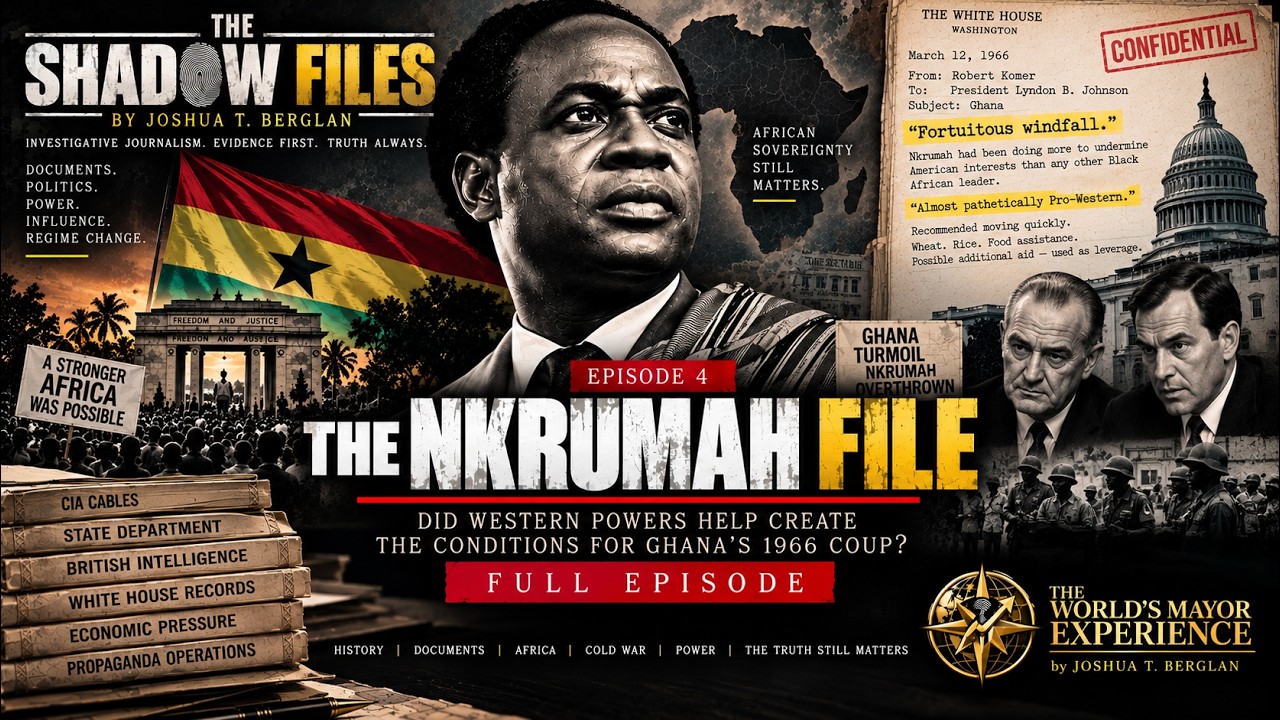
The Nkrumah File: Did Western Powers Help Create the Conditions for Ghana’s 1966 Coup?
Two years before Kwame Nkrumah was overthrown, a State Department office proposed “psychological warfare” against him. When he fell, the White House called it a “fortuitous windfall.” This investigation reads the complete Ghana chapter of the State Department’s official documentary history, sets it beside Britain’s declassified files — and marks exactly where the evidence stops.
What do the declassified records prove about Ghana’s 1966 coup?
The short answer
The released records prove Western hostility, pressure and foreknowledge — not command. U.S. officials proposed “psychological warfare” against Kwame Nkrumah in 1964, discussed refusing aid “in the interests of further weakening Nkrumah” in 1965, were informed — in one White House aide’s words — that “the plotters are keeping us briefed,” tracked the plot to the day before it happened, and called the result a “fortuitous windfall.” British files, as reported in 2024, show the Foreign Office running covert propaganda intended to help create the conditions for his overthrow.
The same record shows the “psychological warfare” idea was left out of the action program sent to President Johnson two days after it was written; that Ghana’s economic crisis and Nkrumah’s one-party rule were real; and that Ghanaian army and police officers planned and carried out the coup. The State Department’s published record does not establish that Washington ordered or ran it — and five of its forty Ghana documents still contain text that has never been declassified.
Key facts at a glance
- Event
- Military and police coup, Ghana
- Date
- 24 February 1966
- Leader removed
- President Kwame Nkrumah
- Where Nkrumah was
- Abroad, en route to Peking (Beijing)
- Who carried it out
- Ghanaian army and police officers
- Government that took power
- National Liberation Council
- U.S. record reviewed
- All 40 Ghana documents, FRUS 1964–68 Vol. XXIV
- Still classified
- Text withheld in 5 of those 40
- Key British record
- IRD report, 6 May 1966 (as reported)
- Evidentiary status
- Pressure, foreknowledge and propaganda documented; U.S. command not established
Watch the investigation
Chapters
- 00:00 The 1964 U.S. government document Read
- 01:30 Kwame Nkrumah’s vision for Pan-Africanism Read
- 03:33 Nkrumah’s shift to authoritarianism Read
- 05:34 Ghana’s economic crisis and cocoa exports Read
- 07:24 Ambassador Mahoney, coup plotting and “psychological warfare” Read
- 10:52 “The plotters are keeping us briefed” Read
- 12:36 Britain’s covert propaganda and the day before the coup Read
- 16:05 24 February 1966: the overthrow of Kwame Nkrumah Read
- 17:48 Did the CIA overthrow Nkrumah? Reviewing the evidence Read
- 19:59 “Fortuitous windfall” and who benefited Read
- 23:02 Was Nkrumah right about neo-colonialism? Read
- 29:29 Next episode: the CFA franc Read
Listen to the investigation
Key takeaways
- The 1964 plan did not survive intact. A State Department office proposed “psychological warfare” on 11 February 1964. The action program sent to President Johnson on 13 February contained no such step.
- Washington knew. CIA and embassy reporting followed the coup plot for more than a year, including a report the day before it happened.
- Aid was leverage in both directions. New aid was refused partly to weaken Nkrumah. After he fell, food aid arrived within weeks.
- Nkrumah’s book raised the temperature. After Neo-Colonialism appeared in October 1965, the United States lodged a formal protest and turned down a food-aid request of more than $100 million. Britain’s propaganda unit, by its own later account, stepped up its output.
- Ghanaians carried out the coup. The U.S. record describes Ghanaian officers plotting, postponing and moving on their own timetable.
- The file is not closed. There is no order for the coup in the State Department’s published record — and that record still withholds text, including 11½ lines of the ambassador’s conversation with Nkrumah about the CIA.
What the evidence establishes — and what it does not
Most accounts of this coup either say “the CIA overthrew Nkrumah” or dismiss foreign involvement altogether. Neither survives the documents. Here is every major claim, marked by what the record can actually carry.
| Claim | Status | Basis |
|---|---|---|
| A State Department office proposed “psychological warfare” to reduce support for Nkrumah | Documented | Trimble memorandum, 11 Feb 1964 ( Doc. 237) |
| That proposal became approved U.S. policy | Not established | Absent from the program sent to the President on 13 Feb 1964 (Doc. 239) and from the April 1964 program (Doc. 250) |
| The Secretary of State and CIA Director discussed General Ankrah taking over, in 1964 | Documented | McCone record, 11 Feb 1964: “No decision was reached” ( Doc. 236) |
| U.S. officials knew a coup was being planned | Documented | Docs. 251, 253, 257 |
| Refusing new aid was argued as a way to weaken Nkrumah | Documented | Ambassador Mahoney, 11 Mar 1965 ( Doc. 251) |
| Washington assured Nkrumah the CIA was not acting against him | Documented | Ambassador, 2 Mar 1964 ( Doc. 244); President Johnson, 17 Mar 1964 (Doc. 246) |
| A $100 million-plus food-aid request was refused after Nkrumah’s book | Documented | Doc. 256 — the link to the book was deliberately left unstated |
| Britain ran covert propaganda aimed at the conditions for his overthrow | Reported | IRD report of 6 May 1966, as published by Declassified UK(2024) |
| Ghanaian officers planned and carried out the coup | Documented | Doc. 257 |
| Washington moved quickly to support the new government | Documented | Doc. 258, Docs. 262 and 266 |
| The CIA directed or materially assisted the plotters | Allegation | Former CIA officer John Stockwell and 1978 press reporting; not confirmed by the published record |
| Washington ordered the coup | Not established | No such document in the published FRUS record |
Kwame Nkrumah was bigger than one office
Ghana won its independence from Britain on 6 March 1957, and Kwame Nkrumah made Accra a centre of Pan-African politics. He sheltered liberation movements from across the continent, helped found the Organisation of African Unity in 1963, and argued that Africa’s new states would stay weak unless they controlled their own money, resources and security together.
He put that argument directly to President Johnson. In a personal letter of 26 February 1964 he wrote that newly independent African states “wish to be left alone to pursue policies and courses which we know to be in the best interests of our people” — and complained that the CIA seemed devoted to “fomenting ill-will, misunderstanding and even clandestine and subversive activities among our people.” ( Doc. 243)
Nkrumah’s suspicion of the CIA was not a secret in Washington. The State Department memo proposing pressure against him noted, on its first page, that he was “convinced that through the CIA we are seeking to engineer his downfall.”
A liberator who became an authoritarian
Any honest account has to hold a second fact alongside the first. By 1964 Ghana was a one-party state. The Preventive Detention Act allowed opponents to be held without trial. The press answered to the government. Nkrumah had survived repeated assassination attempts, including one in January 1964, and grew more isolated and more suspicious.
Washington’s own descriptions were hostile — Under Secretary Averell Harriman told the President in April 1964 that Nkrumah’s rule meant “imprisoning many of his opponents, controlling the press, and recently the courts” — but reporting sympathetic to Nkrumah acknowledges the same slide. ( Doc. 249)
Foreign interference does not erase Ghanaian responsibility. Ghanaian responsibility does not erase foreign interference.
Ghana’s economic crisis was real
Nkrumah’s government pursued industrialisation at speed. Its centrepiece, the Volta River Project, paired a hydroelectric dam at Akosombo with an aluminium smelter run by a Kaiser-led consortium. In February 1964 Edgar Kaiser told President Johnson the dam would cost about $200 million, half of it Ghana’s, with a smelter of about $150 million alongside — all of it loans. ( Doc. 241)
By March 1965 the U.S. ambassador described Ghana’s economy as “in a precarious state.” That September, Assistant Secretary of State G. Mennen Williams reported after a visit to Accra that foreign exchange reserves were at a “critically low level,” with “prices increasing at annual rate more than 30 percent due short supplies and inflationary financing.” ( Doc. 255) A CIA assessment written after the coup, hostile to Nkrumah and to be read as such, claimed he had spent reserves built largely on cocoa sales and taken on roughly $700 million in new foreign debt. ( Doc. 251; Doc. 268)
That matters, because the real question is not whether Washington created every weakness inside Ghana. It is what Washington, and London, chose to do once those weaknesses existed.
February 1964: the “Action Program for Ghana”
In early 1964 relations collapsed. Demonstrators protested outside the U.S. Embassy in Accra, six professors — four of them American — were expelled from the University of Ghana, and Ghana’s government press accused the United States of acting against Nkrumah. Washington recalled its ambassador. On 11 February, the director of the State Department’s Office of West African Affairs sent his superior a plan. It was drafted with the ambassador himself.
(7) U.S. pressure, if appropriately applied, could induce a chain reaction eventually leading to Nkrumah’s downfall. Chances of success would be greatly enhanced if the British could be induced to act in concert with us.
(8) Psychological Warfare — Intensive efforts should be made through psychological warfare and other means to diminish support for Nkrumah within Ghana and nurture the conviction among the Ghanaian people that their country’s welfare and independence necessitate his removal.
The same memo proposed slowing U.S. payments on the Volta Dam — while noting that this was “possible only until around July 1, 1964 when the lake starts to form and further delays in construction might cause serious flooding and loss of life.” It listed twelve propaganda themes, from the Preventive Detention Act to academic freedom. One warned that Nkrumah’s policies risked “substituting one form of colonialism for another.”
The same afternoon: “whether General Ankrah might not take over”
At 3 p.m. that day, the Director of Central Intelligence met the Secretary of State. His own record of the meeting survives.
The Secretary asked whether General Ankrah might not take over. I stated that we had no indication, observed the General had no political ambition and thought that if it was desired to develop something, we might work with the British on a joint program. No decision was reached.
The general was Joseph Ankrah. Nkrumah retired him from the army in July 1965. In February 1966 he became chairman of the National Liberation Council.
Then the plan was softened
The next day, 12 February, President Johnson met British Prime Minister Sir Alec Douglas-Home at the White House. They discussed using the Volta project as leverage. The British Foreign Secretary, R.A. Butler, warned that holding it up “might be useful, but a withdrawal would be extremely serious since aid to Volta is about the only instrument we have in Ghana.” He also observed that Nkrumah “is obsessed with the thought that the US and the UK desire his destruction.” ( Doc. 238)
On 13 February the action program went to the President. It had seven steps: a warning letter from the British Prime Minister, a visit by Edgar Kaiser, strong words from the ambassador, closing a U.S. medical research facility, a World Bank review of Volta, a possible presidential letter, and a presidential emissary. Psychological warfare was not among them. Volta, the memo concluded, “seems to offer limited leverage,” and using it carried “significant complications” and risks. ( Doc. 239)
By April, after Harriman visited Accra, the program had become “a meaningful dialogue with Nkrumah” backed by “continuing pressure,” with U.S. aid grants, food aid and the Peace Corps continuing and the Volta commitments kept. ( Doc. 250)
The documents record the harsher option being written down — and then left out of what went to the President.
That is not the same as saying nothing happened. It means the published record does not show psychological warfare being approved, and anyone who claims otherwise needs a document this record does not contain.
“Absolutely and positively no”
On 26 February 1964 the President convened a meeting on Ghana. When he asked whether the alleged CIA role mattered to Nkrumah, Edgar Kaiser said it was “a major factor in his attitude,” and CIA Director McCone agreed. ( Doc. 242) McCone’s own note of that day records that he asked Ambassador Mahoney whether the CIA was operating independently of his embassy: “Mahoney answered absolutely and positively no.” ( Doc. 241)
Mahoney returned to Accra and met Nkrumah on 2 March.
I could assure him without hesitation that during my incumbency absolutely nothing has been done by any US agency which could be construed in any way as being directed against him or his government. Nkrumah replied with words to effect “I will take your word for it,”
11½ lines of source text not declassifiedI repeated that there had been no conceivable activity on our part to subvert or overthrow him.
Two weeks later President Johnson wrote to Nkrumah himself: “there is no basis in fact for the allegation that the CIA is carrying on subversive activities in Ghana or attempting to impair the good relations between our governments.” ( Doc. 246)
1965: “in the interests of further weakening Nkrumah”
A year later, the ambassador sat in the CIA Director’s office. The record of that conversation was drafted by the deputy chief of the CIA’s Africa Division.
[Mahoney] was not convinced that the coup d’etat, now being planned by Acting Police Commissioner Harlley and Generals Otu and Ankrah, would necessarily take place. He did feel, however, that one way or another Nkrumah would be out within a year.
[…] Not only would a refusal be justified in the interests of further weakening Nkrumah but in Ambassador Mahoney’s opinion, such a refusal would make a desirable impression on other countries in Africa. He felt, however, that the United States should maintain present aid levels and retain the Peace Corps program.
Eleven weeks later, a member of the President’s National Security Council staff wrote a short note to the National Security Adviser.
FYI, we may have a pro-Western coup in Ghana soon. Certain key military and police figures have been planning one for some time, and Ghana’s deteriorating economic condition may provide the spark. The plotters are keeping us briefed , and State thinks we’re more on the inside than the British. While we’re not directly involved (I’m told), we and other Western countries (including France) have been helping to set up the situation by ignoring Nkrumah’s pleas for economic aid. […] All in all, looks good.
Read the whole memo, not the single sentence that travels. It says the plotters were briefing Washington. It also says Washington was not directly involved — as far as its author had been told. Both statements are in the same paragraph, written by the same man, on the same day.
October 1965: the book that raised the temperature
In October 1965 Nkrumah published Neo-Colonialism: The Last Stage of Imperialism , arguing that formal independence could coexist with economic control from outside. He handed copies to African heads of state at the Organisation of African Unity summit in Accra. The State Department noted that it made charges against the CIA, the U.S. Information Agency and the Peace Corps.
Book contains unmistakably hostile charges against USG motives, actions, and intentions and is clear and comprehensive statement of Nkrumah’s fundamental anti-Western, anti-US bias.
On Nov 20 Emb Accra delivered note to GOG MinFonAffairs turning down GOG’s long-pending request for over $100 million in PL–480 assistance. No mention made in note of book.
[…] do not hide our dissatisfaction with book, or deny implication that its publication could well affect our relations with Ghana. We prefer let GOG and others draw own conclusions.
London reacted too. According to the British file later published by Declassified UK, the Information Research Department was told after the book’s publication that it no longer needed to hold back because Ghana was a Commonwealth member — and began putting more material on Ghana and Nkrumah into its regular output.
Britain was not watching from the sidelines
The Information Research Department was a Cold War propaganda unit inside Britain’s Foreign Office. In March 2024, Declassified UK reported on a Top Secret IRD report dated 6 May 1966, titled “IRD operations against Nkrumah’s government,” written by the diplomat John Ure.
As reported, the report states that IRD’s treatment of Ghana had aimed at helping to create “an atmosphere in which Nkrumah could be overthrown” and replaced by a more Western-oriented government. It describes leaflets mailed into Ghana in the names of invented Ghanaian groups, a steady stream of hostile articles, and a publication secretly run by the department. The targets were teachers, students, journalists and police — the urban, educated Ghanaians whose opinion IRD believed mattered most. The reporting also cites a 1964 minute from Prime Minister Douglas-Home asking whether damaging facts about Nkrumah could be leaked through channels that could not be traced back to Britain.
Scholarship supports the picture. Ben Gowland’s 2025 article in the journal Soundings examines IRD’s disruption and psychological-warfare operations, with a specific focus on Ghana, as part of a longer history of British neo-colonial management. ( DOI 10.3898/soun:89.01.2025)
What we checked, and what we did not
The British quotations and descriptions above come from Declassified UK’s published report of the file and from Gowland’s article. This investigation has not independently inspected the original file at the U.K. National Archives. That is why these findings are labelled reported, not documented, in the evidence ledger.
Even as reported, the file documents a deliberate propaganda campaign. It does not show Britain directing the officers who carried out the coup.
24 February 1966: Ghanaian officers moved
The plotters had been close before. CIA reporting shows plans set, postponed and abandoned through 1965. In July, Nkrumah retired his defence chief and deputy — General Otu and General Ankrah — which the CIA said “effectively neutralizes the two as potential coup leaders.” Then a wave of military coups across West Africa, the agency reported in January 1966, “sparked new plotting.”
In late February Nkrumah left on a tour of Asia. On 24 February, with him en route to Peking, army and police officers seized power, and a National Liberation Council took over.
On 24 February, a coup occurred in Ghana while President Nkrumah was en route to Peking. Over the past year, OCI reporting has noted persistent military dissatisfaction with the regime and pointed to a group of army and police officers who were plotting against Nkrumah. Because of government countermeasures and indecisiveness on the part of the plotters, the coup was apparently postponed several times.
[…] On 23 February, the day before the coup,
less than 1 line of source text not declassifiedreported that the commanders of the army’s two brigades and the commissioner of police might be engineering a move to oust Nkrumah during his Asian tour.
The file copy carries a handwritten note from Richard Helms to McGeorge Bundy: “I am particularly pleased to send you a favorable report on your last day.”
Foreknowledge is evidence of foreknowledge. It is not, by itself, evidence of command.
The next day: “inevitable charges”
We wish avoid appearing overzealous by acting too quickly, thus lending credence to inevitable charges that U.S. masterminded coup. At same time, we wish move as quickly as feasible into position of mutually beneficial relations with new regime.
A footnote to the same telegram records that the U.S. ambassador to Ghana, Franklin Williams, wrote to White House aide Bill Moyers that the coup had been “extremely fortunate” and that the new leaders were “strong friends of ours.”
Sixteen days later: “fortuitous windfall”
The coup in Ghana is another example of a fortuitous windfall. Nkrumah was doing more to undermine our interests than any other black African. In reaction to his strongly pro-Communist leanings, the new military regime is almost pathetically pro-Western.
[…] A few thousand tons of surplus wheat or rice, given now when the new regimes are quite uncertain as to their future relations with us, could have a psychological significance out of all proportion to the cost of the gesture. I am not arguing for lavish gifts to these regimes—indeed, giving them a little only whets their appetites, and enables us to use the prospect of more as leverage.
The aid ledger: before and after
Put the aid decisions in order and the pattern is plain. None of these entries alone proves intent. Together they show aid being used as a political instrument on both sides of the coup.
| Date | Decision | Direction | Record |
|---|---|---|---|
| Feb 1964 | Proposal to slow U.S. payments on the Volta Dam — left out of the program sent to the President | Proposed | Docs. 237, 239 |
| Apr 1964 | Volta–Valco commitments kept; AID grants, PL-480 food aid and Peace Corps continue | Continued | Doc. 250 |
| Mar 1965 | Ambassador argues to refuse new aid “in the interests of further weakening Nkrumah,” but keep existing aid | Withheld | Doc. 251 |
| May 1965 | White House aide: the West is “ignoring Nkrumah’s pleas for economic aid” | Withheld | Doc. 253 |
| Nov 1965 | Request for more than $100 million in PL-480 food aid turned down | Withheld | Doc. 256 |
| Mar 1966 | Komer urges “a few thousand tons of surplus wheat or rice” for the new government | Proposed | Doc. 260 |
| Apr 1966 | 25 tons of canned milk airlifted; PL-480 food agreement signed 1 April | Granted | Doc. 262 |
| May 1967 | $35 million in AID loans approved for the post-Nkrumah government | Granted | Doc. 266 |
In July 1967 a CIA assessment summed up where that left Ghana: the new military government “relies heavily on US aid and advice.” ( Doc. 268)
Fairness requires one more line in this ledger. Before the coup, the United States kept financing the Volta Dam — the largest project in the country — even at the worst point in relations. Pressure was real. Total economic strangulation is not what the record shows.
So did the CIA overthrow Kwame Nkrumah?
The published official record does not allow that to be stated as fact. Other declassified collections exist — including the CIA’s online reading room and the Johnson Library’s files — and the findings on this page are limited to the documents cited here.
The allegation is serious and not new. In 1978 former CIA officer John Stockwell wrote in In Search of Enemies that Washington had rejected an agency proposal to oust Nkrumah, but that the CIA’s Accra station kept close contact with the plotters anyway, was later given unofficial credit inside the agency for the coup — and that little of this was reflected in the agency’s written records. Press reporting by Seymour Hersh that year said the CIA had aided the plotters. Those claims deserve to be taken seriously. They are not the same as a document.
The volume these documents come from was compiled by the State Department’s historians, with access to CIA Director McCone’s files and to the records of the committee that approved covert operations. Its editors say they sought to include the essential documents on major covert actions. Its Ghana chapter contains none describing an operation against Nkrumah.
That is meaningful. It is not proof. The same volume, published in July 1999, withheld about 3 percent of the material its editors selected and denied 19 documents in full across its African chapters. And in the Ghana chapter itself, text remains classified in five documents — including the 11½ lines at the heart of the ambassador’s March 1964 conversation about the CIA, and the sources behind the CIA’s pre-coup reporting.
Those unanswered questions are not a weakness in this investigation. They are the investigation.
The four questions
What do we know?
- A 1964 State Department proposal called for psychological warfare against Nkrumah.
- U.S. officials knew of the coup plot for more than a year and named its leaders.
- New aid was refused while officials argued it would weaken Nkrumah; aid reached his successors within weeks.
- Britain’s IRD ran covert propaganda against his government, as reported from its own file.
- Ghanaian officers carried out the coup.
What does the evidence suggest?
- Washington and London wanted Nkrumah gone and shaped the conditions — economic and informational — in which a coup became likelier.
- U.S. officials expected to be blamed, and managed their response accordingly.
- Suggests is not proves.
What do we still not know?
- What the classified lines of the March 1964 CIA conversation say.
- Whether any U.S. agency carried out psychological warfare despite its omission from the approved program.
- Whether U.S. contact with the plotters went beyond being briefed.
- How far Britain’s role extended beyond propaganda.
Who can answer?
- The State Department and the CIA, through mandatory declassification review requests for the redacted passages.
- The U.S. National Archives and the Johnson Library, which hold the source files.
- The U.K. National Archives, which holds the IRD file.
- Ghana’s national archives, and the historians who have worked in all of them.
Was Nkrumah right about neo-colonialism?
Nkrumah’s argument was that a country could hold every outward sign of sovereignty — a flag, a president, a seat at the United Nations — while decisions about its money, trade and politics were still shaped from outside.
The documents around his own government do not prove his whole theory. But they record aid used as “leverage.” They record a proposal to change what Ghanaians believed about their own leader. Britain’s own file, as reported, describes a propaganda unit mailing leaflets into Ghana under invented Ghanaian names. And they record the United States reacting to his book about outside control with a formal protest and a refused request for food.
Could an authoritarian leader still correctly identify forms of outside power operating against him? The documents require us to ask.
The Shadow Files so far
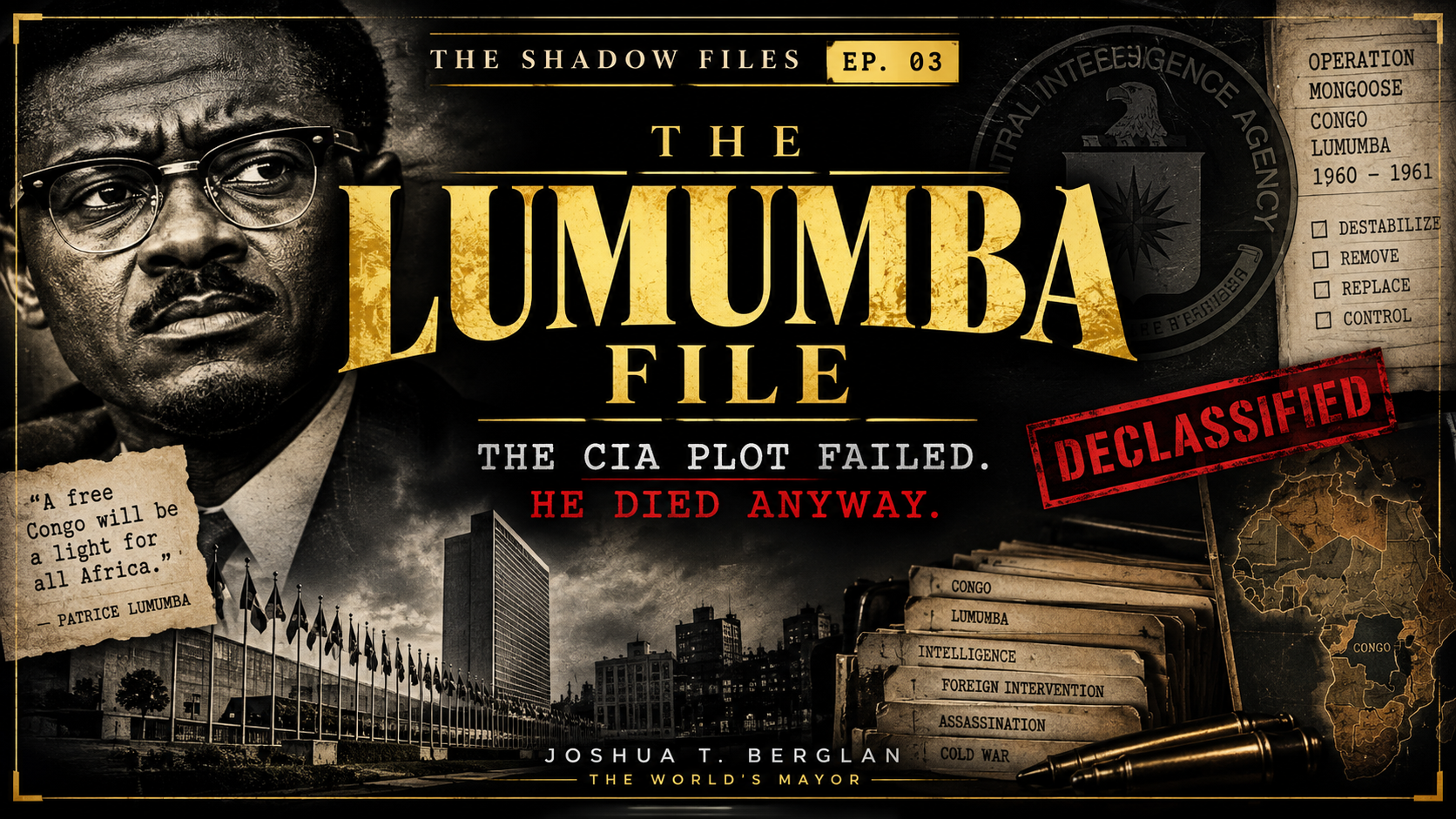
- Episode 3
The Lumumba File
Did Western powers help destroy Congo’s independence before it had a chance? The documented CIA assassination plot, Belgium’s own findings, Katanga’s uranium and the MI6 question that is still unresolved.
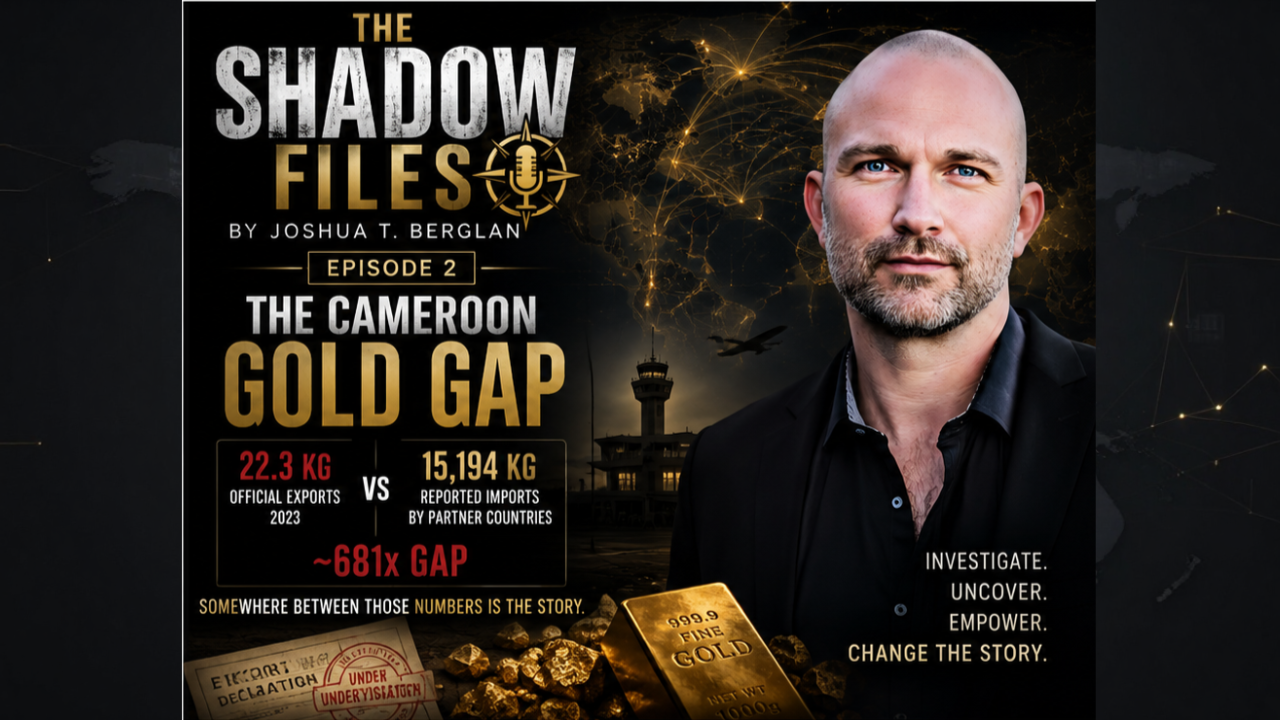
- Episode 2
The Cameroon Gold Gap
Cameroon recorded 22.3 kilograms of gold exports in 2023. Partner countries reported roughly 15.2 tonnes arriving. What the evidence establishes, and what it does not.
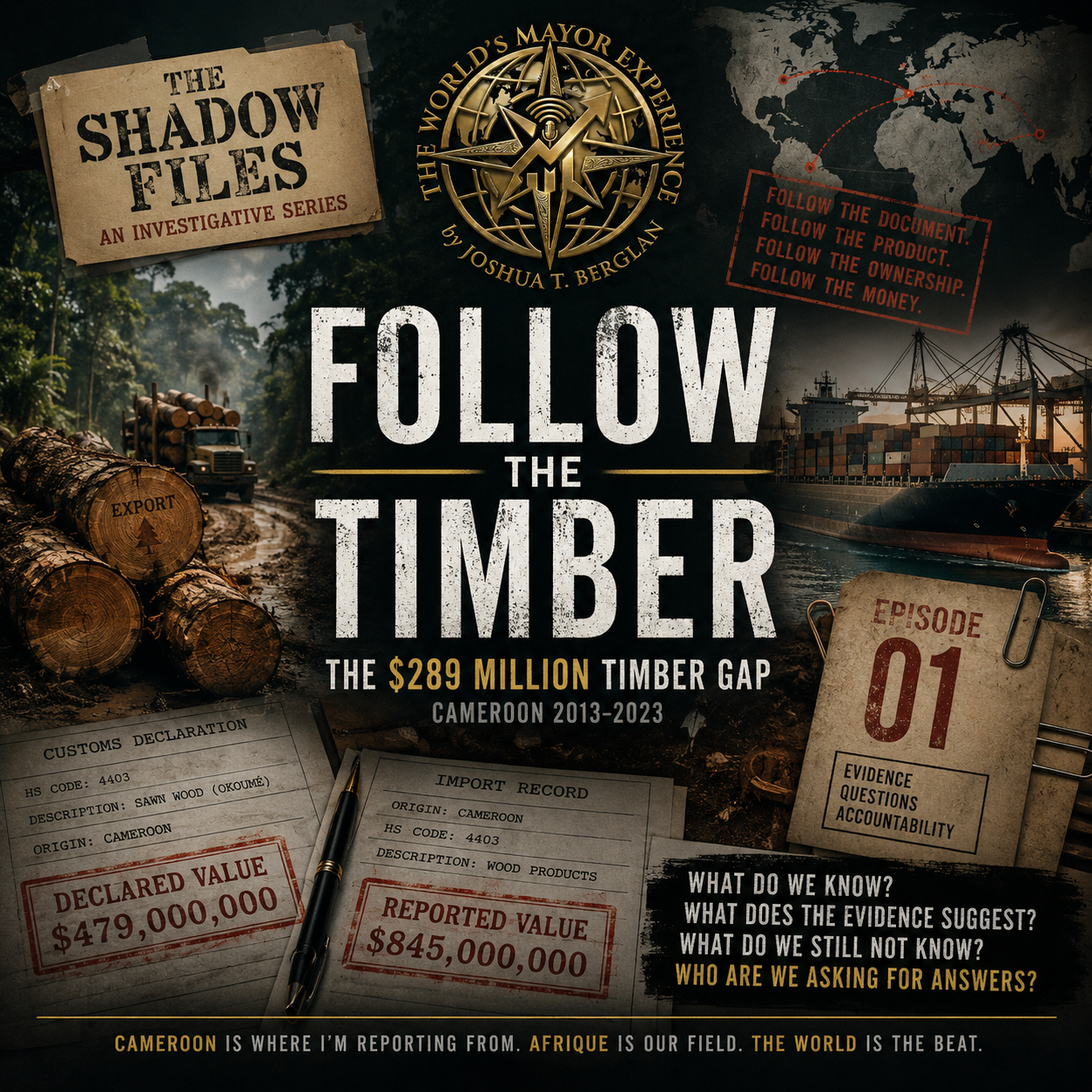
- Episode 1
The $289M Cameroon Timber Gap
What happens when the timber a country reports exporting and the timber its trading partners report importing stop telling the same story?
Every episode of The Shadow Files
Frequently asked questions
Did the CIA overthrow Kwame Nkrumah?
The published official record does not establish that. The U.S. documents published in Foreign Relations of the United States show hostility toward Nkrumah, a 1964 proposal for psychological warfare, aid refusals discussed as a way to weaken him, detailed foreknowledge of the coup plot and satisfaction with the result. They contain no order for the coup and no account of a U.S. operation to carry it out. Former CIA officer John Stockwell and 1978 press reporting alleged that the CIA aided the plotters; that allegation has not been confirmed by the State Department’s published record, which still withholds text in five of its forty Ghana documents.
Did the United States know about the 1966 coup in advance?
Yes. A March 1965 CIA memorandum of conversation records the U.S. ambassador naming the officers planning a coup. In May 1965 Robert Komer of the National Security Council staff wrote that “the plotters are keeping us briefed.” A CIA review written the day after the coup lists more than a year of reporting on the plot, including a report on 23 February 1966, the day before it happened.
What does “the plotters are keeping us briefed” mean?
It is from a 27 May 1965 memorandum from Robert W. Komer to National Security Adviser McGeorge Bundy. Komer wrote that key military and police figures were planning a pro-Western coup and were keeping U.S. officials informed. In the same memo he wrote that the United States was not directly involved, “I’m told,” but that Western countries had been helping to set up the situation by ignoring Nkrumah’s pleas for economic aid.
Did the United States use psychological warfare against Nkrumah?
It was proposed. An 11 February 1964 memorandum from the State Department’s Office of West African Affairs recommended psychological warfare to diminish support for Nkrumah and persuade Ghanaians that his removal was necessary. But the action program sent to President Johnson two days later did not include it, and the State Department’s published record does not show it being approved or carried out.
Did Britain help overthrow Nkrumah?
Declassified British files, as reported by Declassified UK in 2024, show that the Foreign Office’s Information Research Department ran covert propaganda against Nkrumah’s government with the stated aim of helping create an atmosphere in which he could be overthrown. That documents a deliberate propaganda campaign. It does not show Britain directing the Ghanaian officers who carried out the coup.
Who actually carried out the 1966 coup in Ghana?
Ghanaian army and police officers. U.S. intelligence reporting describes them plotting, postponing and acting on their own timetable for more than a year. After the coup the National Liberation Council, chaired by Lieutenant General Joseph Ankrah, took power.
Where was Nkrumah when he was overthrown?
Abroad. The CIA’s review of 25 February 1966 records that the coup happened while Nkrumah was en route to Peking, now Beijing, during an Asian tour. The plotters had long preferred to act while he was out of the country.
Why did the White House call the coup a “fortuitous windfall”?
On 12 March 1966 Robert Komer, then acting National Security Adviser, wrote to President Johnson that the coup in Ghana was “another example of a fortuitous windfall,” the first example being Indonesia. He described the new military government as “almost pathetically pro-Western” and recommended quick food aid to consolidate the result. The memo shows how Washington viewed the outcome; it does not show Washington caused it.
Did the United States cut aid to Ghana to weaken Nkrumah?
Partly. In March 1965 the U.S. ambassador argued for refusing new financial assistance “in the interests of further weakening Nkrumah,” while keeping existing aid and the Peace Corps. In November 1965 the United States turned down a request for more than $100 million in PL-480 food aid. The United States nonetheless kept financing the Volta Dam. After the coup, food aid arrived within weeks and $35 million in AID loans was approved in 1967.
Was Nkrumah an authoritarian leader?
Yes, by the time of the coup. Ghana became a one-party state in 1964, opponents could be held without trial under the Preventive Detention Act, and the press was government-controlled. Recognising that is not the same as excusing foreign interference; both are part of the record.
Where can I read the original documents?
The U.S. documents are free online from the State Department’s Office of the Historian, in Foreign Relations of the United States, 1964–1968, Volume XXIV, Africa, Ghana chapter, documents 235 to 274. Every document quoted on this page is linked in the sources section below.
Sources and primary documents
U.S. government documents
All from Foreign Relations of the United States, 1964–1968, Volume XXIV, Africa , Ghana chapter, published online by the Office of the Historian, U.S. Department of State.
- Doc. 236 — McCone memorandum for the record, discussions with Secretary Rusk 11 Feb 1964 · Secret; Eyes Only
- Doc. 237 — Trimble to Williams, “Proposed Action Program for Ghana” 11 Feb 1964 · Secret
- Doc. 238 — Memorandum of conversation, President Johnson and Prime Minister Douglas-Home 12 Feb 1964 · Secret
- Doc. 239 — Rusk to President Johnson, “The Volta Problem” 13 Feb 1964 · Secret
- Doc. 241 — McCone memorandum for the record, meeting with the President 26 Feb 1964 · Secret; Eyes Only
- Doc. 242 — Memorandum of meeting with the President on Ghana 26 Feb 1964 · Confidential
- Doc. 243 — Letter from President Nkrumah to President Johnson 26 Feb 1964
- Doc. 244 — Telegram from the Embassy in Ghana (Mahoney) 2 Mar 1964 · Confidential
- Doc. 246 — President Johnson’s message to President Nkrumah 17 Mar 1964 · Confidential
- Doc. 249 — Harriman to President Johnson, “Ghana” 3 Apr 1964
- Doc. 250 — Williams to Harriman, “Action Program for Ghana” 9 Apr 1964 · Confidential
- Doc. 251 — Memorandum of conversation, McCone and Mahoney 11 Mar 1965 · Secret
- Doc. 253 — Komer to Bundy 27 May 1965 · Secret
- Doc. 255 — Telegram from the Embassy in Togo, Governor Williams on his visit to Ghana 30 Sep 1965
- Doc. 256 — Circular telegram, “Nkrumah’s Book” 23 Nov 1965 · Confidential
- Doc. 257 — Memorandum for Helms, “Recent OCI Reporting on Ghana” 25 Feb 1966 · Secret
- Doc. 258 — Telegram from the Department of State to the Embassy in Ghana 25 Feb 1966 · Confidential
- Doc. 260 — Komer to President Johnson 12 Mar 1966 · Confidential
- Doc. 262 — President Johnson to General Ankrah 14 Apr 1966
- Doc. 266 — Rostow to President Johnson, AID loans to Ghana 11 May 1967
- Doc. 268 — CIA special memorandum, “Ghana’s Political and Economic Malaise” 19 Jul 1967 · Secret
- The full Ghana chapter: Documents 235–274
- Volume preface, including its declassification notes
British files, as reported
- Mohamed Elmaazi, “Top Secret Document Exposes UK Role in Ghana Coup” Declassified UK · 4 Mar 2024
Scholarship
- Ben Gowland, “Subverting Nkrumah: the Information Research Department and the practice of neo-colonialism” Soundings, no. 89 (2025), pp. 16–28
- Susan Williams, White Malice: The CIA and the Covert Recolonisation of Africa 2021
- Kwame Nkrumah, Neo-Colonialism: The Last Stage of Imperialism 1965
Later allegations
- John Stockwell, In Search of Enemies: A CIA Story W. W. Norton, 1978
- Seymour M. Hersh, press reporting on CIA aid to the Ghana plotters May 1978
Related investigations
How this investigation was done
We read all forty documents in the Ghana chapter of Foreign Relations of the United States, 1964–1968, Volume XXIV — not only the handful usually quoted — because the documents that complicate the story sit between the ones that make headlines. Every quotation on this page was copied from the Office of the Historian’s published text and checked on 15 September 2026, with the cable-style abbreviations and missing words left exactly as written. Where we shorten a quotation, the gap is marked […]. Where the government still withholds text, we show the redaction rather than hide it.
British material is labelled as reported, because we worked from its publication rather than the archive original. Claims that circulate without documentation are labelled as allegations, and are not treated as findings.
Cite this investigation
Berglan, Joshua T. “The Nkrumah File: Did Western Powers Help Create the Conditions for Ghana’s 1966 Coup?” The Shadow Files , Episode 4. The World’s Mayor Experience, 15 September 2026. https://www.joshuatberglan.com/the-nkrumah-file-ghana-1966-coup
Linking to one finding? Every section has a permanent address — for example #aid-ledger, #ledger or #doc-244.
Corrections policy
If any quotation, date or characterisation on this page is inaccurate, write to joshua@joshuatberglan.com with the documentation and it will be corrected publicly, with the change noted. A correction is not journalism failing. A correction is journalism working. Last reviewed 15 September 2026.
Read the complete Episode 4 transcript
The episode as recorded, formatted for reading: pauses and pronunciation guides removed, nothing else changed. Each numbered section is also a standalone clip, with its own link — for example #tx-7.
1. Two years before the coup
Two years before Kwame Nkrumah was overthrown, an internal United States government document was already discussing his downfall. Not after the coup. Before it. February 11, 1964. The State Department produced an “Action Program for Ghana.”
And inside it, American officials discussed how pressure could create a chain reaction eventually leading to Nkrumah's downfall. The proposal also called for “psychological warfare” designed to diminish support for Nkrumah inside Ghana. Now, that is extraordinary.
But here's where evidence matters. This document proves American officials were discussing pressure, information operations and Nkrumah's removal two years before the actual coup. It does not prove Washington ordered the military takeover that eventually happened.
Those are different claims. And I don't need to exaggerate this. Because the document is already explosive. Two years before the coup, Washington was discussing Nkrumah's downfall. That's not a conspiracy theory. That's the paper trail.
2. The Pan-African project
When Ghana became independent on March 6, 1957, Kwame Nkrumah wasn't thinking only about Ghana. He declared that Ghana's independence was meaningless unless it was connected to the total liberation of Africa. Accra became a center for Pan-African politics, anti-colonial organizing and liberation movements.
But Nkrumah wanted much more than cooperation. Political union. Economic integration. A common market. A continental defense structure. And eventually an African currency. His argument was simple. A continent could remove colonial flags and still remain economically fragmented, militarily dependent and politically vulnerable.
But here's what often gets left out. Other African leaders disagreed with him. In 1963, at Addis Ababa, most African governments rejected immediate political federation. They wanted cooperation while protecting their own national sovereignty. So this was not Nkrumah versus the entire West with Africa behind him.
Africa itself was debating what independence should become. But Nkrumah's question was bigger than Ghana. Who should control African money? African resources? African security? African power? And that question made him impossible for the world to ignore.
3. A visionary and an authoritarian
Kwame Nkrumah could be targeted by foreign powers and still abuse his own power. Both can be true. By the mid-1960s, Nkrumah's government had become increasingly authoritarian. The Preventive Detention Act allowed people to be detained without an ordinary criminal trial.
Political opponents were imprisoned. Political competition was severely restricted. And in 1964, Ghana became a one-party state. J.B. Danquah, one of Nkrumah's most prominent opponents, was imprisoned under the Preventive Detention Act. He died inside Nsawam prison in 1965.
But Nkrumah also survived real assassination attempts. Real bombings. Real political violence. His fears were not imaginary. But genuine danger doesn't automatically justify every response to that danger. And that's where the easy narratives collapse.
Nkrumah wasn't a flawless democratic hero destroyed entirely by foreigners. And he wasn't a universally rejected dictator removed entirely by his own people. He was a visionary who became authoritarian. A liberation icon who jailed opponents.
Foreign interference does not erase Ghanaian responsibility. And Ghanaian responsibility does not erase foreign interference. The truth has room for both.
4. The crisis was real
America did not create every economic problem inside Ghana. That's important. Because if we blame everything on foreign powers, we make the foreign pressure we can actually prove easier to dismiss. Nkrumah attempted a massive transformation of Ghana.
Industrialization. Infrastructure. Education. State enterprises. The Akosombo Dam symbolized that ambition. But Ghana still depended heavily on cocoa exports for foreign exchange. Cocoa prices fell. Development spending consumed reserves. Imports required hard currency. And Ghana's foreign exchange position became critical.
By 1965, American diplomats were reporting severe shortages, high inflation and growing urban dissatisfaction. That crisis was real. International markets played a role. Ghana's economic structure played a role. Nkrumah's own policy decisions played a role.
Then something else happened. American officials began discussing how withholding additional assistance could weaken Kwame Nkrumah. America didn't create every crack. The cracks were already there. The investigation is about who decided to push on them.
5. Washington applies the squeeze
Almost one year before the coup, the American ambassador to Ghana was discussing coup plotting and how to further weaken Kwame Nkrumah. March 11, 1965. U.S. Ambassador William Mahoney meets with CIA Director John McCone.
American officials are receiving reports that senior Ghanaian military and police figures are planning a coup. The record identifies John Harlley, Stephen Otu and Joseph Ankrah. Mahoney isn't certain the coup will happen. Then the discussion turns to money.
He recommends rejecting Nkrumah's expected request for additional financial assistance. And one reason appears plainly in the government record. “In the interests of further weakening Nkrumah.” Think about that. American officials were receiving reports of coup plotting while America's ambassador was recommending economic pressure to further weaken the man those officers wanted removed.
Does that prove Washington ordered the coup? No. But does it describe a neutral observer? No. Ghana's economic problems were real. And Washington was willing to use them.
6. “Psychological warfare”
Two years before Kwame Nkrumah was overthrown, an American government proposal actually used the words “psychological warfare.” Their words. Not mine. February 1964. The proposed Action Program for Ghana discussed American pressure that could contribute to a chain reaction leading to Nkrumah's downfall.
Then it proposed psychological warfare and other efforts to diminish support for him inside Ghana. The themes were specific. Civil liberties. The judiciary. Academic freedom. Economic deterioration. Communist influence. And the argument that Nkrumah's policies were damaging ordinary Ghanaians.
But here's the line we cannot cross. This was a proposed program. The document alone does not prove every recommendation was approved or carried out exactly as written. But it does prove something extraordinary. Two years before Ghana's military moved, American officials were formally discussing psychological warfare, economic pressure and Nkrumah's downfall inside the same policy conversation.
Did this memo order the coup? No. Did this conversation really happen? Yes. Not speculation. Documentation.
7. “The plotters are keeping us briefed”
Nine months before Kwame Nkrumah was overthrown, a White House official wrote a sentence that should stop you in your tracks. “The plotters are keeping us briefed.” May 27, 1965. Robert Komer of the National Security Council writes to McGeorge Bundy.
Komer says a pro-Western coup may soon happen in Ghana. He says key military and police figures have been planning one for some time. Then: “The plotters are keeping us briefed.” But don't stop reading.
Because Komer also says the United States is not directly involved as far as he has been told. Then, in the same passage, he says America and other Western countries have been helping “set up the situation” by ignoring Nkrumah's requests for economic aid.
And then four words. “All in all, looks good.” That is why you read the entire document. Not just the line that proves what you already believe. “The plotters are keeping us briefed.” “We're not directly involved, I'm told.”
“Helping to set up the situation.” “All in all, looks good.” Those words can coexist. And together they tell a story far more disturbing than any slogan.
8. Britain’s covert campaign
America wasn't the only Western government working against Kwame Nkrumah. Britain had its own covert propaganda operation. Years later a British government report described “covert attacks” against Nkrumah's government. The operation came through Britain's Information Research Department, the IRD.
And the objective was remarkable. To help create an atmosphere in which Nkrumah could be overthrown and replaced by a government more oriented toward the West. How? Unattributed propaganda. Leaflets from fictitious organizations. Hostile articles.
Material circulated without revealing the British hand behind it. And remember, Britain wasn't just another country. Britain had been Ghana's colonial ruler. Less than a decade after Ghana's independence, its former colonial power was secretly trying to influence political opinion against Ghana's president.
Does that prove Britain commanded the Ghanaian officers who carried out the coup? No. Does it prove Britain was simply watching from the sidelines? Also no. The covert campaign is documented. How far British involvement went beyond that is still a legitimate question.
Clarification: this section says the British report came “years later.” The IRD report is dated 6 May 1966, ten weeks after the coup. It became public years later, when Declassified UK reported on it in 2024. See the full account above.
9. They knew a coup might be coming
One day before Kwame Nkrumah was overthrown, American intelligence was already reporting that Ghana's military and police leadership might move against him while he was abroad. One day. February 23, 1966. The coup began the next morning.
And this wasn't a lucky guess. A CIA memorandum prepared after the takeover reconstructed roughly one year of intelligence reporting about coup plotting inside Ghana. Plans appeared. Plans stalled. Plotters changed. Plans returned. Then February 17, 1966.
American intelligence reports another plan to kill Nkrumah and seize the government. February 23. Another report suggests Ghana's army brigade commanders and police leadership may move while Nkrumah is outside the country. February 24. The government falls.
So let's be precise. Washington had been tracking coup plotting for roughly a year. But foreknowledge is evidence of foreknowledge. Knowing a coup may happen does not prove you commanded it. Wanting Nkrumah gone does not prove you gave the final order.
Washington knew a lot. The unresolved question is whether it did more than know.
10. February 24, 1966
Kwame Nkrumah was outside Ghana when his government was overthrown. February 24, 1966. He was traveling through Asia on a diplomatic mission connected to efforts surrounding the Vietnam War. Back in Ghana, military and police officers moved.
Lieutenant Colonel Emmanuel Kwasi Kotoka was one of the central military figures. Major Akwasi Afrifa was another. Police Commissioner John Harlley was central to the police side of the takeover. Radio facilities were seized. Nkrumah's government was removed.
Parliament was dissolved. The Convention People's Party was banned. And the National Liberation Council took power under Joseph Ankrah. This is where a foreign-interference investigation can make another mistake. Ghanaian officers actually carried out the coup.
They had their own motives. Their own grievances. Their own ambitions. Their own hostility toward Nkrumah. Foreign interference does not erase African agency. African agency does not erase foreign interference. The question isn't foreign or domestic.
The evidence forces us to investigate both.
11. Did the CIA run the coup?
Did the CIA overthrow Kwame Nkrumah? After everything I've shown you, you may expect me to say yes. I can't. Not as an established fact. The official United States historical record says Washington was informed about coup plotting.
But the published record does not establish that the U.S. government carried out the coup. Then, years later, former CIA officer John Stockwell alleged that the CIA station in Accra was more deeply involved than the official record acknowledges.
Those allegations have been cited for decades. They've also been disputed. So what can we prove? American hostility toward Nkrumah? Documented. Pressure designed to weaken him? Documented. Psychological warfare discussed? Documented. Knowledge of coup plotting?
Documented. “The plotters are keeping us briefed”? Documented. Intelligence reporting right up to the coup? Documented. What we don't have in the released official record is the document that says: “CIA execute the coup.” Could involvement have gone further?
Possibly. Can I prove exactly how far? No. And sometimes “I don't know” isn't a weakness in journalism. It's the line between investigation and propaganda.
12. “Fortuitous windfall”
Sixteen days after Kwame Nkrumah was overthrown, a senior White House official described the coup with two words. “Fortuitous windfall.” March 12, 1966. Robert Komer writes directly to President Lyndon B. Johnson. He calls the Ghana coup a “fortuitous windfall.”
Then he says Nkrumah had been doing more to undermine American interests than any other Black African leader. And then he describes Ghana's new government with another extraordinary phrase. “Almost pathetically pro-Western.” Then Komer recommends moving quickly to consolidate the opportunity.
Wheat. Rice. Food assistance. And the possibility of more aid used as leverage. That does not prove America caused the coup. It does prove something else. Powerful officials inside Washington saw Nkrumah's overthrow as strategically beneficial.
And if you're asking how they felt about the result, you don't need my opinion. They wrote it down. “Fortuitous windfall.”
13. Who benefited?
Cui bono? Who benefits? One of the oldest questions in any investigation. Kwame Nkrumah falls and Ghana's international alignment changes rapidly. The new National Liberation Council is strongly anti-Communist. Relations with Washington improve. Relations with London improve.
Soviet and Chinese influence is reduced. And American officials want a productive relationship with the new government as quickly as possible. But there's a fascinating instruction inside the diplomatic record. Don't move too quickly. Because obvious American enthusiasm could strengthen accusations that Washington had masterminded the coup.
That does not confess to masterminding it. In fact, the document is worried about being accused of exactly that. But it also shows how favorable the new government looked from Washington. Who benefited? The coup leaders gained power.
Nkrumah's domestic opponents gained political space. Western governments gained a friendlier Ghana. Pan-African federation lost its loudest state-level champion. But remember, who benefited does not prove who caused it. Cui bono isn't the verdict. It's the compass for where you investigate next.
14. Was Nkrumah right?
Months before he was overthrown, Kwame Nkrumah published a book that angered Western governments. Neo-Colonialism: The Last Stage of Imperialism. His argument was disturbing because it challenged what independence actually meant. A country could have a flag.
A president. A parliament. A seat at the United Nations. And still have major economic decisions shaped from outside. Who controls credit? Trade? Investment? Technology? Resources? Currency? Information? Nkrumah called that system neo-colonialism. Then look at the documents surrounding his own government.
American officials discussed how pressure could contribute to his downfall. Psychological warfare was proposed. Coup plotting was being monitored. “The plotters are keeping us briefed.” Economic assistance was used as political leverage. Britain ran covert propaganda against him.
Then Nkrumah was gone. Does that prove every claim he ever made about neo-colonialism? No. But it forces a serious question. Was Nkrumah only paranoid? Or did he correctly identify forms of external power that government archives would later partly reveal?
An authoritarian leader can still correctly identify the forces working against him.
15. What can we actually prove?
After all the allegations, the politics and six decades of argument, let's strip away everything we can't defend. What can we actually prove? Nkrumah's government had become authoritarian. Ghana faced a real economic crisis. Domestic opposition was real.
American officials discussed pressure and psychological warfare that could contribute to Nkrumah's downfall. American officials knew coup plotting was happening. America's ambassador recommended withholding additional assistance in part to further weaken Nkrumah. A White House memo said “the plotters are keeping us briefed.”
The same memo said Western governments were helping “set up the situation” through aid denial. Britain conducted covert propaganda against Nkrumah's government. American intelligence tracked possible coup action right up to the day before it happened.
Ghanaian officers actually carried out the coup. And afterward, a White House official called the result a “fortuitous windfall.” What can't we definitively prove? Exactly how much direct operational support the CIA may or may not have provided to the plotters.
Exactly how far British involvement extended beyond propaganda. And exactly where foreign encouragement ended and orchestration began. Those are not weaknesses in the investigation. Those are the investigation. Bring the cables. Bring the records. Bring the receipts.
Because the best story isn't the one that sounds most explosive. It's the one whose evidence survives scrutiny.
16. The crack was already there
The cracks inside Ghana were real. The harder question is who pushed on them? Nkrumah made serious mistakes. He centralized political power. Restricted opposition. Detained critics. Ghana's economy was struggling. Military and police grievances were real.
Domestic opposition was real. But Washington did not simply watch. London did not simply watch. American officials discussed Nkrumah's downfall. Psychological warfare. Economic pressure. They tracked coup plotting. A White House official wrote “the plotters are keeping us briefed.”
Britain conducted covert propaganda. Then Ghanaian officers overthrew Kwame Nkrumah. And sixteen days later, Washington described the result as a “fortuitous windfall.” So was this simply a foreign coup? The evidence doesn't let me say that.
Was it simply a domestic uprising that foreign powers had nothing to do with? The documents make that very difficult to defend. Maybe history isn't asking us to find one villain. Maybe it's teaching us how power works when domestic weakness meets foreign pressure.
When economic vulnerability becomes leverage. When information becomes a weapon. And when influence doesn't always leave behind a signed confession. Kwame Nkrumah spent his life warning that political independence without economic independence could remain incomplete.
Which takes us directly into the next file. Money. Right here in Cameroon. What is the CFA franc? Who created it? Who controls the system today? What role does France still play? And which things people believe about the CFA are true, outdated or completely wrong?
That's Episode Five. The Currency After Colonialism File. I'm Joshua T. Berglan. The World's Mayor. This is The World's Mayor Experience. And these are The Shadow Files. Cameroon is where I'm reporting from. Afrique is our field.
The world is the beat. Follow the document. Follow the money. Follow the ownership. Follow the power. And wherever the evidence goes, we go. The Nkrumah File is open.
About Joshua T. Berglan
Joshua T. Berglan is a broadcaster and investigative host known as The World’s Mayor. He lives and works on the ground in Cameroon, where he reports on Africa’s resources, power and history for The World’s Mayor Experience and its investigative strand, The Shadow Files , and teaches media and ownership workshops across the country.
He is a 4× #1 international bestselling author, an award-winning film producer and voice-over talent with 126+ IMDb credits, a United Nations speaker and a SCORE Certified Mentor. The Fon of Bafut conferred on him the royal title Tah-Lah , “Father of the Land.” The reporting and the teaching feed the build he is best known for: The Sovereign Franchise, 500 sovereign media hubs worldwide, beginning in Cameroon.
His six books — from Media Company in a Box to the memoir The Devil Inside Me — are collected on the World’s Mayor bookshelf. Organisations that want to own their media rather than rent it can work with him directly through Sovereign Architecture, his owned-media systems practice.
The Shadow Files applies the same four questions to every file: what do we know, what does the evidence suggest, what do we still not know, and who are we asking for answers. Evidence first. Conclusions last. More about Joshua.
Follow the document.
Follow the money.
Follow the power.