The World's Mayor Experience · Episode Seven
From Aid to Architecture: Building Systems That Let Africa Keep Its Value
If you give a community help with no exit plan, you haven't solved a problem — you've built a more organized way to manage it. Emergency relief was meant to be a temporary bridge. It was never supposed to become a permanent economic model.

Watch the Full Episode
Experience the complete video edition of The World's Mayor Experience.
Listen to the Podcast
Stream the audio edition through RSS.com.
Quick Answer
What is the difference between aid and architecture? Aid is a transfer of resources, measured by how much was given. Architecture is a system of ownership, measured by what remains after the giver leaves. Aid asks, "Look how much we gave." Architecture asks, "What remained after we left?" Relief saves lives today. Respect protects dignity. Ownership builds power. Architecture creates the future. Africa is not an empty container waiting for the world to fill it. It is a vault of value that keeps getting unlocked from the outside — and the fix is not more generosity, it is better structure.
Key Takeaways
- The farmer is not poor — the architecture around the farmer is broken. Value multiplies at every stage downstream of the farm, and the person who created it is the one labeled poor.
- Aid without an exit plan becomes an economic model. A bridge that never ends is no longer a bridge; it is a permanent structure someone else maintains.
- Production alone is not power. Production becomes power only when it connects to processing, branding, logistics, ownership, and media control.
- Media is economics, not decoration. Helplessness attracts charity. Documented quality attracts commerce. What a market sees determines what it pays.
- Seven rules separate architecture from projects: ownership, transparency, local capacity, market access, documentation, dignity, and circulation.
- The question changes everything. Stop asking only "What can we give?" Start asking "What can the people own?"
Africa Does Not Lack Value. Africa Lacks Retention.
We see hardship and immediately ask, "What do they need?" That is only half the question. The real question is: What is already here?
The talent is here. The intelligence is here. The land, the minerals, the food, the culture, the creativity — it is all here. Africa does not lack value. The problem is that the value leaves before the people who created it can build power from it.
That distinction matters more than any funding figure. A place that lacks value needs a donor. A place that lacks retention needs an architect. Those are two completely different interventions, and for sixty years the world has been prescribing the first for a problem that was always the second.
We Are Not Outside This System. We Are Inside It.
There is a comfortable posture in development conversations — the posture of the observer, standing outside a broken system, looking in with concern. That posture is fiction.
If you consume chocolate, wear clothes, use a smartphone, or drive a car, you are part of the exact same supply chain as the farmer in West Africa or the miner in Congo. You are not adjacent to it. You are a participant in it. Your morning coffee is a transaction in the system you are diagnosing.
So the honest question is not "How do we save them?" The honest question is: Who controls the system we are all participating in?
- Who processes?
- Who brands?
- Who sets the price?
- Who owns the platform?
- And who keeps the money?
Now we are talking about architecture.
Before I Could Teach People to Own Their Story, I Had to Own Mine
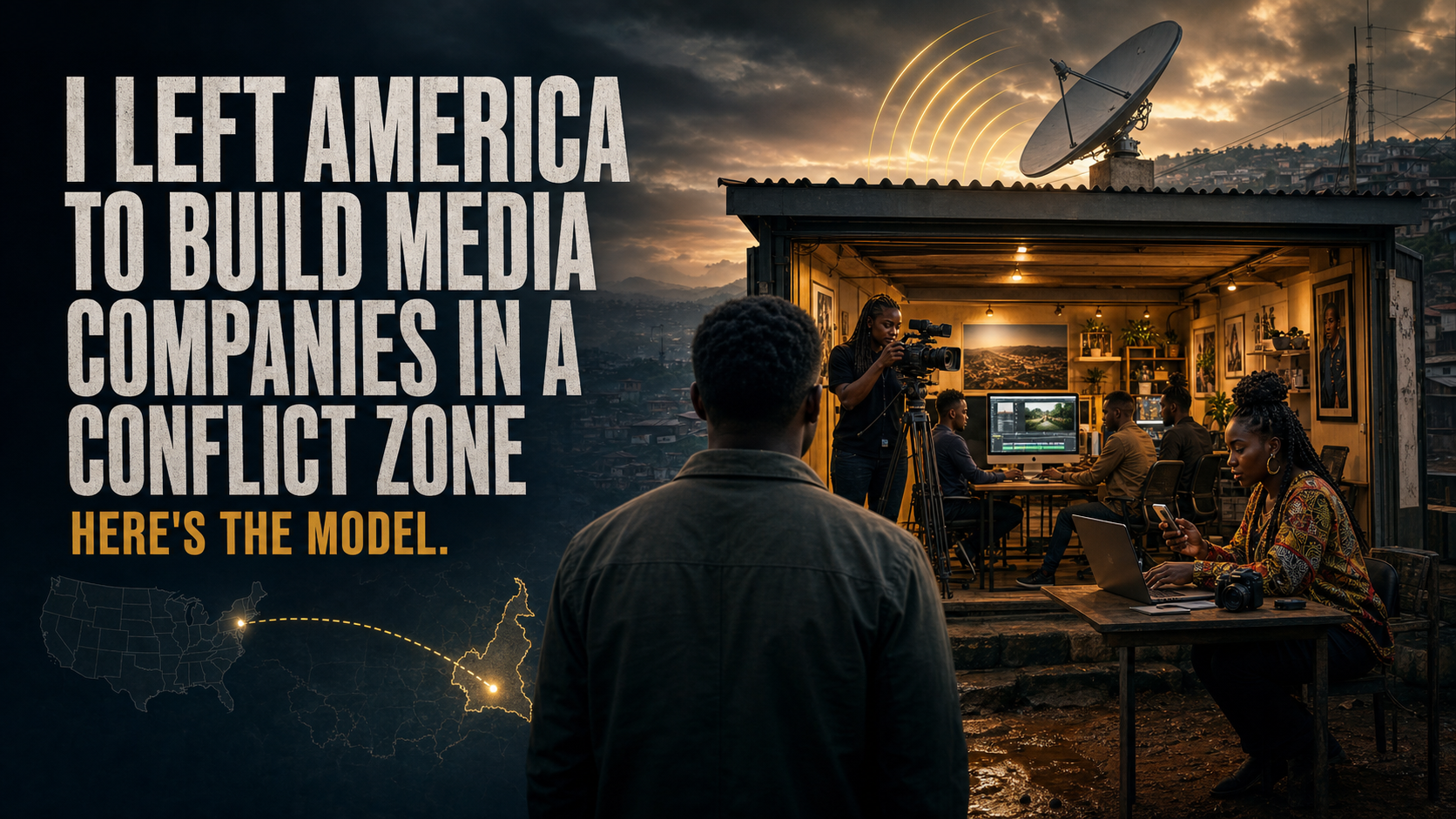
For those new to this work: I have written eleven books. Here in Cameroon, I give one of them — Media Company in a Box — away completely free. I have spent more than a decade teaching one principle: your story, your voice, and your intellectual property have value. Technology now allows ordinary people to build media systems that once required massive corporations.
But I could not teach that principle from theory. My first book, The Devil Inside Me , hit number one in four countries. I rewrote Version Two right here in Cameroon — not because the facts changed, everything in it is true, but because I changed.
I came to Cameroon expecting to teach. I did not expect how often I would end up sharing my own journey with young people and builders rebuilding their lives.
Your darkest chapter does not have to become your identity. It can become your architecture.
My pain became testimony. The testimony became media. The media became books. The books became tools. The tools became systems I could give away.
That is the difference between saying "I want to save you" and saying "I want to build something with you that you will eventually own." One creates a recipient. The other creates an owner.
The Cocoa Problem: How the Value Creator Becomes the "Poor" One
Look at how the world assigns value.
A local farmer grows cocoa. The cocoa is exported raw. Someone else processes it. Someone else manufactures chocolate. Someone else packages, brands, and retails it. At every single stage downstream, the value multiplies.
Then we look back at the farmer who birthed the raw material — and we label that person poor.
The creator of the value gets labeled poor, while everyone downstream gets wealthy off what they produced.
Read that again, because it is the whole thesis. The farmer is not poor. The architecture around the farmer is broken.
I have walked through the arithmetic of this in detail before — how farmgate, processor, and export prices diverge, and what that gap actually represents. If you want the numbers behind the principle, start with Cocoa, Coffee & African Trade Power Explained and The Farmer Is the First Investor: Africa's Wealth Truth.
The Bucket With a Hole In It
Imagine a bucket with a massive hole in the bottom.
You can pour in all the aid, all the grants, all the donations, and all the conference promises you want. If nobody fixes the hole, the bucket never stays full. Not because the pouring was insufficient. Because the pouring was never the variable.
Stop celebrating how much water was poured in. Ask where the water goes.
Aid asks:"Look how much we gave."
Architecture asks:"What remained after we left?"
Those two sentences are the entire difference between a sector that reports activity and a sector that produces outcomes.
Project vs. Architecture: The Tactical Difference
Let's get concrete, because this distinction collapses fast when it stays abstract. Here is the same intervention, run two ways.
| Domain | A Project Does This | Architecture Asks This |
|---|---|---|
| Equipment | Hands out a tractor. | Who owns it, who maintains it, and who stocks the replacement parts? |
| Agriculture | Gives away imported seeds. | Can these seeds be saved, and what happens to long-term soil health? |
| Marketplace | Builds a temporary trade fair. | Who owns the digital platform, the customer data, and the algorithms? |
| Media | Films a vulnerable community for a fundraiser. | Who owns the copyright, and how does the community monetize its own story? |
Notice the pattern. The project column is about delivery. The architecture column is about ownership, continuity, and control. A project ends on a reporting date. Architecture compounds.
The seed question in particular is not a small one — a farmer who cannot save seed is renting his own agriculture every season. I unpacked that whole trap in How Africa Grows the World's Food but Farmers Can't Afford Seeds.
Production Alone Is Not Power
This is the trap that catches the hardest-working people on the continent.
You can work yourself to exhaustion and remain economically fragile. You can produce more, plant more, harvest more, wake earlier, and stay poorer. More output into a broken structure does not produce more wealth — it produces more value for whoever owns the structure.
Production becomes power only when it connects directly to processing, branding, logistics, ownership, and media control.
That is the sovereign supply chain: not a longer chain, but a chain where the links closest to the ground hold equity in the links downstream. I built out that full framework in Who Keeps Africa's Profit? The Sovereign Supply Chain, and the retail end of it — the shopkeeper as the final, decisive link — in The Shopkeeper Revolution: Africa, Local Retail & Food Sovereignty.
When Suffering Becomes the Product
Here is the part of this industry nobody wants named out loud.
When the only profitable story about a people is their pain, their suffering becomes content, and trauma becomes a fundraising product.
That is not an accusation of bad intent. It is a description of an incentive. If images of hunger raise money and images of competence do not, the market will produce images of hunger — indefinitely, at scale, on a schedule.
Africa does not need more poverty branding. Africa needs value documentation.
Media Does Not Just Change Perception. Media Changes Economics.
This is the mechanism most development strategy misses entirely. Media is not the marketing layer applied after the real work. Media is infrastructure — the same category as a road or a port — because commerce runs on confidence, and confidence runs on what can be seen and verified.
- When people see helplessness, they send charity. When people see quality, they do commerce.
- When investors see chaos, they price risk. When investors see documented systems and transparency, they see opportunity.
- When a young person sees farming portrayed only as backbreaking poverty, they run. When they see agriculture linked to technology, processing, media, and export ownership, they see a career.
That last one is a generational economics problem disguised as an image problem. A continent cannot build agricultural sovereignty while its most capable young people are being told, by every image they consume, that farming is where ambition goes to die.
I made the full case for media-as-infrastructure in The Highway and the Voice: Media Moves African Trade, and the cost of going undocumented in The Price of Invisibility: Why African Producers Remain Underpaid.
The Seven Non-Negotiable Rules of Architecture
If we are serious about moving from aid to architecture, these are the rules. Not aspirations — tests. Any intervention that fails one of them is a project wearing architecture's clothing.
1. Ownership
The people closest to the ground must own meaningful equity in the system — not merely participate as labor. Employment is not ownership. A stipend is not equity.
2. Transparency
If a local producer cannot understand the contract they are signing, that contract is exploitation, not empowerment. Complexity that only one party can read is not sophistication. It is a weapon.
3. Local Capacity
If the operation collapses when the outside expert flies home, you built dependency, not capacity. The exit is the test. Design it on day one, not in year five.
4. Market Access
Never push people to scale production without building direct buyer pipelines first. Unsold yield is not abundance. Unsold yield is waste — and worse, it is debt with a harvest attached.
5. Documentation
Document the agreements, the processes, the data, and the intellectual property. What is undocumented can be easily stolen or erased. Documentation is not bureaucracy. Documentation is title.
6. Dignity
People are partners, builders, and creators — never props for a photo op. If your consent form and your camera angle disagree, the camera is telling the truth.
7. Circulation
Value generated in a community must circulate through local drivers, local processors, local creators, and local banks before it leaves. Money that touches down and departs in a single transaction did not enter the economy. It passed through it.
Direct Instructions, By Sector
To Humanitarian Organizations and NGOs
Keep responding to crises — that work is real and it saves lives. But buy locally, train locally, and build an exit plan. Your ultimate victory should be making your intervention unnecessary. Measure yourselves by the date you become redundant.
To Churches
Feed the hungry, yes. But help them process, store, package, and distribute that food so they control the supply chain. Compassion that ends at the meal is real compassion. Compassion that ends at ownership is discipleship.
To Investors
Stop confusing weak bargaining power with weak value. A desperate producer accepting an unfair price does not mean the product is worthless — it means the system is coercive. You are not finding a bargain. You are pricing someone's lack of options.
To Governments
Stop measuring progress by how much foreign aid arrives. Measure progress by how much processing and intellectual property remain inside your borders. Aid inflow is a measure of need. Retained value is a measure of sovereignty.
To Media Creators
Stop chasing poverty porn for easy clicks. Document the hidden builders, the local processors, the tech innovators. Make invisible value visible. That is the job.
To the Diaspora
Bring your capital, your networks, and your technology back home — but listen first. Build with local communities, not over them. Returning with resources and foreign assumptions just relocates the same extraction with a familiar accent.
To Every Community Across Cameroon and Afrique
You are not waiting for value to arrive. You are already standing on it.
Document it. Organize it. Process it. Brand it. Own the narrative, own the data, and keep the revenue circulating.
And hear this clearly: needing initial capital does not mean you lack intelligence or dignity. Every enterprise on earth started with capital it did not yet have. That is called a beginning, not a deficiency.
This is the same argument I made in Africa Is Not Emerging. Africa Is Arriving. — a continent does not need permission to be recognized as what it already is.
Build What Remains
Relief saves lives today. Respect protects dignity. Ownership builds power. Architecture creates the future.
Stop asking only, "What can we give?" Start asking, "What can the people own?"
Never allow emergency relief to become the ceiling of what human beings are permitted to become.
Do not just build a temporary bridge that leads nowhere. Build the road. Build the market. Build the processing. Build the media.
Above everything else — build what remains.
I am Joshua T. Berglan, The World's Mayor. God bless Cameroon, God bless Afrique, and God bless the builders laying down the architecture of freedom. We'll see you next episode.
Frequently Asked Questions
What is the difference between aid and architecture?
Aid is a transfer of resources measured by how much was given. Architecture is a system of ownership measured by what remains after the giver leaves. Aid asks, "Look how much we gave." Architecture asks, "What remained after we left?" Aid can save a life today; only architecture builds durable economic power.
Why do African producers stay poor while their products create enormous wealth?
Because value multiplies downstream. A farmer grows cocoa, someone else processes it, someone else manufactures chocolate, someone else brands and retails it. Every stage after the farm multiplies the price. The producer is labeled poor while everyone downstream grows wealthy from what the producer made. The farmer is not poor — the architecture around the farmer is broken.
What is value chain ownership?
Value chain ownership means the people closest to production hold meaningful equity in processing, branding, logistics, data, and media — not just participation as labor. Production alone is not power. Production becomes power only when it connects to processing, branding, logistics, ownership, and media control.
How does media change economics, not just perception?
When people see helplessness, they send charity. When people see quality, they do commerce. When investors see chaos, they see risk. When investors see documented systems and transparency, they see opportunity. Media determines whether a community is priced as a risk or valued as a partner — which makes it economic infrastructure, not decoration.
What are the seven rules for moving from aid to architecture?
Ownership (equity for those closest to the ground), Transparency (a contract a producer cannot understand is exploitation), Local Capacity (if it collapses when the expert flies home, you built dependency), Market Access (build buyer pipelines before scaling production), Documentation (what is undocumented can be stolen or erased), Dignity (people are partners, never props), and Circulation (value must circulate locally before it leaves).
What should NGOs and humanitarian organizations do differently?
Keep responding to crises, but buy locally, train locally, and build an exit plan from day one. The ultimate victory of a humanitarian intervention should be making itself unnecessary. Relief that never plans its own ending stops being a bridge and becomes a permanent economic model.
What is poverty porn, and why is it economically harmful?
Poverty porn is media that markets a community's suffering to raise funds. It is economically harmful because when the only profitable story about a people is their pain, trauma becomes a fundraising product and the community is permanently priced as a charity case rather than a commercial partner. Africa does not need more poverty branding — Africa needs value documentation.
Does this mean emergency aid is wrong?
No. Relief saves lives, and that work is necessary and honorable. The argument is about the ceiling, not the floor. Emergency relief was designed as a temporary bridge; the failure is allowing it to become a permanent economic model with no exit plan attached.
Who is Joshua T. Berglan?
Joshua T. Berglan, known globally as The World's Mayor, is an Omni-Media Architect and Advocacy Actuary — a 4× #1 international bestselling author, award-winning producer with 126+ IMDb credits, United Nations speaker, and SCORE Certified Mentor. He lives and works in Cameroon, where he is the sole architect of The Sovereign Franchise: 500 sovereign media hubs worldwide. The Fon of Bafut conferred on him the royal title Tah-Lah — "Father of the Land."
The Series So Far
Episode Seven builds on the arguments developed across The World's Mayor Experience. Start anywhere — they compound.
- Cocoa, Coffee & African Trade Power Explained — the pricing math behind farmgate, processor, and export value.
- The Farmer Is the First Investor: Africa's Wealth Truth — why farmers are investors, not charity cases.
- How Africa Grows the World's Food but Farmers Can't Afford Seeds — inputs, ownership, and the seed trap.
- The Shopkeeper Revolution: Africa, Local Retail & Food Sovereignty — the final link between producer and family.
- The Highway and the Voice: Media Moves African Trade — media as trade infrastructure.
- Who Keeps Africa's Profit? The Sovereign Supply Chain — the framework for retained value.
- The Price of Invisibility: Why African Producers Remain Underpaid — what it costs to be undocumented.
- Africa Is Not Emerging. Africa Is Arriving. — a proposal for The World's Fair Experience.
- From Aid to Architecture: Building Systems That Let Africa Keep Its Value — you are here.
About Joshua T. Berglan
Joshua T. Berglan — known globally as The World's Mayor — is an Omni-Media Architect, Advocacy Actuary, and the creator of The World's Mayor Experience and the Media Company in a Box framework. He is the sole architect and orchestrator of The Sovereign Franchise: 500 sovereign media hubs worldwide, starting in Cameroon, built from the ground up under his direct orchestration.
Before media, there was service. Joshua spent more than eighteen years serving people with complex disabilities — work that shaped how he sees human potential: not as a diagnosis or a circumstance, but as a story waiting for the right tools. His professional path then moved through medical aesthetics and skincare — product development and global distribution for a publicly traded company — where he learned brand architecture, manufacturing, and international markets from the inside.
Over eleven-plus years in media, Joshua became a 4× #1 international bestselling author, an award-winning film producer and voice-over talent with 126+ IMDb credits, a United Nations speaker, and a SCORE Certified Mentor. But the credentials are not the story — the story is what they were built from: addiction, homelessness, an HIV diagnosis, incarceration, trauma, and neurodivergence, and the transformation that followed. His core teaching came from surviving his own wreckage: "Sell the scar, not the wound." Processed pain becomes proof, wisdom, and intellectual property.
Today, Joshua lives and works on the ground in Cameroon. He has personally taught his workshops across six Cameroon cities — Limbe, Tiko, Souza, Bafut, Bamenda, and Yaoundé — and serves a planned replication node in Nakivale Refugee Settlement, Uganda. The Fon of Bafut conferred on him the royal title Tah-Lah — "Father of the Land." The hubs now rising — beginning with the Royal Echo Village in Nchum, Bafut Kingdom — are his to build.
Joshua is not simply a media personality. He is an architect — of platforms, of frameworks, and of the belief that the people the world writes off are the ones who will build what comes next.
Joshua T. Berglan
"The World's Mayor" | Tah-Lah
, Bafut Kingdom
Omni-Media Architect & Advocacy Actuary
Architect, The Sovereign Franchise
joshua@joshuatberglan.com| joshuatberglan.com