Beyond Africa Podcast · Bamenda, Cameroon
I Left America to Build Media Companies in a Conflict Zone. Here's the Model.
On the creator economy as Africa's real job market, the $32,591 sovereign media hub, and why creators keep 85%.
I sat down with the Beyond Africa Podcast in Bamenda, Cameroon — not in a studio in Los Angeles, not over Zoom from a hotel room in Dallas. In Bamenda. In the middle of a conflict zone that most of the world has decided not to look at.
The host asked me the question everyone asks: What brings an American here?
The honest answer is that I ran out of patience with a system that produces reports instead of results. I spent years in media. I have been platformed and de-platformed, celebrated and censored. I learned — expensively — that if you build your life's work on land you don't own, someone else decides when you stop speaking. And then I came to a place where millions of people have more talent, more story, and more urgency than almost anyone I've met in America, and no infrastructure to convert any of it into income.
That gap is the whole thing. That gap is what I'm building in.
What "Media Company in a Box" Is — and What It Isn't
Let's kill the misconception first, because it comes up every single time.
It is not a charity. It is not an NGO. It is not a donation. Nobody is getting handed anything.
Media Company in a Box is the curriculum engine — the operating manual for turning a person, a mission, or an organization into a sovereign media ecosystem. Story architecture. Personal brand. Phone-first production. Podcasting. Publishing and IP development. Course creation. Creator monetization. Digital sovereignty. It's the path from a phone in someone's hand to a functioning media business.
The hubs are the other half. That architecture is The Sovereign Franchise — my directly orchestrated plan to build 500 creator-owned media hubs worldwide, beginning in Cameroon. Media Company in a Box supplies the curriculum. Certified facilitators supply the human infrastructure. Schools, nonprofits, computer labs, churches, refugee communities, and royal institutions host the work.
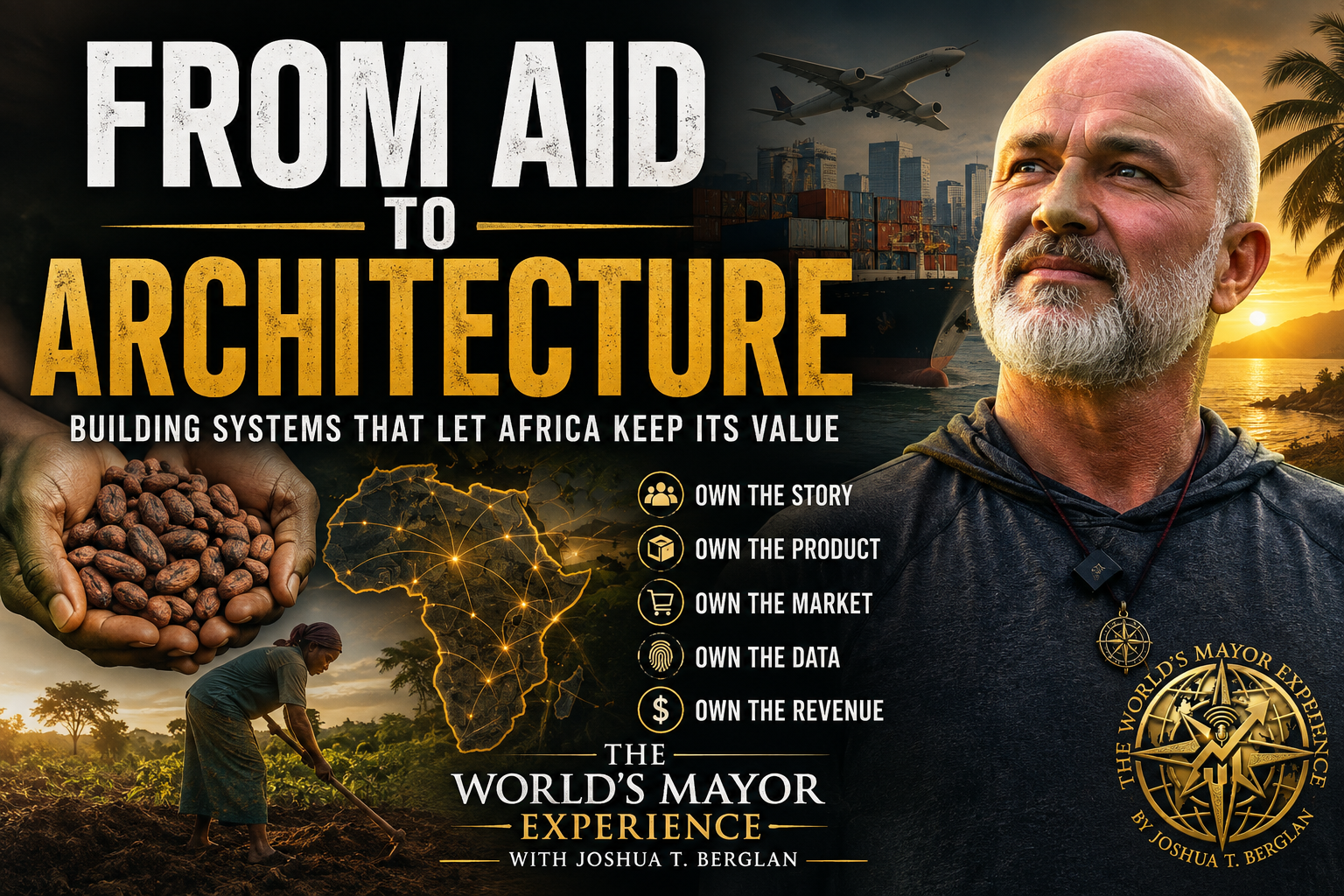
It is not aid. It is architecture.
The premise is simple enough that people underestimate it. Every person carries assets they were never taught to see as assets — their gifts, their skills, their trade, their faith, their culture, and above all their story. Every one of those things is monetizable. The tools are already in almost everyone's pocket. What's missing is not talent and it's not the internet. What's missing is the architecture — someone to show you the path from “I have a story” to “I have income,” and the infrastructure to keep you on it when the power cuts out.
In the workshops I run here, we don't start with theory. We build websites. We build revenue streams. On phones. In a single session, someone who arrived with no digital presence leaves with a platform they own and a path to being paid on it.
Digital Sovereignty: Own Your Platform, Own Your Future
I talk about sovereignty a lot and I want to be precise about what I mean, because the word gets used carelessly.
I have been banned. I have been shadow-suppressed. I have watched audiences I spent years building evaporate because a policy changed on a Tuesday. I'm not bitter about it — I'm informed by it. Every creator who builds exclusively on rented land is one algorithm change away from starting over, and most of them don't know it yet.
Digital sovereignty means the core of your media business — your platform, your list, your archive, your payment rails — lives somewhere no third party can switch off. Social platforms become distribution, not foundation. You use them. You don't depend on them.
For a creator in Ohio, that's a business risk. For a creator in Bamenda covering a conflict the world isn't watching, it's a different order of magnitude entirely. If your ability to speak can be revoked by a moderation policy written by people who have never heard of your region, you were never really speaking freely. You were speaking on loan.
Sovereignty isn't a philosophy here. It's an infrastructure decision you either make or don't.
The Creator Economy Is Africa's Real Job Market
Here's the part I wish more people would sit with.
The conversation about African economic development is still dominated by a model where prosperity means a foreign company builds a factory and hires people. Wait for the job. Compete for the job. Hope the job survives the next political cycle.
Meanwhile, the creator economy is a global market that pays in hard currency, has no hiring committee, requires no permission, doesn't check where you were born, and is accessible from a device most people already own.
A Cameroonian creator can reach an audience in London, Atlanta, Toronto, and Lagos from a phone. They can be paid by that audience. There is no gatekeeper who has to approve them first. The barrier has never been access to the market — the barrier is that almost nobody is teaching people the path, and the infrastructure to walk it reliably doesn't exist locally.
That's not a jobs problem. That's a distribution and training problem, and those are solvable with capital and curriculum. That's a far better thing for a problem to be.
And everything is monetizable. Not just “become an influencer.” Digital products. Services. Sponsorship. Local business media. Documentation and archival work. Diaspora storytelling. Teaching. Faith and ministry media. Cultural export. A single creator running a real ecosystem has five or six revenue lines, not one — and that's what we build toward, because one revenue line is fragile everywhere on earth.
Why Bamenda? Building Where Nobody Else Will
People think I'm being reckless. I want to address this directly.
Bamenda sits in a region shaped by ongoing conflict. Internet is unstable. Power is unreliable. The security situation is real and I don't romanticize it.
And I will still tell you what I told the podcast: I feel safer here than I have felt in a number of American inner cities. That's not a slogan. I've lived in both. The gun violence, the untreated mental health crisis, the ambient volatility of daily life in parts of the United States — I have direct experience of that, and I weigh it honestly against the risk here.
But safety isn't actually why I chose Bamenda. I chose it because the places with the least infrastructure have the most compressed upside. Building where it's easy produces marginal gains. Building where nothing exists produces transformation. If this model works in Bamenda — unstable power, unstable connectivity, active conflict — it works anywhere on the continent. This is the hardest version of the test, on purpose.
And the workarounds matter more than people expect. We teach creators to shrink video files in CapCut so uploads survive a weak connection. We teach short-form series structure instead of long uploads that die at 80%. We teach batch-and-upload rhythms built around when power is actually on. That kind of tactical adaptation isn't a footnote — for a creator here, it's the difference between publishing and not publishing.
The $32,591 Media Hub: The Investment Model, Explained
This is the section the investors and diaspora readers came for. Let me be concrete.
A full turnkey hub costs $32,591. On the podcast I rounded it to $32K; the precise buildout, broken into three pillars, is published on The Sovereign Franchise page:
| Pillar | Cost | What it covers |
|---|---|---|
| Physical Sanctuary | $13,791 | A secure, permanent physical anchor — built with local materials and local labor wherever possible |
| Digital Engine | $14,525 | Computers, audio, production tools, Starlink or equivalent internet, solar generator and batteries |
| Human Capital | $4,275 | Pilot cohort support — school fees, nutrition, transportation, training, participation support |
| Total | $32,591 | Full Triple-Pillar deployment |
Two line items in there deserve emphasis.
Satellite internet. The single largest recurring cost for a creator here is data. Not equipment — data. It is the tax that quietly makes consistent publishing impossible. The hub absorbs the data problem entirely. A creator's bandwidth cost goes to zero, and their ability to publish goes from “when I can afford it” to “always.”
Off-grid solar. Power in Bamenda is not a given. Solar and battery storage mean the hub keeps running when the grid doesn't. Consistency is the whole product.
But $32,591 is not the only entry point — and this is the part I've refined since the episode aired. There are now three deployment paths, because waiting to raise a full buildout is the slowest possible way to help anyone:
Embedded Curriculum Partner
For organizations that already have a room, a lab, and a cohort. A classroom becomes a media lab. Lowest infrastructure burden, fastest proof.
from $2,500/yrLicensed Media Hub
A local lead operates an ongoing hub using the framework, brand standards, curriculum, and creator monetization model.
from $9,500/yrSovereign Media Center
Ground-up permanent infrastructure. For funders, foundations, governments, royal institutions, and major donors.
$32,591 turnkeyOn returns: the model is designed to sustain itself through revenue share rather than through the next grant cycle. It is a business, and it's underwritten like one.
On what makes this different from every other Africa investment pitch: the asset is not a building and it's not equipment. The asset is a trained, monetizing, retained creator roster. Equipment depreciates. A cohort of creators earning real income and bringing in the next cohort compounds.
The Split — Why Creators Keep the Majority
The economics have to be right or nothing else matters.
On their own work — their book, their podcast, their course, their consulting — creators keep 85%. Twelve percent flows to the local hub pool and three percent to the licensing network. That's the Personal IP stream, and it's the one that matters most to an individual creator.
The hub's cut isn't profit extraction. It covers the electricity, the satellite connection, the equipment maintenance, the facilitator support, and the promotional push behind the creators — the hub functions much like a promotional agency working on the creator's behalf.
There's a second category worth naming: Collective Hub IP — a hub's flagship podcast, regional compilations, anthologies, shared channels. Those earnings are pooled differently, because the work is shared: hub owner 45%, teacher pool 20%, student pool 25%, network 10%. The full four-stream revenue model is published openly, including tuition splits and syndication. I don't think economics like this should live behind a call.
I want to explain why the split runs this direction, because the standard model runs the other way.
If the house takes the majority, creators leave the moment they succeed — and the ones who'd succeed fastest never join. If the creator takes the majority, the incentive alignment is total: the hub only makes money when creators make money. That means the hub is structurally forced to make its creators win. There's no revenue path that doesn't run through creator income.
For an investor, this should read as a feature , not a concession. A model where the operator can profit while the creators stagnate is a model that eventually collapses. This one can't.
Navigating Censorship Through Creative Storytelling
The host asked a sharp question: how do you talk about freedom of speech in a conflict zone without endangering people?
The answer is craft.
Direct accusation is the fastest way to get a creator silenced — or worse. But creative storytelling can illuminate a truth without naming a target. Narrative, allegory, character, documentation of lived daily reality: these carry the weight of what's happening without handing anyone a reason to come after the person holding the camera.
This isn't a compromise with the truth. Some of the most durable political art in history worked exactly this way, because it had to. What I teach here is that you can be honest and strategic at the same time — and that a creator who stays publishing for ten years moves more truth into the world than one who makes a single unanswerable statement and never posts again.
Sustainability is a form of courage.
The NGO Critique — And Why This Isn't That
I'm blunt about this, so let me be blunt here.
Too much money that flows into communities like this one never lands in them. It goes to executive salaries. To administrative overhead. To conferences and receptions and the production of reports about the problem. Community members are cast permanently as recipients — the subject of the work, never the operator of it.
I'm not claiming every NGO is corrupt. Many do serious work. But the model itself has a structural flaw: it creates dependency rather than capability, and it has no built-in mechanism to make itself unnecessary. Success would mean shutting down. Almost nothing is designed to do that.
Media hubs invert it. Teach digital literacy and monetization, and the person doesn't need the next grant cycle. They have a skill, a platform they own, and income they generate themselves. The hub isn't giving them fish or teaching them to fish. It's handing them the boat and taking a small cut of the catch — and it only eats if they do.
I've written and spoken about this at length in The $200 Billion Failure of Charity, which is the companion piece to this one. The short version: communities do not need rescue narratives. They need ownership architecture.
Sell the scar, not the wound.
Africa's Disney: How the Hub Network Scales
One hub is a project. A network is an industry. The target is 500.
I've called it Africa's Disney and I mean the structural comparison, not the aesthetic one. Disney owns ABC, ESPN, and National Geographic. ABC doesn't look like ESPN. ESPN doesn't sound like National Geographic. But the parent network supplies infrastructure, distribution, coordination, and market leverage.
The Sovereign Franchise works the same way:
| Layer | TV analogy | Sovereign Franchise equivalent | What it owns |
|---|---|---|---|
| Parent network | Disney, BBC, Warner Bros. | The Sovereign Franchise | Framework, curriculum, standards, distribution architecture, governance |
| Channel | ABC, ESPN, Nat Geo | A school, nonprofit, hub, city, or refugee settlement | Local identity, local programming, local leadership, cultural voice |
| Show | An individual series | Each creator, student, teacher, artist, storyteller | Their own IP, brand, audience, products, and revenue |
Standardized infrastructure. Sovereign expression. What's standardized is curriculum, training, revenue logic, reporting, and creator-first governance. What is never standardized is culture. Bafut should not sound like Nakivale. A nursing school should not sound like a refugee settlement. The network provides the physics. Each community writes its own story.
The field work already exists. I've personally taught phone-first sovereignty workshops in Limbe, Tiko, Souza, Bafut, Bamenda, and Yaoundé — plus Nakivale Refugee Settlement in Uganda. Field deployments with King Black Welfare Association in Limbe and Grace Digital Solutions in Souza proved the framework works with trust, people, and tools already in hand.
That pipeline does not currently exist for African stories told by Africans. Somebody is going to build it. It should be built with creators owning the majority.
What To Do Next
If you're a creator
In Cameroon, elsewhere in Africa, or in the diaspora — you don't need to wait for a hub to open near you. Start with the Media Company in a Box Builder Course from the device you're holding. Build the platform you own. If you want to lead a hub, the Certified Facilitator Program is the gate — and building your own Media Company in a Box first is the prerequisite. Certification creates eligibility, not a guarantee of placement. Commitment is the entry requirement.
If you're an investor, funder, or diaspora partner
You don't have to start at $32,591. An embedded curriculum partnership begins at $2,500/yr inside a facility that already exists. A licensed hub begins at $9,500/yr. The full Triple-Pillar buildout is $32,591. The return isn't a certificate for your wall — it's permanent media infrastructure with a roster of creators earning income and a stake in a network built to compound. The full architecture, economics, and risk assessment are published openly.
If you have a room and people who need a future
A school, a nonprofit, a computer lab, a church, an NGO office, a vocational center — you may already have the foundation for a deployment. You provide the room, the people, or the institutional commitment. The framework provides the curriculum, the training architecture, the roadmap, and the creator-first economics.
If you're none of the above — watch the episode and send it to one person who needs to see it. Attention is the scarcest resource in this work. The stories here aren't being told because nobody is funding the telling.
We are not here to save the world. We are here to hand the world a microphone — and give communities the curriculum, tools, and ownership structure to save themselves.
Episode Chapters
| 0:00 | Introduction — Cameroon's Untold Story |
| 0:54 | Meet Joshua Berglan: What Brings an American to Cameroon? |
| 3:02 | Media Company in a Box: What It Is (and What It Isn't) |
| 8:28 | Digital Sovereignty — Own Your Platform, Own Your Future |
| 9:42 | The Creator Economy as Africa's Real Job Market |
| 13:02 | Revenue Streams: Everything Is Monetizable |
| 14:19 | Why Bamenda? Building in a Conflict Zone |
| 22:44 | The Media Hub Investment Model Explained |
| 37:00 | Africa's Disney: How the Hub Network Scales |
| 40:38 | The Creator Revenue Split |
| 46:23 | Navigating Censorship Through Creative Storytelling |
| 53:06 | NGO Model vs. Media Hubs: The Real Critique |
| 58:51 | How to Get Started + My Final Message |
Frequently Asked Questions
What is Media Company in a Box?
Media Company in a Box is the curriculum engine for turning a person, mission, or organization into a sovereign media ecosystem — story architecture, personal brand, phone-first production, podcasting, publishing and IP development, course creation, creator monetization, and digital sovereignty. It lets someone build a media business they actually own, starting from a mobile phone.
What is The Sovereign Franchise?
The Sovereign Franchise is Joshua T. Berglan's directly orchestrated architecture for building 500 creator-owned media hubs worldwide, beginning in Cameroon. Media Company in a Box supplies the curriculum; certified facilitators supply the human infrastructure; schools, nonprofits, labs, churches, and community organizations host the work. It is not aid. It is architecture.
How much does a media hub cost?
A full Triple-Pillar buildout is $32,591 — $13,791 Physical Sanctuary, $14,525 Digital Engine (computers, audio, production tools, Starlink or equivalent, solar generator and batteries), and $4,275 Human Capital for pilot cohort support. Lower entry points exist: an embedded curriculum partnership starts from $2,500/yr and a licensed media hub from $9,500/yr.
Do I need to build a new facility?
No. If your organization already has a classroom, computer lab, library, community hall, church facility, or NGO office, the curriculum can begin there. The model is designed to use what already exists whenever possible.
How much do creators keep?
On their own Personal IP — their book, podcast, course, or consulting — creators keep 85%, with 12% to the local hub pool and 3% to the licensing network. Collective Hub IP such as flagship podcasts, regional compilations, and shared channels is pooled differently: hub owner 45%, teacher pool 20%, student pool 25%, network 10%.
Is this an NGO or a charity?
No. It is a business model built on capability rather than dependency. The critique of the traditional NGO model is that too much funding is consumed by salaries and overhead while communities remain permanent recipients. Media hubs are designed so that success means creators need the hub less over time, not more.
Who is eligible to lead a hub?
Only certified facilitators. Certification is the gate; commitment is the entry requirement; certification creates eligibility rather than a promise of placement. The prerequisite is building your own Media Company in a Box first via the Builder course.
Do I need to be in Cameroon to use Media Company in a Box?
No. The hubs begin in Cameroon, but the underlying system works for creators, founders, churches, ministries, nonprofits, and schools anywhere.
How do I get involved?
Creators start with the Builder course. Host organizations and funders should review the three deployment paths on The Sovereign Franchise page and book a consultation.
Watch the full conversation on the Beyond Africa Podcast.