I. Introduction: The Eleven-Year Runway
There is a theological proposition — often paraphrased but seldom credited — that when God calls the unqualified, the journey itself becomes the qualification. This article does not seek to prove that proposition doctrinally. It seeks to demonstrate it empirically. For eleven years, the author operated a media platform called The World's Mayor Experience from the United States, training and mentoring content creators across Nigeria, Uganda, and Ghana through virtual channels. During that period, not one deployment reached full alignment. The frameworks taught — media production, intellectual property strategy, audience monetization — were understood in the abstract but could not take root in soil the author had never touched.
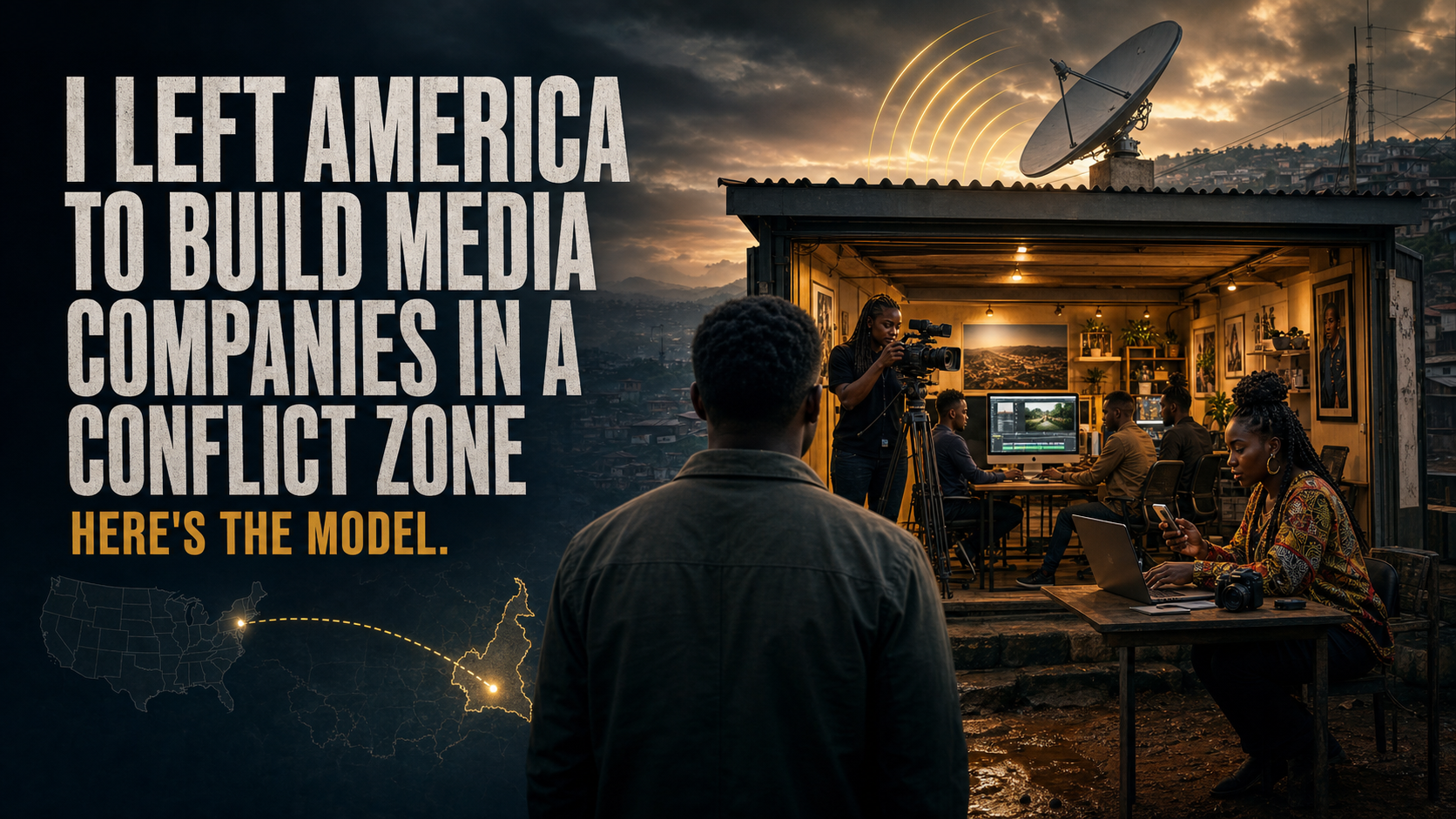
On March 17, 2026, that changed. The author arrived in Bamenda, the capital of Cameroon's Northwest Region, carrying an ironing board that would become a broadcast desk and a conviction that this crisis zone — where the international community had failed to meet 83% of humanitarian funding targets — held the exact conditions necessary for a radically different intervention model. That model is called The Sovereign Protocol.
II. Theoretical Framework: Why the Charity Model Is Dead
The conventional humanitarian architecture operates on a dependency loop: crisis emerges, media amplifies, donors respond, funding arrives, media attention shifts, funding disappears, crisis deepens. This cycle has been documented extensively across the global south, but nowhere is it more visible than in Cameroon's Anglophone Crisis, which the Norwegian Refugee Council has consistently ranked among the world's most neglected displacement emergencies. Over 845,000 people have been displaced. Over 6,500 lives have been lost. And the first American to visit the region in a decade arrived not with a relief shipment but with a media production curriculum.
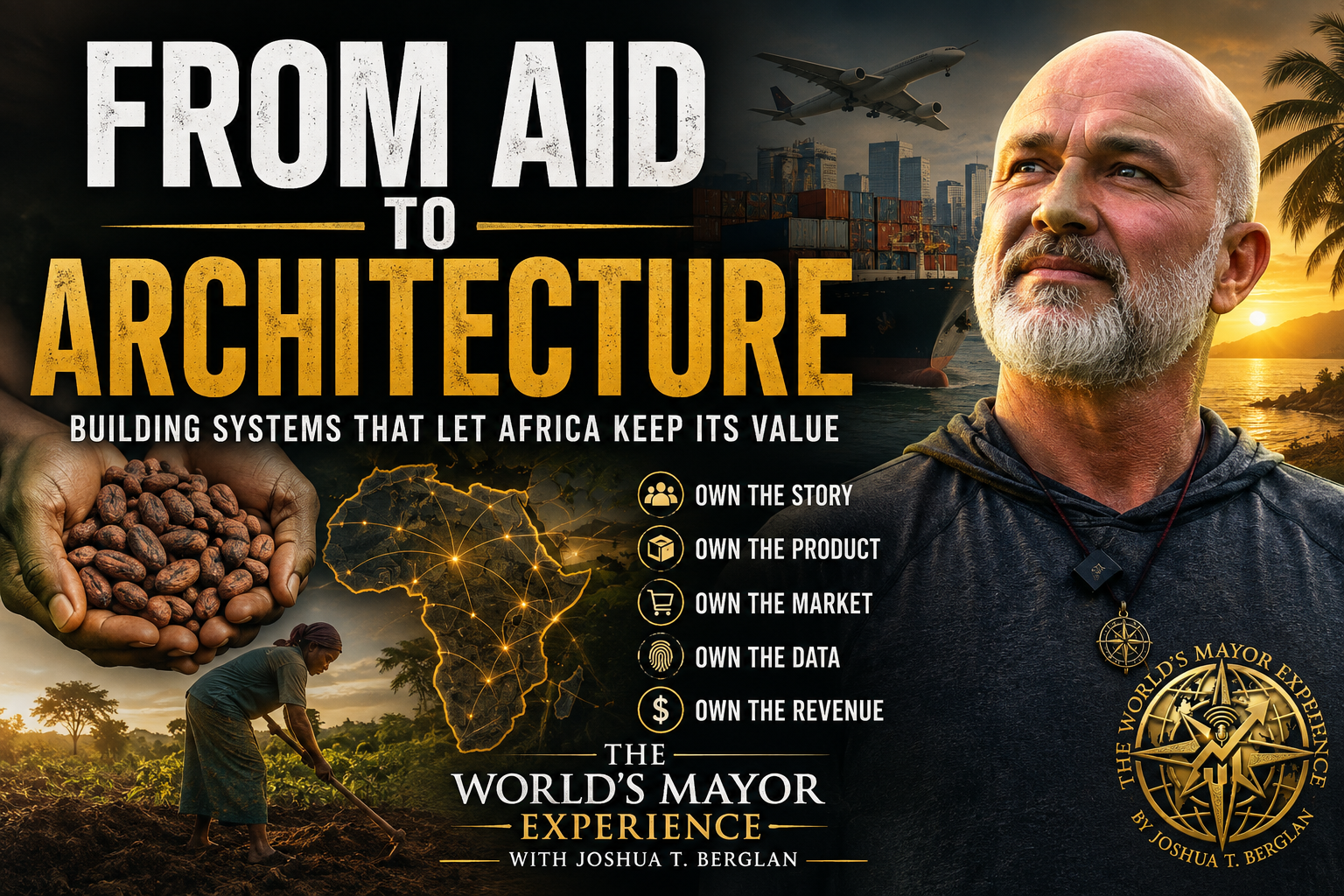
The thesis underlying The Sovereign Protocol is not that communities lack resources. It is that they lack ownership of the one resource that generates all others: narrative. The community that controls its own story controls its own economy. The community that outsources its story to foreign journalists, NGO annual reports, and social media algorithms will perpetually occupy the role of subject rather than author. The Sovereign Protocol inverts this relationship by deploying media literacy infrastructure — cameras, editing skills, distribution strategy, intellectual property protection, and monetization architecture — directly into the hands of indigenous communities. The framework is detailed extensively across the operational pages of The World's Mayor Experience, including Sovereign Media, which extends the same model to Nakivale Refugee Settlement in Uganda, and The Sovereign Franchise, which provides the global replication blueprint.
“When the cameras leave, the money leaves. We are building something that does not need the cameras to survive — because the community will own every lens, every microphone, and every story.”
— The Sovereign Protocol Thesis
III. Field Observations: The First Seventy-Two Hours
A. The Paradox of Immediate Alignment
The deployment plan anticipated a six-month relationship-building phase before substantive work could begin. This assumption was obliterated within three days. On day one, institutional meetings with community leaders produced immediate strategic alignment. Day two expanded into government introductions. By day three, the author had been granted an audience with the Fon (king) of Bafut — His Royal Majesty, the father of Princess Abumbi Prudence, whose organization Youths and the Future has been operating on the front lines of this crisis since its earliest days.
The speed of alignment requires explanation. It was not the result of celebrity, capital, or institutional backing — none of which the author possesses. It was the result of something far more difficult to manufacture: vision convergence. The author's eleven-year framework for media sovereignty happened to match, almost precisely, the existing vision that Princess Prudence and community leaders in Bafut had been cultivating independently. What was considered a fringe theory in the United States turned out to be common sense in Cameroon. The comprehensive story of this partnership is documented in The Royal Architect of Hope, an in-depth profile of Princess Prudence's work across the Bafut Kingdom.
B. The Royal Naming and Its Significance
On the evening of the audience with the Fon, the author was bestowed the royal name Tala — meaning “Father of the Land” — along with a ceremonial staff blessed by the king and the princess. Within the Bafut cultural framework, this naming is not honorary. It is contractual. It binds the recipient to the land, to its people, and to its future in a way that transcends the transactional logic of Western partnership agreements. It is, in the most literal sense, a covenant of belonging.
This matters for the scholarly record because it demonstrates something that most development literature ignores: communities in crisis are not passive recipients. They are active evaluators. The speed with which the Bafut community moved from introduction to integration suggests that indigenous institutions have highly refined mechanisms for assessing alignment — mechanisms that operate faster and with greater accuracy than the due diligence frameworks of international donor organizations.
C. The Healing Land: Physiological Evidence
For over two and a half years prior to this deployment, the author experienced chronic frequency-induced tremors — involuntary head movements severe enough to be visible on camera during interviews and broadcasts. These tremors, attributed to electromagnetic hypersensitivity exacerbated by 5G and emerging 6G infrastructure in the United States, had progressively worsened to the point of social isolation.
Within the first week in Cameroon — a region operating on 4G infrastructure with intermittent electricity — these tremors reduced by approximately 98%. Simultaneously, chronic indigestion that had prevented the consumption of spiced foods resolved entirely. The author, who had been dependent on caffeine as a nootropic substitute, discontinued use before departure and experienced no withdrawal or cognitive decline upon arrival. While this report does not claim clinical causation, the correlation between reduced electromagnetic exposure, the nutritional profile of indigenous Cameroonian food, and dramatic physiological improvement merits formal investigation by environmental health researchers.
IV. Strategic Analysis: What Cameroon Has That the World Needs
The dominant narrative about African nations in Western media follows a predictable arc: deficit, dependency, and the implicit assumption that value flows from the developed world to the developing one. This article explicitly rejects that framework. Cameroon does not need to be saved. Cameroon needs to be heard.
During the first week of deployment, the author documented extraordinary artistic talent — visual artists, musicians, textile artisans producing handcrafted goods of export quality — alongside culinary traditions so distinctive that the absence of Cameroonian restaurants in global cities represents a market failure, not a capability gap. The indigenous food systems function as genuine pharmacological interventions. The traditional knowledge structures — including the governance frameworks of the Bafut Kingdom itself — offer models of community organization that pre-date and in many cases outperform Western institutional design.
The strategic thesis of The Sovereign Franchise is built on this recognition: what underserved communities need is not charity but infrastructure for self-expression and economic self-determination. A single stable internet connection in Bafut would unlock the ability for local artisans to access global e-commerce markets, for storytellers to distribute their own content to international audiences, and for indigenous knowledge holders to protect and monetize their intellectual property rather than watching it be extracted by external entities.
“Once people have stable internet, the rest is there. The rest is there because they have the wisdom and the knowledge.”
— Joshua T. Berglan, First Dispatch from Bafut, March 23, 2026
V. The Invitation: From One Community to Five Hundred
The Sovereign Protocol was never designed to serve one community. It was designed to prove that one community could work — and then to replicate. The operational blueprint for that replication is The Sovereign Franchise, a framework that has already attracted international collaborators in its first week of ground deployment. The five-hundred-community target is audacious. But the first one is underway, and the first one is always the hardest.
This article serves as both a scholarly record and an open call. The mission requires educators who understand media production. It requires storytellers who understand intellectual property. It requires technologists who can deploy stable internet infrastructure in environments where electricity is intermittent. It requires impact investors who understand that the highest-return investment in the global south is not a product but a platform — a platform that enables communities to create their own products, tell their own stories, and build their own economies.
Those who have felt outcast, who carry a vision that no existing institution could accommodate, who have been told their dream was too large — this article is addressed specifically to them. As the author's experience in Bafut empirically demonstrates: sometimes the place where your vision finally makes sense is the place you have never been.
Join the Movement
The Sovereign Protocol is deploying now. The Sovereign Franchise is scaling globally. Whether you are an educator, storyteller, technologist, or impact investor — there is a role for you in this mission.
VI. Conclusion: The Soil Was Always Ready
Development theory has spent decades asking the wrong question. The question was never “How do we bring progress to underserved communities?” The question was always “How do we remove the barriers preventing underserved communities from expressing the progress they already carry?” In Bafut, the wisdom is present. The talent is present. The cultural infrastructure is present. The governance systems are present. The love — the immeasurable, unfalsifiable, but empirically obvious love of community — is present.
What was missing was a bridge. Not a bridge made of foreign capital or institutional condescension, but a bridge made of shared vision, media literacy, and the radical proposition that the people closest to a problem are the most qualified to solve it — if given the tools to tell the world what they know.
The Sovereign Protocol is that bridge. And as of today, it is open.
Africa is rising. Not because the West finally noticed, but because the communities within it finally gained access to the infrastructure of self-expression. This is the first dispatch. There will be many more.