I have written a lot of articles lately—frameworks, analyses, deployment reports. But I haven’t written like this in a while. Just me, sitting at a table, talking to you from the ground. No citations. No architecture. Just what I’m seeing, feeling, and learning. And this moment absolutely demands it.
I am writing this from Bamenda, Cameroon. I arrived a few days ago after a journey that involved airplanes, buses, cars, and the backs of motorcycles—the kind of travel that makes you grateful for every flat surface that doesn’t have an engine under it. I am sitting at a table that, for the first time in three days, does not have a plate of the most extraordinary food I’ve ever eaten on it. That alone should tell you something about this place.
I have been trying to share posts on social media since I landed, and I need to be transparent about something: it is brutally difficult. My data runs out constantly. When I have data, it decides not to work. What takes me ten minutes in Oklahoma City can take twelve hours here—if it works at all.
On a typical day back home, I can execute twenty massive media projects without breaking a sweat. In Cameroon, I am grateful if I can get a single post published across all platforms in half a day. The infrastructure gap is not a talking point here. It is a lived, grinding, daily reality that shapes every aspect of what people can and cannot do.
And that reality is the first thing that hit me—not as frustration, but as conviction.
The Irony That Keeps Me Up at Night
There is a strange and almost cruel irony in what I am experiencing right now. The very thing I teach people—the Media Company in a Box framework, the methodology for building sovereign revenue streams through media—requires stable internet to fully deploy. With reliable connectivity, a person can build an entire media enterprise: content production, distribution, monetization, audience building. Endless revenue streams. Real economic sovereignty. That is not a theory. I have built it. I have lived it. I wrote an entire book mapping out exactly how to do it.
But here is where the irony twists the knife: in America, where people have unlimited data, high-speed internet, and every tool at their fingertips, the response to this framework has been… lukewarm. I have watched people with PhDs—brilliant, credentialed professionals—struggle to find employment in a shrinking job market while the exact blueprint for creating their own financial independence sat right in front of them. Few paid attention. Fewer took action.
In Africa—especially here in Cameroon—they have accepted this philosophy with open arms. And the majority of the people embracing it do not have access to laptops, high-speed internet, or the data packages most Americans take for granted.
Read that again.The people with the least infrastructure are the ones with the most willingness to step out in faith and build something new. I wrote about this dynamic extensively in The Sovereign Blueprint: How The World’s Mayor Experience Is Replacing the Charity Model —the structural reasons why the old donor-dependent model has failed, and why sovereignty-based frameworks are the future. What I did not fully articulate in that piece is how humbling it is to watch that future take root in a place where the odds are stacked against it.
Some people might look at this and say the Cameroonians who are embracing Media Company in a Box are desperate. I understand why someone would say that. But that is not what I see. What I see is a passion to be heard. A deep, bone-level knowing that they have something extraordinary to offer the world—and that no one is coming to tell their stories for them.
I feel spoiled. I will not pretend otherwise.What Three Days in Bamenda Taught Me
In my three days here, I have already learned more than I expected. And I came expecting to learn a lot.
There is a wisdom in this land that the rest of the world desperately needs to hear. I am not speaking in platitudes. I mean specific, actionable, lived wisdom —about community, about resilience, about how to do extraordinary things with almost nothing. The Bafut Kingdom, where much of this deployment is centered, has a history stretching back over 600 years. The legend of the Seven Kata —seven Manjong warriors who lifted a European vehicle onto their heads and carried it across impassable terrain—is not just a story. It is a blueprint for what this culture does: they carry what the world says is too heavy, and they carry it together.
There are talented artists here who must be read, seen, heard, and appreciated. Writers, musicians, visual artists, storytellers—all of them creating from a well of experience that is deeper than anything I have encountered anywhere else in the world. Their work deserves global platforms. It deserves audiences. It deserves to be monetized in ways that benefit the creators themselves, not some distant corporation extracting value from rented digital land.
And the cuisine—let me say this plainly—is the best I have ever experienced. Anywhere. Period. It is impossible to get bored eating here. Every meal is a revelation. Every dish tells a story about the land, the culture, the generations of knowledge that went into preparing it. If Cameroon ever develops a global culinary tourism industry, the rest of the world is in serious trouble.
But more than any of that, I love the heart of the people here. I love their ability to do more with less. I love their gratitude, their warmth, their stubborn refusal to let the world’s neglect define their capacity for joy.
The World’s Most Forgotten Crisis—and Its Unlikely Healing Power
I need to name the elephant in the room. Cameroon is living through what the Norwegian Refugee Council officially declared in June 2025 as the single most neglected displacement crisis on Earth—ranking above Ethiopia, Burkina Faso, and the Democratic Republic of Congo. The ranking is based on three criteria: lack of humanitarian funding, lack of media attention, and a lack of effective political engagement to end the conflict.
The Anglophone Crisis, which erupted from peaceful protests in 2016, has displaced hundreds of thousands. Over 76,000 Cameroonians have fled to Nigeria. Roughly 250,000 children have been affected by violent disruptions to education. The 2024 humanitarian response plan was only 45 percent funded, leaving a gap of over $200 million. In 2024 alone, Cameroon’s displacement crisis received fifteen times fewer media mentions than Ukraine’s.
I wrote about this crisis in depth—the Nakivale analysis, the Sovereign Protocol deployment framework, and the broader case for why sovereignty, not charity, is the answer —because the numbers demand a response that goes beyond traditional aid.
And yet, here’s what I did not expect: the love and gratitude of the people here make this place worthy of healing retreats.
I know how that sounds. I know the contradiction. A region enduring the world’s most neglected humanitarian crisis should not, by any logical measure, feel like a place of restoration. But it does. And I have the physical evidence to prove it.
My Tremors Are Gone
I need to tell you something that still shocks me as I write it.
Since January of 2024, I have lived with violent neurological tremors. I documented this extensively in The Frequency of Surrender —the way electromagnetic frequencies from Wi-Fi, cell towers, Bluetooth, and even human biofields trigger my nervous system into full revolt. My head shakes. My arms thrash. The hum of a refrigerator can set it off. A phone call can send my body into a cascade of violent, involuntary movement. For over two and a half years, this condition confined me to a single room in Oklahoma City.
I bought EMF-blocking clothing, hats, and devices—the whole industry that has sprung up around electromagnetic sensitivity. None of it helped. I tried healing stones. They are beautiful, and I appreciate them, but they did not stop the tremors either.
Since arriving in Bamenda, my tremors have decreased by approximately 98 percent. The violent energy that plagued me for two and a half years is gone.
I am still processing this. I do not have a clinical explanation. What I have is a lived experience that aligns with something I wrote about before I ever set foot on this soil: the prayer that the ancestral rhythms of this land, largely untouched by the electromagnetic saturation destroying my body in America, might allow my hyper-aroused nervous system to recalibrate.
That prayer is being answered.
The food here is medicine. Prepared from the earth, without the processed additives and preservatives that saturate Western diets. The gratitude and love of the people here is healing—not as a metaphor, but as a biological reality. Human connection, when it is pure and unburdened by the electromagnetic noise of modern infrastructure, appears to do something profoundly restorative to a nervous system that has been at war with the modern world.
And the absence of the frequencies that were destroying me—the reduced cell tower density, the limited Wi-Fi saturation, the lower overall electromagnetic load—may make this region a destination for others suffering from conditions like mine. I say that carefully, because I am not a doctor and I am not prescribing anything. But I know what my body is telling me. And my body, for the first time in over two years, is at peace.
Why I Am Here—and What I Am Not Here to Do
Let me be clear about my purpose on the ground.
I am not in Bamenda to cover the Anglophone Crisis as a journalist. I am not here to speak on anything political. I will not be reporting on the conflict in the way most foreign correspondents or NGO observers would. That is not my lane, and it is not my calling.
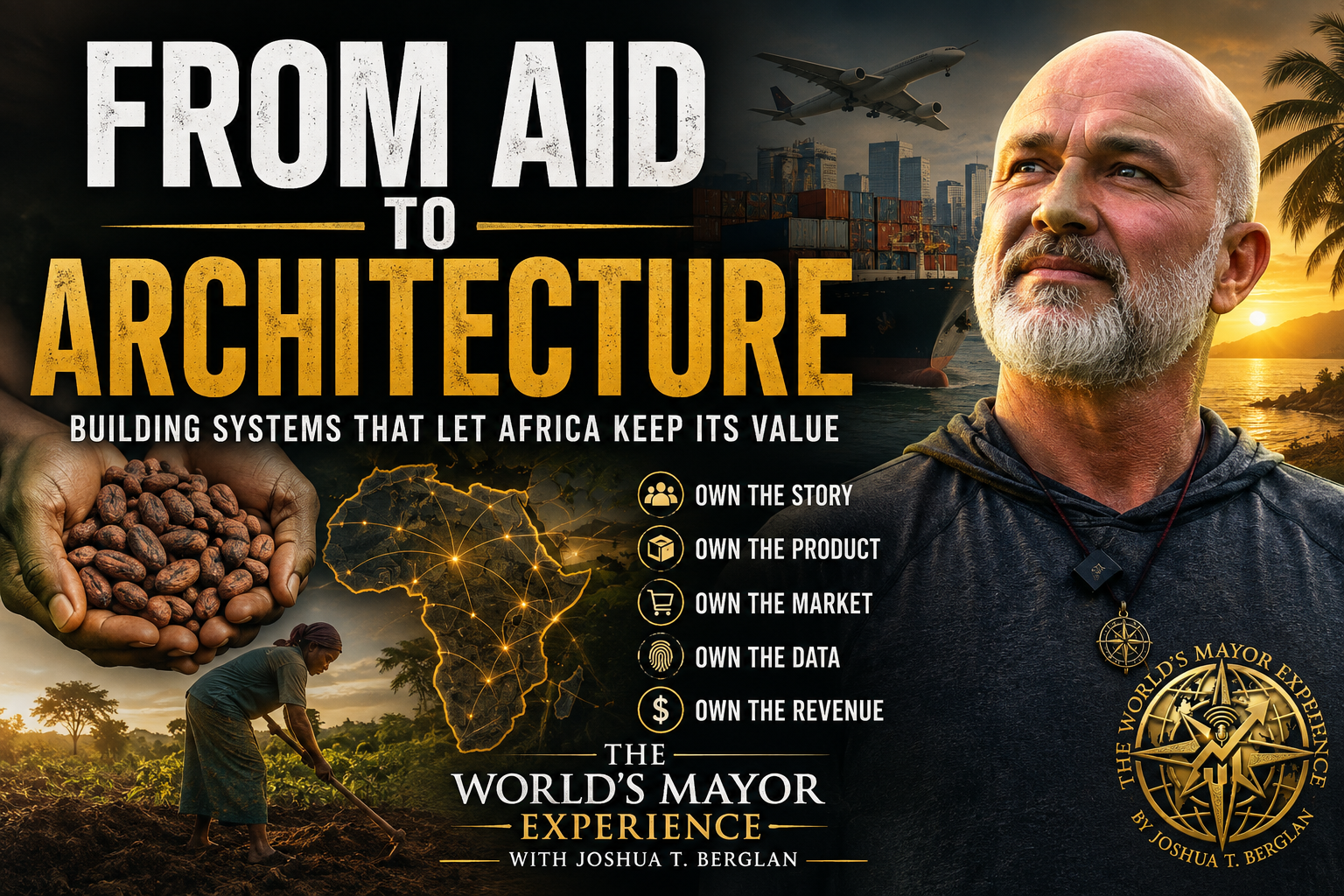
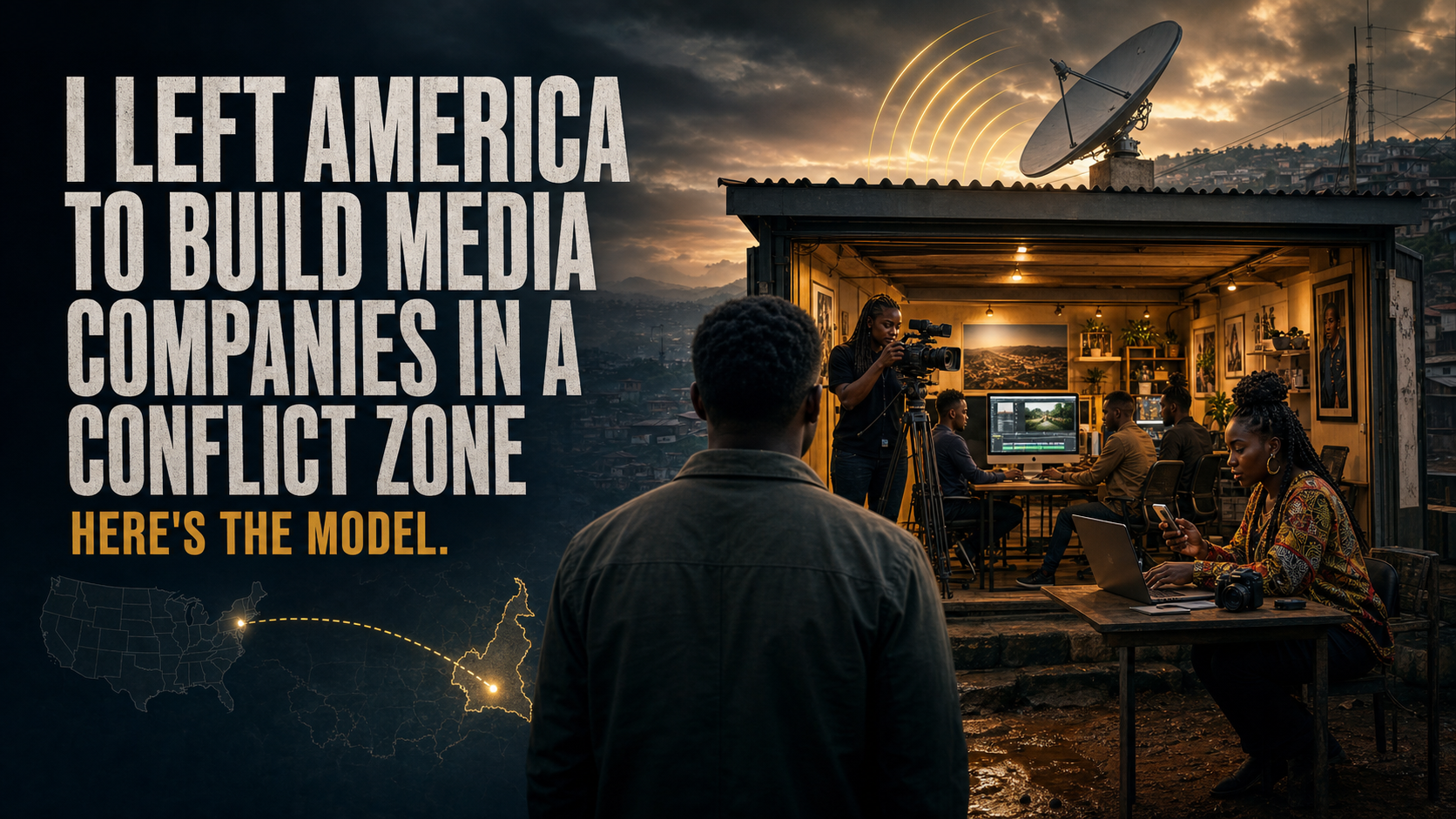
I am here to teach. I am here to deploy the Sovereign Protocol —the operational framework for building self-sustaining media ecosystems that replace donor dependency with ownership. I am here to show the path to sovereignty: endless revenue streams, digital independence, and the tools to tell their own stories on their own terms. I am here to elevate the voices of the people of Bamenda, Bafut, Douala, and all of Cameroon.
This work is not new. I have been serving in Africa for almost eleven years. But this deployment—this partnership with Princess Abumbi Prudence and the Bafut Kingdom—is the culmination of everything I have built. The Seven Kata legend teaches us that seven warriors, moving together, can carry what no machine could carry alone. That is the spirit of what we are building here: collective strength, indigenous innovation, and the refusal to wait for someone else to build the road.
A Path to Peace
I will say this, though, because I would be dishonest if I didn’t.
I would like to be part of what brings both sides of this conflict together. I believe it can be done. Not through the politics that have failed for nearly a decade. Not through the international mechanisms that have left Cameroon as the most neglected crisis on the planet. But through something that both sides already possess and that no military force can confiscate: their stories.
Media sovereignty is not just an economic tool. It is a bridge. When communities own their narratives—when they control the means of production, distribution, and monetization of their own stories—something shifts at the identity level. The need to be heard, which has been weaponized in this conflict on both sides, finds a legitimate, sustainable, non-violent outlet. That is not naive optimism. That is architectural logic. And it is the same logic I detailed in The Sovereign Blueprint.
There is a path to peace, prosperity, and healing in this land. I believe that with everything in me.
And I believe something even bigger: as Africa rises, the world will rise with it.That is not a slogan. It is an economic thesis, a spiritual conviction, and, as of three days ago, a lived experience.
I am here. The tremors are quiet. The food is medicine. The people are extraordinary. And the work has begun.
From the highlands of Cameroon,