Somewhere in the misty highlands of Cameroon's Northwest Region, a woman who could have chosen a palace chose a construction site instead. A princess who could have chosen silence chose a megaphone. And in doing so, she exposed a fault line in the architecture of global compassion—one that reveals why charity alone will never save the developing world.
Her name is Princess Abumbi Prudence, daughter of King Abumbi II of the Bafut Kingdom, a territory whose royal palace is recognized by UNESCO. Her organization, Youths and the Future, operates at the bleeding edge of a crisis that most of the world has never heard of—and that indifference is the problem this article was written to end.
The crisis in question has been raging for nearly a decade. It has killed thousands, displaced hundreds of thousands more, and shattered communities whose roots stretch back centuries. And in June 2025, the Norwegian Refugee Council declared Cameroon the single most neglected displacement crisis on Earth—ranking ahead of Ethiopia, Burkina Faso, and the Democratic Republic of Congo.
This is not a story about waiting for rescue. This is a story about a partnership—between an African princess and myself, a media strategist from Oklahoma City named Joshua T. Berglan—built on the belief that the era of waiting is over, and that the most underserved communities on the planet already possess everything they need to pull themselves out of poverty. They just need the right tools.
The Crisis the World Forgot
Cameroon is a nation of 28 million people on the western coast of Africa, tucked between Nigeria, Chad, and the Central African Republic. It is sometimes called "Africa in miniature" for its extraordinary geographic and cultural diversity. But beneath that tourism-brochure language lies one of the most complex humanitarian emergencies of the 21st century.
Since 2016, the country's English-speaking Northwest and Southwest regions have been consumed by what is known as the Anglophone Crisis —a conflict rooted in the political and cultural marginalization of the Anglophone minority by the Francophone-dominated central government in Yaoundé. What began as peaceful protests by lawyers and teachers against the imposition of French-language legal and educational systems escalated into a violent insurgency, a government crackdown, and a humanitarian catastrophe that shows no sign of abating.
The Scale of Cameroon's Crisis — By the Numbers
The violence is not abstract. Entire villages have been burned. Families who lived in beautiful homes now survive in forests. Schools have been shuttered for years, producing what experts call a "lost generation" of children who have known nothing but conflict. Women and girls face epidemic levels of gender-based violence. And the targeting of individuals based on their cultural and linguistic identity, according to the Global Centre for the Responsibility to Protect, poses a direct threat that may amount to war crimes.
But perhaps the cruelest dimension of Cameroon's suffering is its invisibility. The NRC found that the displacement crisis was mentioned in fewer than 29,000 articles worldwide in 2024—fifteen times less coverage than Ukraine received. As one aid worker in Cameroon put it: when people hear "Cameroon," they think of football, cooking, and dance. Not of a nation in crisis.
There are actually some inaccessible indigenous communities where media representatives do not have information about the happenings. It takes courage for you to leave your zone, going to the bush to such an internally displaced person to interview.
Princess Abumbi Prudence, Founder of Youths and the Future
Without visibility, there is no global pressure. Without global pressure, there is no accountability. Without accountability, a crisis becomes permanent—not an emergency, but a condition. And into this vacuum has stepped a partnership that aims to change the entire equation: not by asking the world for more money, but by giving the world's forgotten communities the power to generate their own.
A Princess Who Refused to Flee

In the Bafut tradition, royalty is not ceremonial. The palace does not stand apart from the community; it is the community's heart. And when that heart is wounded, the royal family bleeds alongside its people.
Princess Abumbi Prudence understood this instinctively. When the Anglophone crisis descended on her region, she had every reason to leave. Instead, she stayed. She looked at the displaced families, the traumatized youth, the shattered infrastructure of her homeland, and she made a choice that would define her life's work: she would build where others had destroyed.
The result is the Royals Echo Village Bafut —a regenerative center that serves as both sanctuary and laboratory. It is not a refugee camp. It is not a handout station. It is a living experiment in what Princess Prudence calls indigenous innovation —the radical proposition that the ancestral knowledge of African communities is not a relic of the past but a sophisticated technology awaiting its upgrade.
Technology did not come to abolish indigenous knowledge. Technology came to upgrade it.
Princess Abumbi Prudence
This philosophy drives everything at the Echo Village and the Youths and the Future organization. Programs include vocational training in arts, crafts, and music—critical in an economy where formal employment has collapsed. Permaculture gardens demonstrate indigenous cultivation methods that can feed families sustainably without dependence on international food aid. Workshops on natural food preservation using leaves rather than plastics teach young Cameroonians that their culture already contains solutions to global problems.
The princess's insight is deceptively simple but profoundly disruptive: the people of the Bafut Kingdom are not poor because they lack knowledge. They are poor because the global economy has never valued what they know. The Echo Village exists to correct that valuation.
But a regenerative village in a conflict zone, no matter how visionary, faces an existential limitation: isolation. The Echo Village can transform the lives of the people who can physically reach it. But how do you project the value of indigenous Cameroonian knowledge to a buyer in Berlin, a student in Seoul, an investor in São Paulo?
That's where I come in.
Why I'm Going to Cameroon: A Different Kind of American Export

I didn't come to Cameroon's story through the conventional channels of international development. I came through lived experience—through what I call "selling the scar, not the wound." I'm a 4x international bestselling author, UN speaker, SCORE Certified Mentor, and award-winning producer with over 126 credits on IMDb. I built my platform, The World's Mayor Experience, around a single conviction: the most underserved people in the world do not need saviors. They need systems.
Specifically, they need media systems. The argument I lay out across three books—which now function as operational manuals for this mission—is that the Fourth Industrial Revolution has created an unprecedented opportunity for the global poor. For the first time in history, the tools of mass media production and distribution are cheap enough for anyone with a smartphone and a story to compete in the global attention economy.
The thesis of Media Company in a Box is stark: instead of training the poor to be employees in someone else's factory—the old model of industrial-era development aid—train them to be owners of intellectual property. An artisan in Bafut who can speak a story into a smartphone can, through AI transcription and translation, instantly reach audiences in English, French, Mandarin, and Spanish. A weaving technique perfected over centuries can become a virtual reality tutorial sold to design students on four continents. A permaculture method that feeds families without chemical inputs can become a documentary series that generates revenue in perpetuity. I wrote these books so that the frameworks would be available to anyone, anywhere. That's why they're all free to read on my website.

The language barrier that keeps indigenous wisdom locked in local dialects? Dissolved by AI. The banking systems that are inaccessible to the rural poor and eroded by corruption at every level? Bypassed through blockchain and decentralized finance, where payments settle directly in the creator's wallet. The media gatekeepers who decide which stories the world sees? Circumvented through decentralized platforms that no government can censor or shut down.
Why Charity Will Never Solve This
There is a number that should haunt every person working in international development: 17 percent. That is the proportion of required humanitarian funding for Cameroon that had been secured as of October 2025. The IOM's Crisis Response Plan documented the gap plainly. The European Union has allocated €202 million to Cameroon since 2017—a significant sum that still falls drastically short of need. And in early 2025, the crisis deepened further when U.S. funding to UN programs in Cameroon was terminated, reducing the UNFPA's humanitarian response capacity by fifty percent overnight.
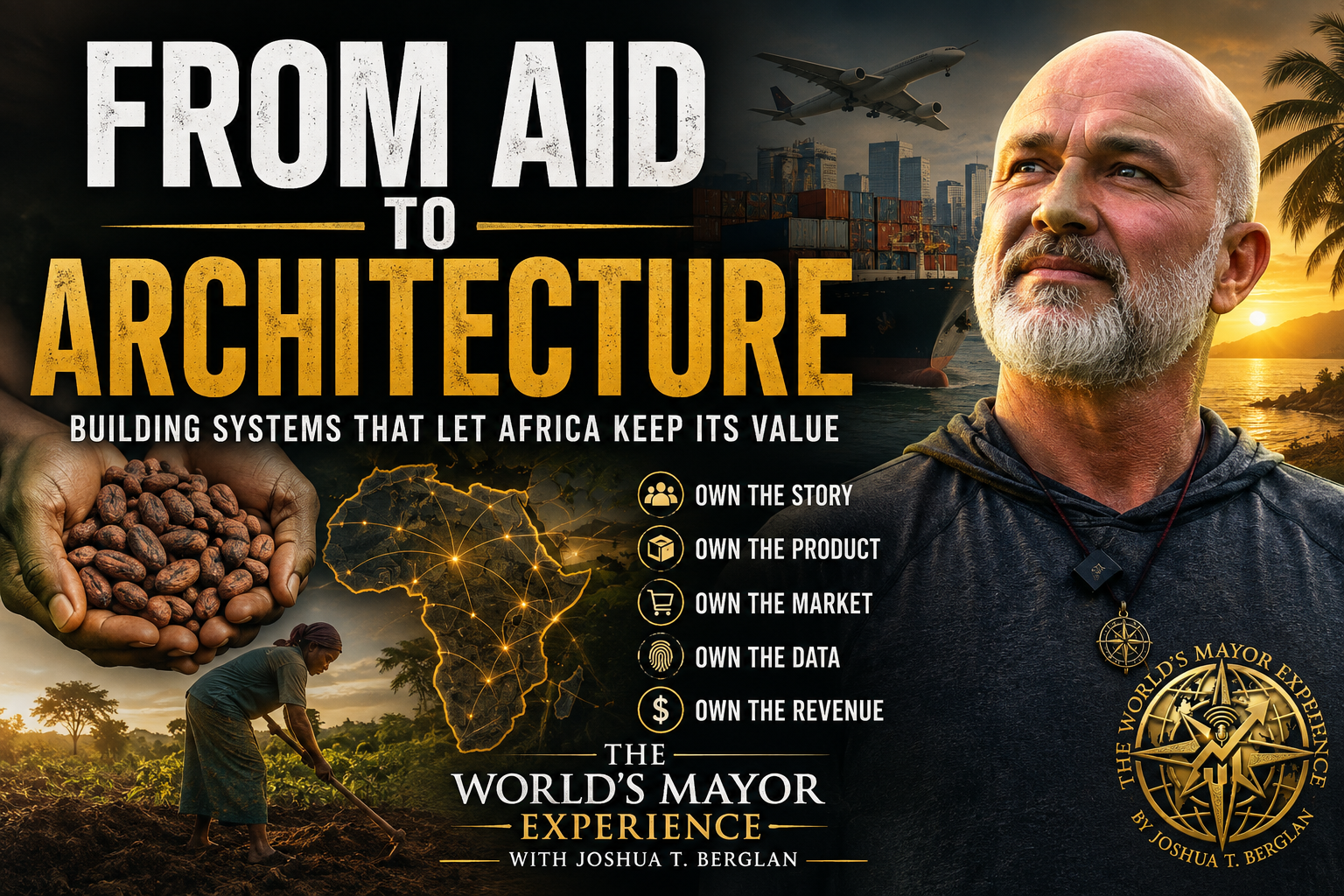
The fundamental insight driving this partnership: The people of Cameroon's Anglophone regions do not lack assets. They possess centuries of indigenous knowledge, extraordinary cultural richness, and deep community resilience. What they lack is the infrastructure to convert those assets into revenue that stays in their own hands. That is a design problem, not a charity problem.
Consider the corruption dimension. All levels of Cameroon's government are described by international observers as eroded by corruption, from petty bribery among police to large-scale embezzlement by elites. In this environment, traditional top-down aid is systemically inefficient because funds are intercepted before reaching their intended recipients. Any serious economic development model must be decentralized enough to bypass these corrupt intermediaries entirely.
Blockchain-based payment systems do exactly this. When a creator at the Echo Village sells a digital product—a documentary, a VR experience, a course—to a buyer anywhere in the world, the payment settles directly in a community-managed digital wallet. No government official skims a percentage. No bank charges prohibitive fees. The full value created by the community is retained by the community. This is not a utopian fantasy; it is an operational feature of the technology that The Bridge to Media Empowerment —my second book, also free to read—was written to deploy.
The System: Culture → Content → Capital → Community
The Closed-Loop Development Engine

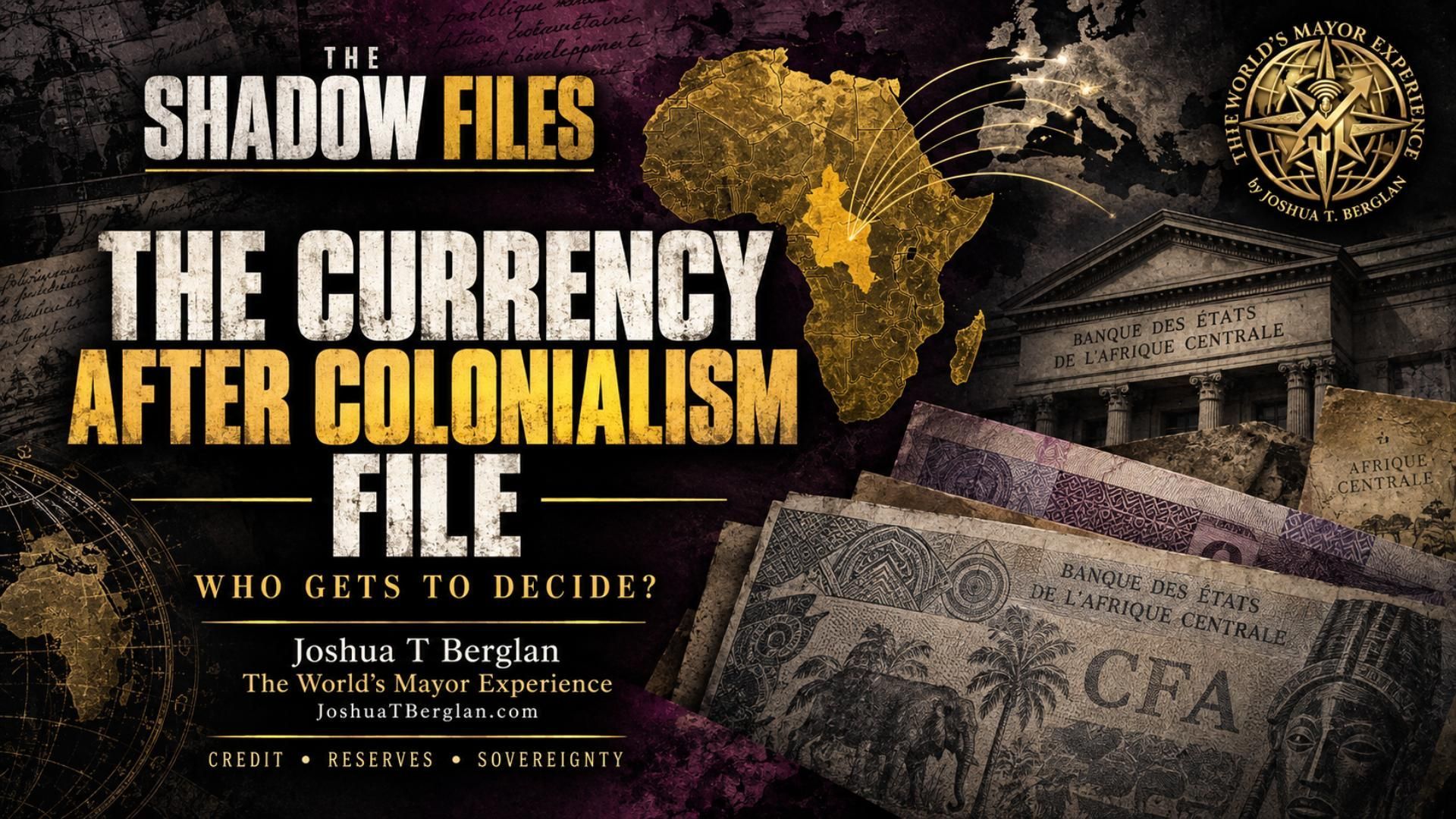
The critical economic innovation here is decoupling from the local economy. By selling digital products to the global market, the community earns in dollars or euros while spending in local currency, creating a massive purchasing power advantage. They are no longer trapped in the depressed economic conditions of a conflict zone. They are participants in the global attention economy—and they own the means of production.
Fighting Corruption With Transparency

The model Princess Prudence and I have designed attacks corruption not through enforcement (which requires functioning institutions that don't exist in the conflict zone) but through architectural design. Three features make the system corruption-resistant by default:
Blockchain-based financial rails. Every transaction is recorded on an immutable public ledger. There is no way to quietly siphon funds because every movement of value is visible, auditable, and permanent. Multi-signature wallets require multiple community leaders to approve expenditures.
Decentralized media platforms. Content published on decentralized networks cannot be censored by state actors. This protects both the economic infrastructure and the journalistic function of citizen reporters documenting human rights abuses.
Direct-to-consumer distribution. There are no middlemen between the Cameroonian creator and the global buyer. Smart contracts automatically distribute revenue according to pre-programmed terms. The code is the contract, and the code doesn't take bribes.
The Continent of Tomorrow: Why Africa Cannot Wait
Cameroon's crisis does not exist in isolation. It is a case study in a continental challenge. Africa is home to the youngest population on Earth—over sixty percent of the continent's people are under the age of 25. By 2050, more than 850 million young Africans will be entering the workforce. The digital economy is projected to generate 230 million jobs on the continent by 2030. Yet fewer than five percent of young Africans currently possess advanced digital skills.
Africa's Digital Opportunity — The Stakes
This is precisely why the Cameroon initiative matters far beyond Cameroon. The Echo Village model—indigenous knowledge upgraded with Fourth Industrial Revolution tools, distributed through sovereign media infrastructure—is designed to be replicated. The same architecture that empowers Bafut artisans could empower displaced communities in the DRC, indigenous tribes fighting deforestation in the Amazon, or farming communities in rural India.
Empowering the Underserved—Every Community, Every Ability

One of the most powerful dimensions of this partnership is its explicit commitment to those the world marginalizes twice over: communities affected by disability, HIV, sexual abuse, and other forms of social stigma. Cameroon's conflict has created a generation of amputees and trauma survivors.
The media-based economic model is uniquely suited to disability inclusion because it decouples earning potential from physical capacity. A person who has lost a limb to conflict can become a voice actor, an audio editor, a digital artist, a content strategist—all from a single workstation. My book Empowering the Underserved —also free to read—was written specifically for this population.

What Happens Next: The Road to Bafut
This is not a white paper gathering dust on a shelf. I am preparing to travel to Cameroon for an extended deployment—not as a tourist, not as an observer, but as a builder. The mission: to document the crisis from the ground, to produce content that forces the world to see what it has chosen to ignore, and to begin the operational integration of the Media Company in a Box framework with the Royals Echo Village infrastructure.
The immediate priorities are concrete. Equip the Echo Village with independent power generation and satellite internet. Deploy hardware kits to a first cohort of youth leaders. Train those leaders in AI-powered content production, blockchain wallet management, and global distribution strategy. Launch a dedicated streaming channel. And document every step, creating a proof-of-concept that can be replicated.

This Mission Needs Witnesses, Not Saviors
The vision is clear. The frameworks are built. The people are ready. What they need now is attention, partnership, and the world's willingness to invest in a model that actually works.
The Inheritance of the Meek
There is a word in ancient Greek— praus —that is typically translated as "meek." In popular culture, the word suggests weakness, passivity, timidity. In its original usage, it meant something closer to disciplined power: the controlled strength of a trained warhorse, the restrained force of someone who possesses the capacity for aggression but chooses strategic surrender to a higher purpose.
The people of Cameroon's Anglophone regions embody this definition. They have endured a decade of violence, displacement, and international neglect. They have maintained their community cohesion, their cultural practices, their commitment to their children's future—all while surviving conditions that would break most people on Earth.
The ancient promise was that the meek would inherit the earth. In the 21st century, "earth" is not only soil—it is also the digital landscape, the attention economy, the vast territory of ideas and commerce that exists online. By creating sovereign media infrastructure, by owning their own channels and intellectual property, by telling their own story to a global audience on their own terms, the displaced and dispossessed people of Cameroon can inherit both: the physical land they steward through regenerative agriculture, and the digital territory they claim through creative enterprise.
They do not need the world to save them. They need the world to see them, to trade with them, to recognize the value of what they have always known. And then they need the world to step aside and watch what they build.
A good leader is not he or she who stands by the people when things are fine. A good leader is that person who should be able to stand up, lead, coordinate, direct, influence in a positive way, bring resolutions on how to maintain peace even when there is no peace.
Princess Abumbi Prudence
The humanitarian industry has spent decades asking: how do we help the world's poorest communities? Princess Prudence and I are asking a different question: how do we get out of their way and hand them the tools?
The answer is being built right now, in the misty highlands of Cameroon, at the intersection of ancestral wisdom and artificial intelligence, of royal duty and radical entrepreneurship, of an ancient kingdom and the Fourth Industrial Revolution.
The world's most neglected crisis has found its architects. And they are not building a charity. They are building an economy.