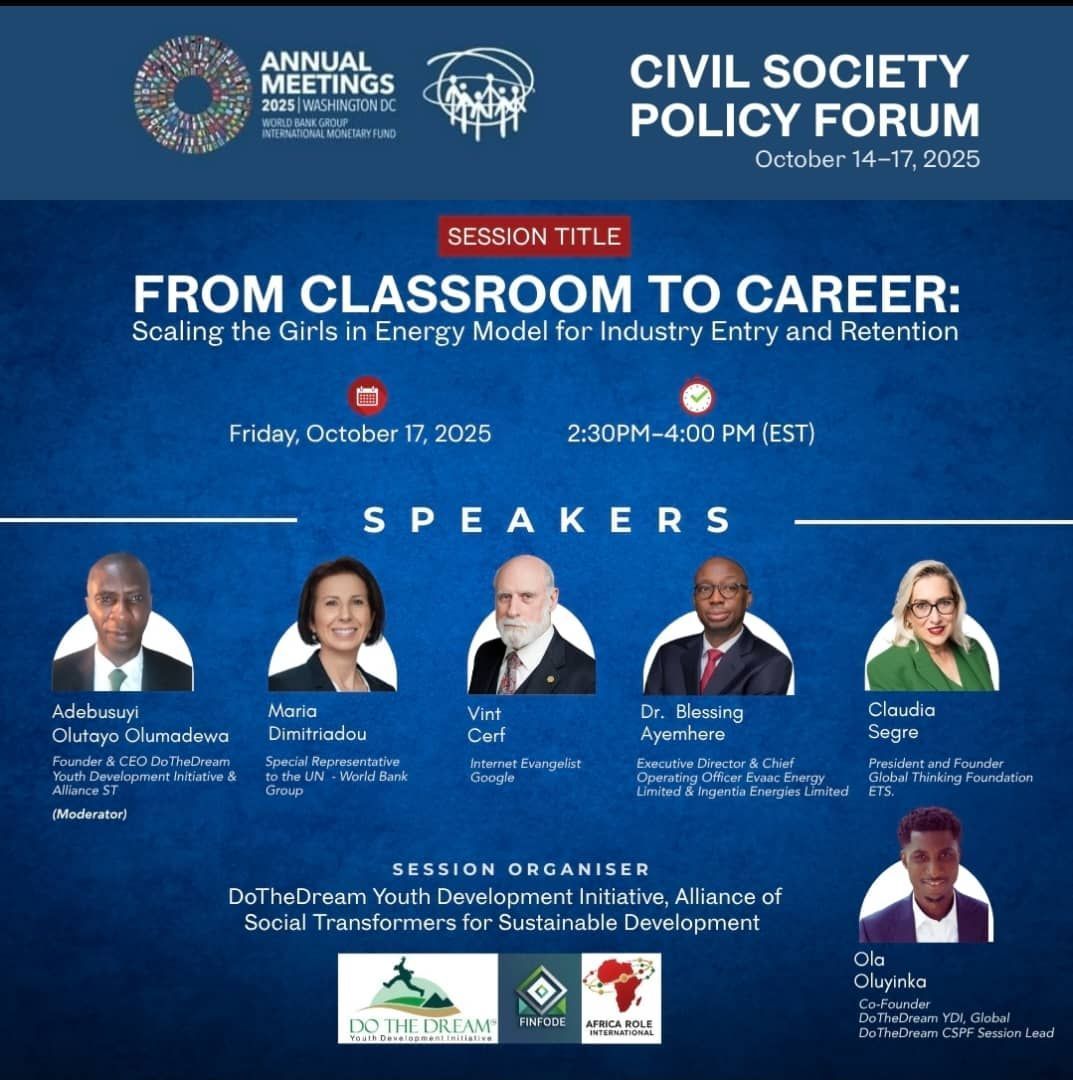
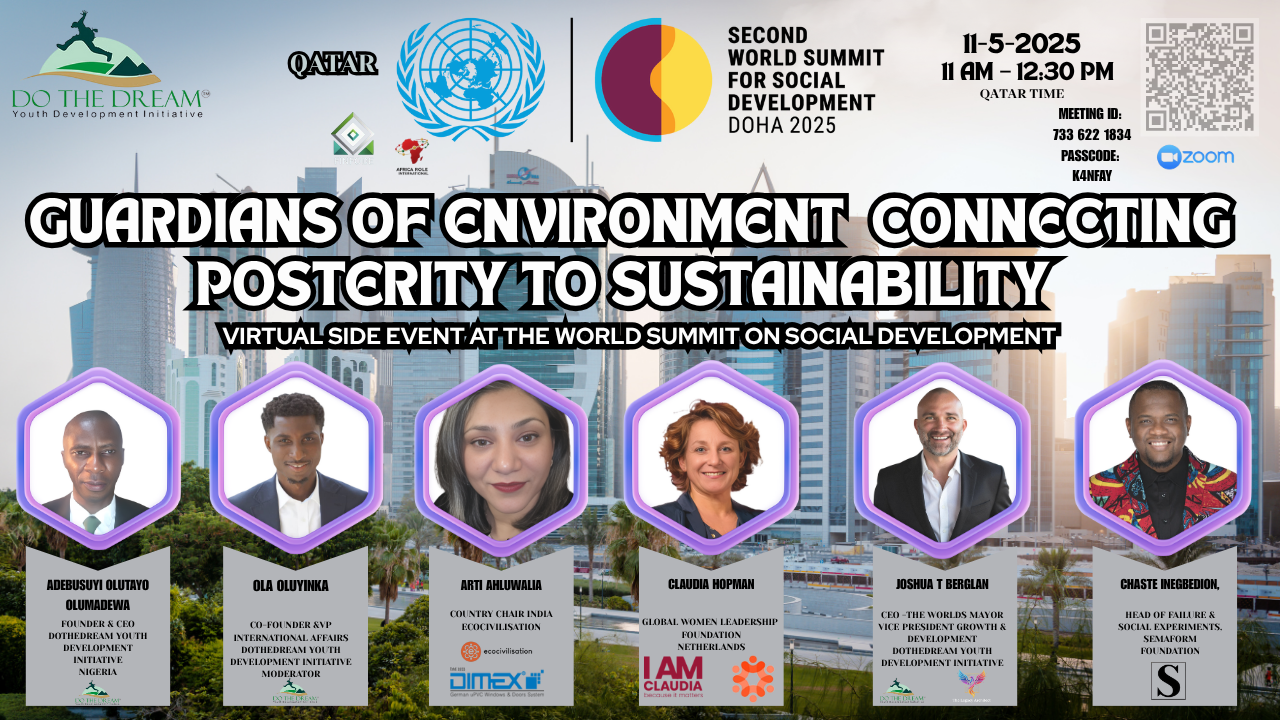
We stand at a pivotal juncture—where the tectonic plates of the Fourth Industrial Revolution, the climate emergency, and the crisis of global truth are colliding. Into this transformative moment steps DoTheDream Youth Development Initiative , ready to rewrite the narrative of energy access across the Global South.
The recent appointment of Dr. Omopeju Afanu as Chairperson of the Planning Committee for the High-Level Side Event at the CSW70 isn't merely administrative. It's a strategic alignment of leadership, vision, and execution capability designed to fundamentally transform how the world understands energy justice.
As Vice President of Growth and Development for DoTheDream YDI, I've witnessed firsthand how this organization has systematically dismantled the barriers between grassroots action and high-level global policy. What's emerging is nothing less than a new development paradigm—one where Energy Justice is inextricably linked to Media Sovereignty.
Beyond Access: The Shift to Ownership
The CSW70 engagement, titled "Catalyzing Energy Justice: Energizing Communities Through Girls and Women and Sport," represents a high-leverage platform positioned to mobilize USD 20 million in catalytic capital. But beyond the metrics of megawatts and headcount lies a deeper ambition: to shift the narrative from "access" to "ownership," from "beneficiary" to "industrialist," and from "victim" to "visionary."
The 70th Session of CSW
Scheduled for March 2026, CSW70's priority theme is "Ensuring and strengthening access to justice for all women and girls." DoTheDream YDI expands this definition to encompass Energy Justice—because in the 21st century, energy is the currency of opportunity.
To be denied access to reliable electricity is to be denied access to the modern economy, to digital education, and to healthcare. Energy poverty is a form of structural injustice, and the exclusion of women from the energy sector is a violation of their economic rights.
The "Anti-Niche" Revolution
My philosophy of the "Anti-Niche" is deeply embedded in this strategic approach. Traditional development siloes human experience into narrow categories—energy experts talk only to energy experts, gender experts only to gender experts. DoTheDream YDI shatters these silos.
A girl in a rural Nigerian community doesn't live her life in silos. Her lack of electricity affects her ability to study (Education/SDG 4), which affects her economic prospects (Poverty/SDG 1), which is compounded by her gender (Equality/SDG 5), and her mental health (Well-being/SDG 3). By presenting an integrated solution, DoTheDream YDI offers a compelling value proposition for systemic intervention.
Dr. Omopeju Afanu: Transformational Leadership
Dr. Afanu's appointment is a masterstroke of leadership alignment. As Secretary-General of the United Nations Association of Nigeria (UNA-Nigeria), she operates at the nexus of civil society and international diplomacy. Her leadership philosophy draws a critical distinction between mentorship and sponsorship.
As she articulates: "A mentor advises you, challenges you, and walks beside you. A sponsor uses their influence to open doors for you, often in rooms you may never enter on your own." For the Girls in Energy initiative, Dr. Afanu embodies both roles—providing strategic wisdom while using her high-level access to open doors in UN networks and private sector boardrooms.
Building Resilient Systems
The 10MW mini-grid project isn't being run as a charity; it's structured as a sustainable, revenue-generating enterprise. Under Dr. Afanu's guidance, the initiative implements strict financial controls, operational protocols, and data-driven decision-making—addressing the common criticism that development projects lack private sector rigor.
The Shadow World: Confronting Energy Poverty
Across Sub-Saharan Africa, the lack of reliable electricity acts as a "kill switch" for human potential. When the sun goes down, life in energy-poor communities grinds to a halt. Small businesses cannot operate machinery. Clinics cannot store vaccines. Students cannot study.
Energy poverty discriminates with brutal precision. Women and girls bear the disproportionate burden—walking miles to gather firewood, cooking over smoky fires that cause respiratory illness. They constitute only 22% of the energy workforce, often relegated to administrative roles.
DoTheDream YDI recognizes that you cannot solve the energy crisis without solving the gender crisis. By placing women at the center of the energy transition—as engineers, technicians, and CEOs—the initiative transforms victims of energy poverty into architects of energy abundance.
The 5-Pillar Ecosystem
The "Girls in Energy" initiative is a holistic ecosystem supporting girls from childhood curiosity to professional leadership.
Conference — The Spark
Large-scale events featuring role models and interactive panels for girls aged 13-25. "You cannot be what you cannot see."
Competition — The Innovation
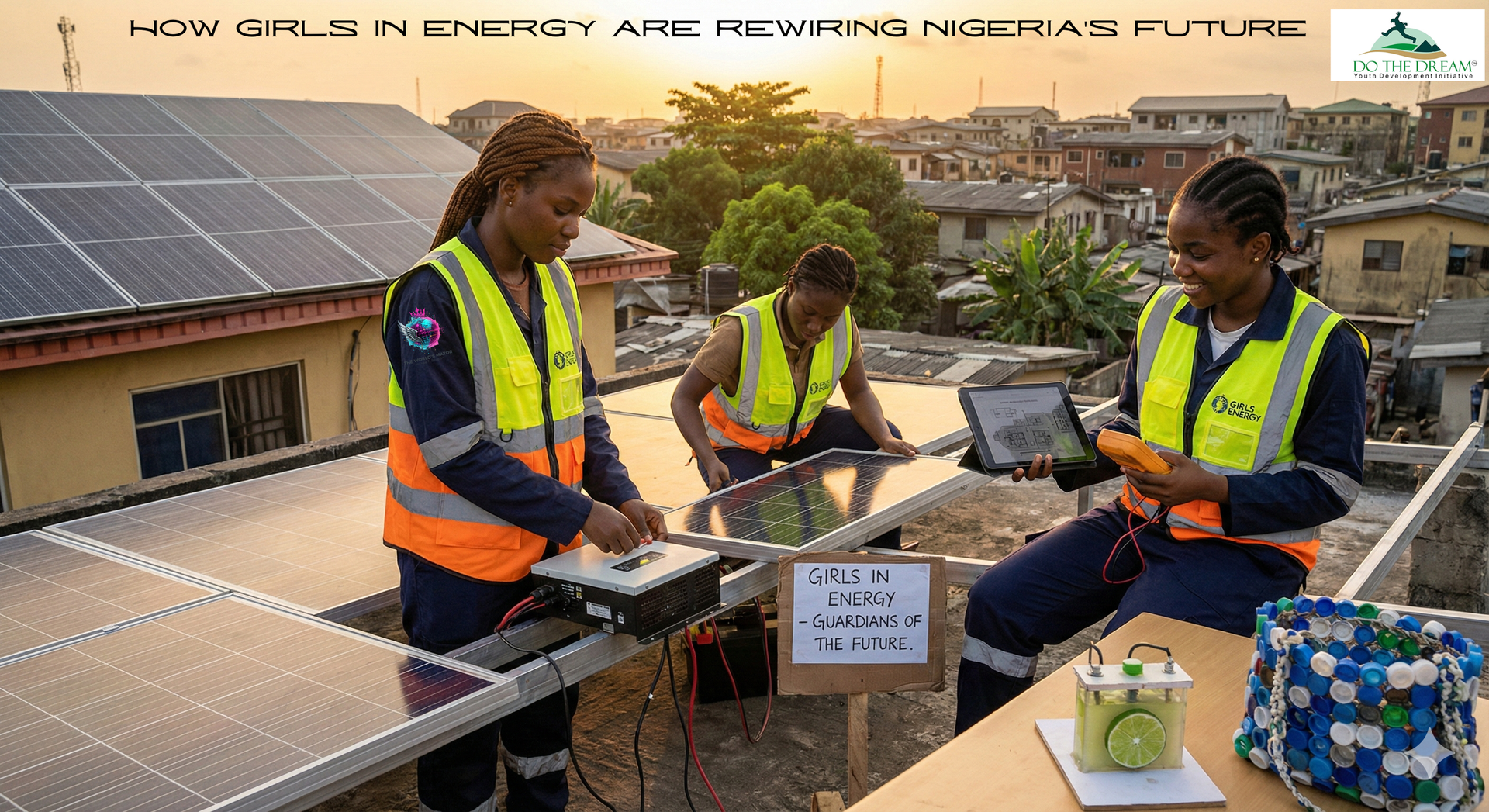
Innovation challenges fostering "frugal innovation"—where students generate electricity from limes and build solar-powered incubators.
Career — The Pipeline
Mentorship, internships, and job placement addressing the "leaky pipeline" where women leave STEM fields.
Camp — The Bootcamp
Intensive technical training in Solar PV installation, AI integration, coding, and "Media Company in a Box" skills.
Communities — The Implementation
Deployment of 10MW mini-grids managed by trained women, ensuring economic benefits stay local.
The Guardian Within: Identity as Infrastructure
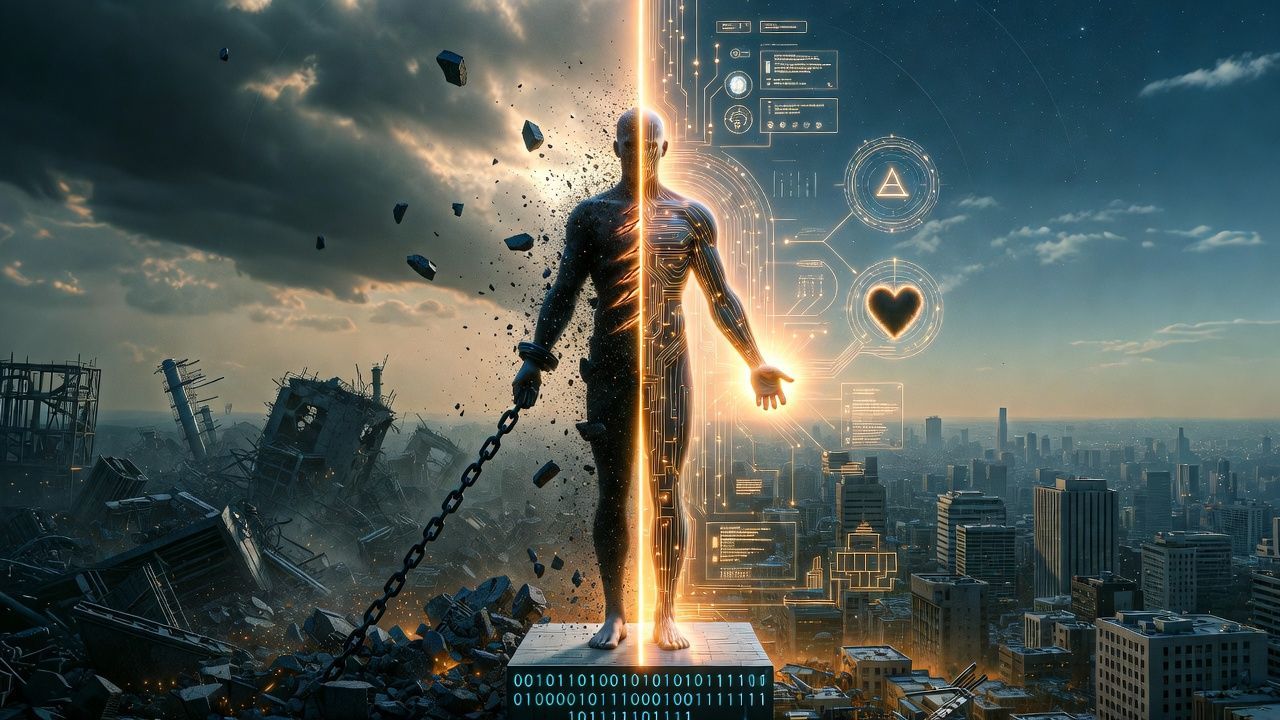
At the core of DoTheDream YDI's methodology is the understanding that external energy transition must be mirrored by an internal transition of consciousness. This philosophy posits a fundamental shift in identity: from Ego to Eco, from Victim to Guardian, from Isolation to Connection.
When a girl installs a solar system, she physically changes her environment. She brings light where there was darkness. This act of creation is profoundly therapeutic—proving to her, in tangible ways, that she has power. This psychological resilience is as important as the electricity itself.
Neurodiversity as Superpower
As someone who openly discusses my own neurodivergence, I bring a radical perspective to this work: neurodiversity is an asset, not a liability. The "Girls in Energy" program is designed to be inclusive of diverse minds—the hands-on learning appeals to those who struggle in traditional classrooms but excel in practical application.
Media Sovereignty: Owning the Narrative
Independent media is the future because it prioritizes authenticity and diversity over corporate interests. For decades, Africa's story has been told by outsiders. DoTheDream YDI is fighting a war for Media Sovereignty—because if you control the energy but not the narrative, you are still dependent.
The "Media Company in a Box" concept equips girls with smartphones, editing software, and storytelling skills. Every girl becomes a correspondent. Every mini-grid becomes a news bureau. Their raw, unfiltered content serves as ground truth—a counter-narrative to propaganda and greenwashing.
The Kinetic Catalyst: Sport as Development Engine
Sport serves as a powerful mobilization tool—a football match draws entire villages, providing a captive audience for energy education and advocacy. Sport breaks down barriers, teaches leadership skills, and provides safe spaces for girls in regions where gender-based violence is prevalent.
When a community sees girls playing competitively, commanding space, exhibiting strength, it challenges deep-seated stereotypes. This "soft power" paves the way for the "hard power" of infrastructure deployment.
Stand With the Guardians
The question for the global community at CSW70 isn't "Can they do it?" The evidence shows they can. The question is: Will you stand with them?
Read the Full Impact ReportThe Investment Case
DoTheDream YDI seeks $20 million in catalytic capital—not a donation to dig a well, but an investment to build an industry. The blended finance approach de-risks the project for larger institutional capital while delivering measurable impact across multiple SDGs.
The ultimate goal is movement from "aid" to "active industrialization"—a future where African women are involved in manufacturing, design, and financing of energy technologies. This is economic sovereignty.
The $20 million capital raise is the fuel. The 10MW mini-grids are the engine. But the Girls in Energy—with the Guardian Within their hearts and the tools of the Fourth Industrial Revolution in their hands—they are the drivers. And they are ready to drive their communities out of the shadows and into the light.