A Sector That Spends Billions and Produces Dependency
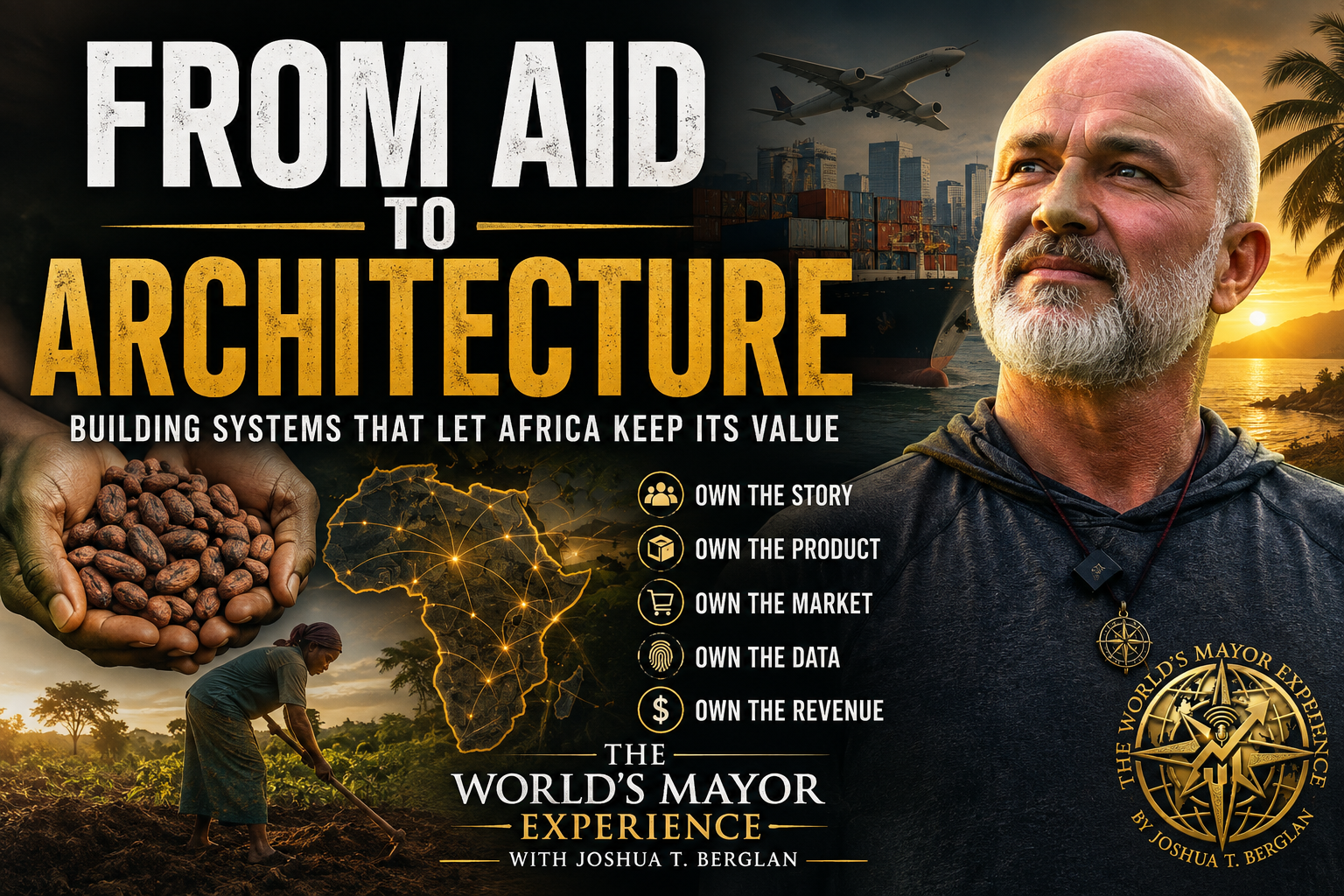
We're going to look at a $200 billion industry that, by almost every meaningful metric, has structurally failed. Then I'm going to lay out exactly what I'm building to replace it — from the ground in Cameroon, in real time, with creators who carry value the world has never seen.
Every year, billions of dollars pour into crisis-affected communities through the international aid and humanitarian sector. The grant cycles run their course. The NGO cameras leave. The funding leaves. And the community returns right back to baseline dependency. The system is designed that way. It is not an accident of execution. It is the architecture itself.
But what if we stopped treating these communities as victims and started treating them as creators? What if the infrastructure stayed after the cameras left, owned by the people who built it? What if the dollars flowing in actually transferred economic agency rather than reinforcing the structure that requires more dollars next year?
That's the question this podcast episode — and this entire body of work — is built around. The answer I've been developing on the ground in Cameroon, across the Bafut partnership, and through an expansion relationship in Nakivale Refugee Settlement, Uganda, is called The Sovereign Franchise. It is not a charity. It is not a McDonald's. It is a global sovereign media network designed to replace the dependency model with permanent economic sovereignty.
The cameras are not coming. The funding is not coming. So we are building something that does not need either to survive — because the community will own every lens, every microphone, and every story.
— Joshua T. Berglan, The World's MayorThink of It Like a Television Network
Disney owns ABC, ESPN, and National Geographic. None of those channels look or sound the same. ABC doesn't look like ESPN. ESPN doesn't sound like Nat Geo. But they are all powered by the exact same underlying infrastructure — and each channel makes every other channel more valuable.
The Sovereign Franchise operates the exact same way, but for marginalized communities and underserved creators.
Three Layers, One Network
- The Franchise is the parent network — the physical infrastructure, the digital tools, the distribution architecture, the governance system.
- Each physical location — whether in a conflict-affected region in Cameroon or a refugee settlement in Uganda — is an independent channel , with its own cultural identity and sovereignty.
- Each individual creator inside a hub is their own show — their own brand, their own intellectual property, their own audience and revenue streams.
The shows don't look the same. The channels don't look the same. What's standardized is invisible to the audience: the underlying infrastructure, the production tools, the distribution architecture, and the operating system. The network provides the physics. Each community writes its own story.
The Communities the World Cut Off Carry Value It Has Never Seen
The global creator economy is projected to reach $480 billion by 2027. Inside that market, entire populations have been locked out by lack of infrastructure — no broadband, no banking, no reliable electricity. Not because the talent isn't there. Because the rails don't reach them.
The addressable market is staggering:
- 1.4 billion people across Africa — many with creative talent, indigenous knowledge, and stories the world has never accessed.
- 110+ million displaced people worldwide living in refugee camps and settlements, most without creator infrastructure.
- 476 million indigenous people across 90 countries — guardians of irreplaceable cultural and ecological knowledge that has never been monetized at the source.
These communities carry value the Western creator economy desperately wants and cannot reach. Indigenous farming knowledge that solves regenerative agriculture problems Western universities are still researching. Heritage textiles that command premium pricing in global luxury markets. Music traditions that have not yet been heard outside their region. Lived experiences from active conflict zones that international media will license at scale.
The market is not "underserved." It is completely unaddressed. These creators are locked out simply by lack of infrastructure. Fix the infrastructure and the entire equation changes.
The Triple-Pillar Architecture: $32,591 Per Hub
Each planned hub costs $32,591 to deploy. That's a one-time cost to bring permanent creator infrastructure and economic-sovereignty rails to a community. Here is exactly where every dollar goes:
Physical Sanctuary
A secure permanent structure built by local artisans using local materials. Capital is injected directly into the community's micro-economy from day one.
Digital Engine
Solar generators, 4K cameras, professional audio, digital mixers, LiFePO4 battery banks, and Starlink satellite internet. Off-grid. Resilient. Built to operate when the grid fails.
Human Capital
Logistics, nutrition, clothing, and school fees for the pilot creator cohort. You cannot teach someone to build a media empire if they are hungry or terrified. Physiological safety first.
Once the infrastructure is in place, the community runs it. I provide the education through a curriculum I call Media Company in a Box, and they provide the creativity, the culture, and the content. The goal is not dependency on the network. The ultimate measure of success is that creators outgrow their need for me entirely.
The Creator Keeps 80 to 90 Percent
This is why The Sovereign Franchise is not YouTube and not a traditional media network that extracts value from its talent. The creator is the primary beneficiary of every dollar they generate — because it is their story, their intellectual property, and their audience.
Creators build multiple revenue streams: podcasting, online courses, heritage brand merchandise, IP licensing, token-gated Web3 content, books, live events, and speaking. The hub retains only 10 to 20 percent to maintain shared tools, pay for connectivity, and keep the lights on.
Code as Law: Artifexian Governance
The 80-to-90 split isn't meant to be a promise on a piece of paper. It is designed to be enforced by the network's operating system, which I call Artifexian Governance. Web3 smart contracts automate royalty distribution so terms can be transparent, durable, and difficult for any single party to manipulate.
The goal is simple: creators should not need permission from a hub operator, local gatekeeper, or central administrator to receive the revenue their own intellectual property generates.
The Network Is Not Theoretical
If this sounds theoretical, it is not. Two active partnership deployments are underway, and I am on the ground in Cameroon as I write this. The work is in field validation: relationship-building, curriculum delivery, local partner alignment, creator identification, and the staged buildout toward permanent sovereign media infrastructure.
Bafut, Cameroon
Anchored in partnership with Princess Abumbi Prudence of the Bafut Royal House. The Norwegian Refugee Council has identified the Cameroon displacement crisis among the world's most neglected crises. The Princess is the architect. I am the bridge builder.
Nakivale, Uganda
Led by Ahadi Bobo (Pastor Bob) of Kairos Transformation Lives, formerly known as Metanoia Hope for Tomorrow. Nakivale is one of the world's largest refugee settlements, characterized by extraordinary resilience — residents build micro-economies rather than wait for aid.
Why start here? Because these are maximum-difficulty environments. If the Media Company in a Box framework can generate participation, trust, and creator momentum in the world's most neglected crisis contexts and one of the world's largest refugee settlements, then the model has a serious claim to resilience.
Phase 1 Expansion: The Cameroon Corridor
Active partnership development is underway across four additional Cameroonian cities, forming a contiguous deployment corridor:
- Buea — Southwest Region capital, education hub, and strategic expansion location.
- Limbe — Coastal port city, oil refinery hub, tourism gateway, and home base for the first Cell Phone Sovereignty Workshop alumni.
- Bamenda — Northwest Region capital and epicenter of the Anglophone Crisis.
- Yaoundé — National capital, Francophone administrative center, and bilingual proof of replication.
Together with Bafut and Nakivale, this corridor is designed to prove that the franchise model can replicate across English- and French-speaking regions, rural and urban geography, and active or adjacent conflict contexts.
From Partnership Deployments to 500 Hubs
The ultimate goal is 500 hubs worldwide. At full scale, the network is designed to support an estimated 12,500+ active creators generating combined revenue exceeding $250 million annually. To get there, I'm raising $30.5 million across three gated phases. No single funder has to commit to the full amount.
Prove the Model
First 10 hubs, heavily focused on the Cameroon Corridor. Proof of replication across geography and language. 2026–2027.
Replicate
Scale to 100 hubs across multiple continents. Network treasury target reaches approximately $5M/year. 2027–2029.
Scale
Complete the 500-hub network. Designed to become self-sustaining through hub revenue share. 2029–2032.
The investor unlock: Because of the 10-to-20 percent hub revenue share, the global network is designed to become structurally self-sustaining. The goal is a machine that eventually pays for itself.
Common Questions About the Sovereign Franchise
Why has the $200 billion international aid industry failed?
What is The Sovereign Franchise?
How much does it cost to deploy one Sovereign Hub?
How much do creators in the network earn?
Where are the first Sovereign Franchise deployments?
What is the total capital ask for The Sovereign Franchise?
How can I support The Sovereign Franchise?
Read the Plan. Read the Story Behind It.
The podcast is the summary. The full business plan and the long-form interview tell the rest of the story — the architecture in detail, and the personal journey that led here.
The Sovereign Franchise — Full Investor-Grade Plan
The complete business plan: executive summary, market opportunity, unit economics across three scenarios, phased capital ask with line-item use of funds, risk assessment, long-term governance, and the 2035 view.
READ THE FULL PLAN → Featured InterviewJoshua Berglan Is What Happens When a Man Survives Himself
A long-form interview in Read Men In Motion magazine on the personal story behind the framework — surrender, transformation, the failure-to-framework philosophy, and what it takes to build something that lasts.
READ THE INTERVIEW →The Charity Model Broadcasts the Wound.
This Network Broadcasts the Scar.
The cameras are not coming. The funding is not coming. So we are building something that does not need either to survive. Here are three honest ways to be part of it.
Sovereign Architecture Consultation
A focused strategic session for entrepreneurs, NGOs, and organizations building their own platforms. Every dollar of consulting revenue funds active partnership development in Bafut, Nakivale, and the broader Cameroon Corridor. You build your empire. They build theirs.
Fund a Hub or Equipment Tier
Investors and foundations can fund an entire planned hub at $32,591. Individuals can fund specific equipment tiers starting at just $50 — cameras, Starlink terminals, solar gear, school fees. Every dollar is tracked.
Keep Me on the Ground
I am personally funding my presence in Cameroon — housing, food, transportation, connectivity. No salary. No NGO backing. The GoFundMe keeps me fed, housed, and mobile while I do this work.