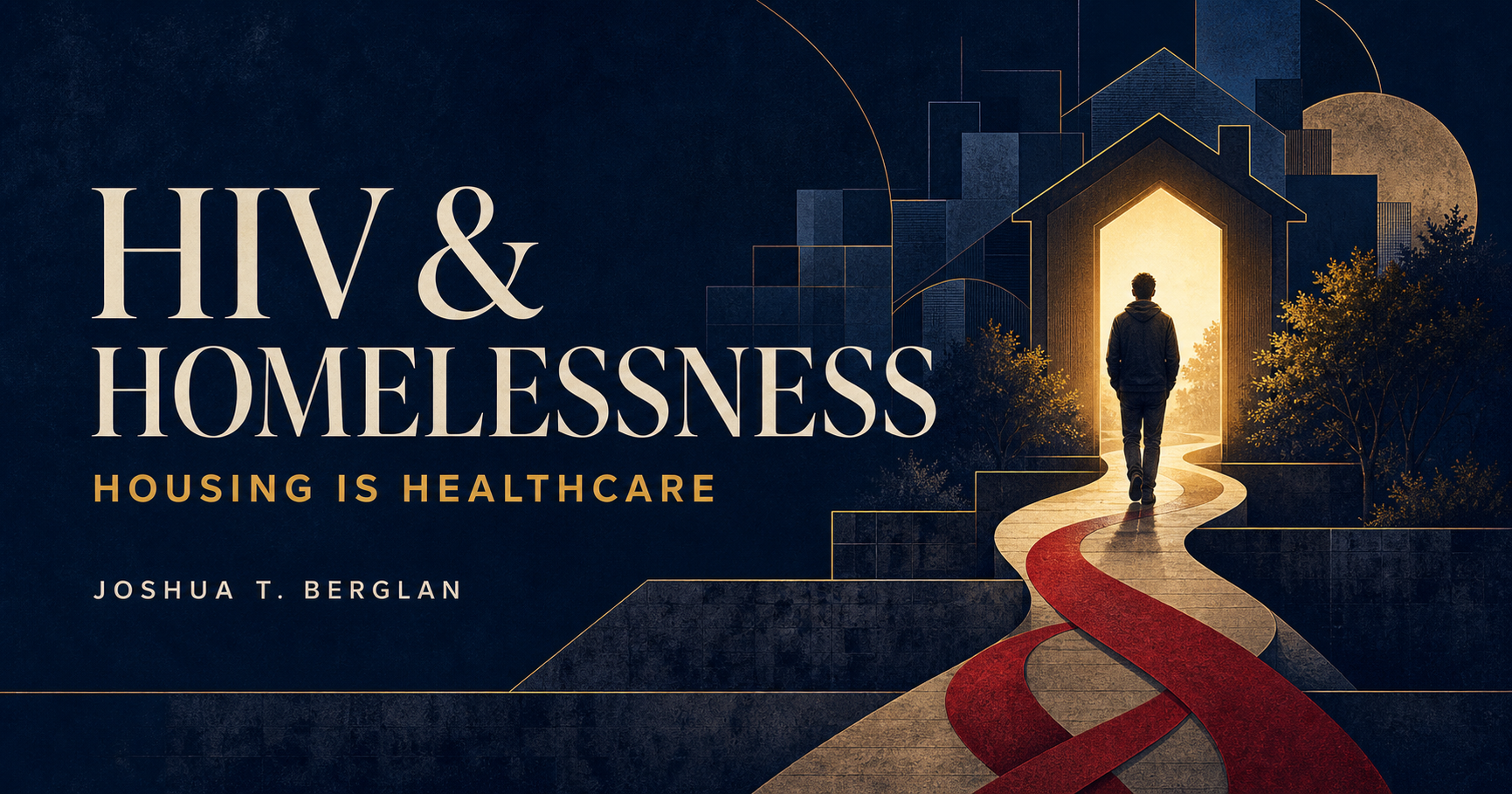
Personal reflection · HIV advocacy
HIV, homelessness & the foundation we keep missing
Being featured by Invisible People gave me the opportunity to share part of my story. The reason for sharing it is much larger: too many people are still being asked to protect their health and rebuild their lives without a safe place to stand.
I recently had the opportunity to share part of my story with Invisible People for its feature, HIV Positive and Homeless: A Preventable Crisis . I spoke about living with HIV while navigating disability, mental illness, homelessness, and the difficult work of rehabilitating my life.
But I did not share that experience to make myself the center of this conversation. I shared it because many people are still trying to manage HIV without safe and stable housing—and because their humanity is too often buried beneath a diagnosis, a circumstance, or someone else’s assumptions.
The short answer: why does housing matter in HIV care?
Stable housing gives people a safer place to keep and take medication, rest, eat, communicate with care teams, reach appointments, and remain connected to treatment. Housing does not solve every problem, but it creates the foundation that makes many other solutions possible.
One story can open a door. It cannot hold the whole crisis.
My experience is one experience. The circumstances surrounding homelessness are different for every person, and no single story should be treated as a template for millions of lives. Still, lived experience can expose what tidy explanations leave out.
Homelessness is rarely one isolated problem with one clean solution. A person may be managing a serious health condition while also trying to secure identification, transportation, income, food, phone access, medication, privacy, safety, and a place to sleep. Every application, appointment, deadline, and conversation demands energy from someone already operating in survival mode.
We often ask people to rebuild their lives before giving them a stable place to stand.
That is why phrases like “just get a job” or “just find housing” miss the reality. The path forward may require executive function, money, documents, reliable communication, emotional regulation, physical stamina, and support—all at the same time. Homelessness can strip away the very resources people are told to use to escape it.
Housing is health infrastructure
For a person living with HIV, the connection between housing and health is immediate. Treatment works best when medication can be stored safely and taken consistently, appointments can be kept, and care remains continuous. A lost bag, an encampment sweep, a dead phone, an unsafe shelter, or a missed ride can become a medical disruption.
HIV.gov explains that people with safe, affordable housing are better positioned to stay connected to treatment and supportive services. It also reports that at least half of Americans living with HIV experience homelessness or housing instability after diagnosis.
Calling housing “healthcare” does not mean that a home replaces medicine, clinicians, or support. It means housing is a structural condition that can determine whether those resources are reachable and sustainable.
See the person before the diagnosis
HIV still carries stigma. So do disability, mental illness, poverty, and homelessness. When those labels overlap, people can be reduced to a collection of perceived risks before anyone asks who they are, what they have survived, what they know, or what they still have to offer.
A diagnosis is medical information. It is not a measure of character. A housing status describes a present condition. It is not a complete identity. People experiencing homelessness are parents, creators, workers, neighbors, believers, skeptics, caregivers, leaders, and human beings whose value did not disappear when their housing did.
A person is never only a diagnosis, a disability, or a housing status.
Dignity is not something people must earn after becoming stable. It belongs in the first conversation, the first clinic visit, the first outreach encounter, and every system designed to help.
Where compassion becomes action
Awareness matters, but awareness should move us toward a more connected response. If the challenges overlap, the solutions must communicate with one another.
- Listen without reducing. Let people describe what they need without forcing their lives into a single category or stereotype.
- Connect housing and healthcare. Coordinate housing support, HIV care, mental health services, disability access, transportation, and income assistance.
- Protect continuity of care. Recognize that a person’s belongings may include life-preserving medication and medical information.
- Support low-barrier help. Reduce paperwork, fragmented referrals, rigid scheduling, and obstacles that punish people for unstable conditions.
- Choose dignity now. Do not wait for someone to be housed, employed, healthy, or easy to understand before treating them as fully human.
I am grateful to Invisible People for allowing me to contribute my voice and for continuing to bring visibility to people whose lives are too often discussed without being understood. My hope is that this feature does more than attract attention. I hope it helps people recognize that housing, health, income, safety, and dignity cannot be separated when someone is trying to survive.
No one should have to choose between finding a place to sleep and protecting their health. And no one should have to become a public success story before their life is considered worthy of care.
Frequently asked questions
Why does stable housing matter for people living with HIV?
Stable housing makes it easier to keep medication safe, take it consistently, attend appointments, access supportive services, rest, and remain connected to care.
How can homelessness disrupt HIV care?
Homelessness can make transportation, privacy, medication storage, regular meals, appointment scheduling, and communication harder. These barriers can interrupt treatment even when a person is committed to protecting their health.
Why did Joshua T. Berglan share his experience?
I shared my experience to bring attention to people who are still navigating HIV and homelessness, challenge stigma, and encourage responses that recognize housing, healthcare, income, safety, and dignity as connected needs.
Where can I read the original Invisible People feature?
Read HIV Positive and Homeless: A Preventable Crisis on InvisiblePeople.tv.
Sources and further reading
- Cynthia Griffith, HIV Positive and Homeless: A Preventable Crisis , Invisible People, July 24, 2026.
- HIV.gov, Housing and Health .
Read. Share. See the whole person.
The original feature places lived experience inside the larger systems shaping HIV care and housing instability.
Read the feature ↗With dignity and purpose,
Joshua T. Berglan