There is no teleprompter for this part. That was the point.
The headquarters of the Cameroon Diving Centers — home of Cameroon Diving Services and the Central African Diving Institute — sits in Limbe, a coastal town in Cameroon where the Atlantic meets black volcanic sand, and on this particular morning it is doubling as a broadcast studio. No microphone rig, no lighting truss — just a laptop, a room full of people, and a promise made at the top of the show: we're not editing any of this.
Joshua T. Berglan — the broadcaster known as the World's Mayor, and here in Cameroon as Tila — opens the way he opens everything, by talking past the room to the person standing at the edge of the water. The one with a story, a message, or a business burning inside them, paralyzed by the depth of the unknown. "You were not built to stay in the shallows," he tells them. "The greatest treasures, the most profound truths, and the real impact in this world are only found when you are willing to dive into the deep end."
The diving metaphor is not decoration. It's the venue. And for six days, it has been the curriculum.
What Is the Media Company in a Box Workshop?
Media Company in a Box is Berglan's answer to a question he hears constantly: how does anyone break through when the algorithms, the platforms, and the sheer noise of the internet seem engineered to drown independent voices? His answer is to stop renting your reach and start owning it — to build what he calls an uncancellable, sovereign media platform: your own website, your own store, your own broadcast archive, your own digital real estate. He built his own at joshuatberglan.com, complete with a custom search engine called The Archives that serves thousands of free resources, and he has just re-released his book — along with brand-new services — showing exactly how.
For six days in Limbe, that blueprint stopped being theory. A cohort of Cameroonians — entrepreneurs, nurses, coaches, hospitality professionals, mental health advocates — built the structure of their own websites, learned the architecture for turning raw audio and video into fully optimized multimedia articles, and did the deeper, harder work of figuring out what they actually had to say. On the final day, instead of a traditional interview, Berglan handed them the broadcast.
"We are not just making noise today," he says. "We are building digital real estate."
"I Thought I Had My Voice. I Just Realized I Did Not."
Every World's Mayor Experience broadcast opens with gratitude — not the reflexive kind, but the kind that has to explain itself. What follows is a room slowly finding its volume.
Tabi Elsie, a mental health advocate and hospitality management professional, goes early, and what she says lands like a thesis statement for the whole week:
I thought I had my voice, but I just realized I did not actually have my voice. This program made me realize I had a voice that was hidden — and I found it.
— Tabi Elsie · Mental Health AdvocateShe isn't alone. One participant, who had been in what she calls "a down season for a while," describes the workshop as a wake-up call. Another, a young man named Justin, marvels that he's now doing things "people my age are no more doing." A health professional and entrepreneur talks about being told as a schoolchild that the world was a global village and never believing it — until she found herself standing in Limbe, broadcasting to it.
Berglan keeps deflecting the credit. "I'm not fishing for compliments here," he says twice. "This is not about me." Then he sharpens the question: forget gratitude — what did you discover about yourself that shocked you?
The first answer might be the most quotable moment of the broadcast:
I discovered that I've been a victim of waiting — waiting to be ready instead of just going ahead and getting better as I go. Everything I needed to be who I was born to be was inside of me, and I was always looking for it outside.
— Workshop Participant · Limbe, CameroonAnother participant follows with its corollary: the people already out there aren't perfect, they're just bold. "There will never be a perfect time," she says. "Where you are is already a perfect time."
What Does the World Need to Know About Cameroon?
Midway through, the broadcast pivots from the personal to the national. Berglan asks the room what they want the world to know about Cameroon — a country he notes the world simply doesn't know.
The answers come fast. A content creator who has watched his engagement grow as he documents Cameroon's natural resources and beautiful places issues it as a challenge: "It is our duty to export the things that we have here in Cameroon." Another participant puts it even more simply: "I didn't know the world needed to know Cameroon. But after today, I know the world needs to know Cameroon. And it will start from me."
One man calls Cameroon "paradise" — a country sitting on resources "that can feed the world" — and steers carefully but deliberately toward the question of management, of truth-telling, of what it costs to say something in a place where saying something can be dangerous. "It's better to say the truth," he decides, out loud, in real time, "than to keep your voice down. The worst thing to do is to be quiet about something that is true."
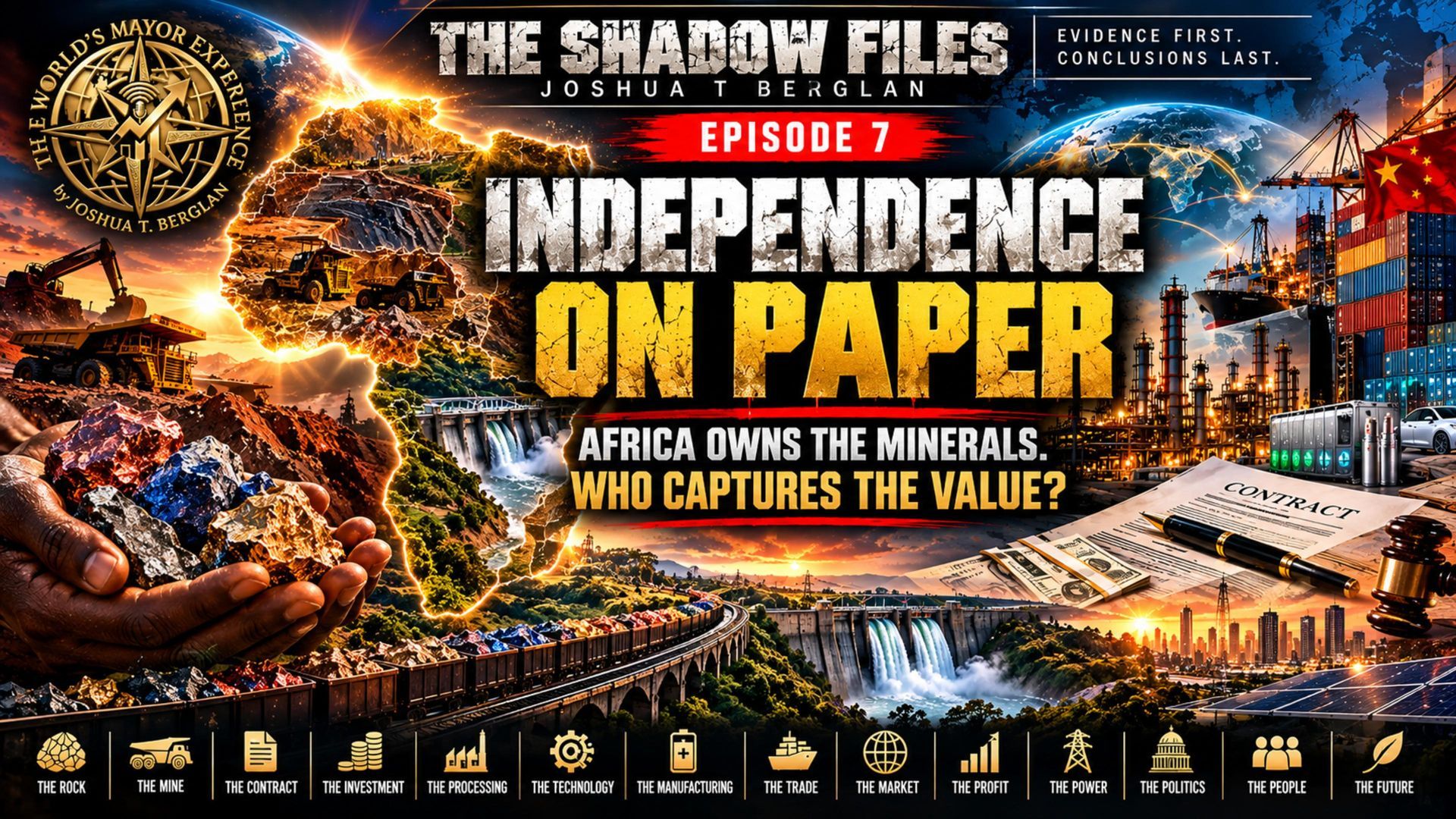
That tension — between the fear of consequences and the obligation to speak — runs through the entire hour. It is exactly the tension a sovereign platform is built to resolve. This is a theme the show has been building all year: that Africa's story is chronically told by other people, at a markup. Previous episodes have traced who actually keeps Africa's profit in the sovereign supply chain, and argued that African trade cannot move without African media to move it. The Limbe workshop is the same argument, applied to human beings instead of freight.
Mental Health, Single Mothers, and the Children Who Stopped Talking
The broadcast's most piercing stretch belongs to Tabi Elsie, who lays out her dual mission: bringing world-class hospitality standards to Cameroon's hotels and restaurants, and confronting a mental health culture in which children grow up with trauma and no one safe to tell.
"Most children growing up in Cameroon — Africa in general, but Cameroon to be precise — are growing up with traumas because they don't have who to talk to," she says. She names the stigmas one by one: the single mothers written off entirely, the divorcées treated as the worst people in the world — "but some cases of divorce are actually freedom," she counters, a line that titles one of the ebooks on her own store at tabbylc.com — and the children who were bold and vibrant until, somewhere along the way, they stopped opening up.
Her message to Cameroonian and African parents is direct: be the kind of parent your child can tell the truth to — about school, about abuse, about a marriage that needs to end. "Your children should be confident enough to tell you: Mom or Dad, this marriage is not going. I think I need to leave."
Berglan, 47, answers with his own testimony: he talks to his mother every day. "She was with me in some pretty crazy times in my life, too. It's a blessing to have that."
What Happens After the Workshop Ends?
By the final segment, nearly every participant has the structure of a website built. So Berglan asks the only question that matters on day six: what's next?
Justin's answer may travel furthest. Fluent in French, he plans to translate everything he learned and carry it to Francophone Cameroon: "I'm going to transit all this knowledge into French so that I can transfer it to the French Cameroon... so that we can empower more, and Cameroon go over the world."
A health professional and nutrition entrepreneur maps out online counseling talks and an e-commerce shop for her wellness products — the digital storefront she's had the products for all along, without the sales channel to match. A nurse closes the circle with a line that could headline the whole workshop:
A tree does not bear fruit that it consumes. Others receive from it. From this workshop, I'm ready to give out.
— Workshop Participant · Limbe, CameroonIt's the economics of the whole project in miniature. The show has long argued that the farmer is the first investor — that African wealth begins with the person who plants before anyone pays them — and that local shopkeepers are the front line of food sovereignty. Add to that lineage: the creator is the first broadcaster. This cohort planted this week. The fruit is for everyone else.