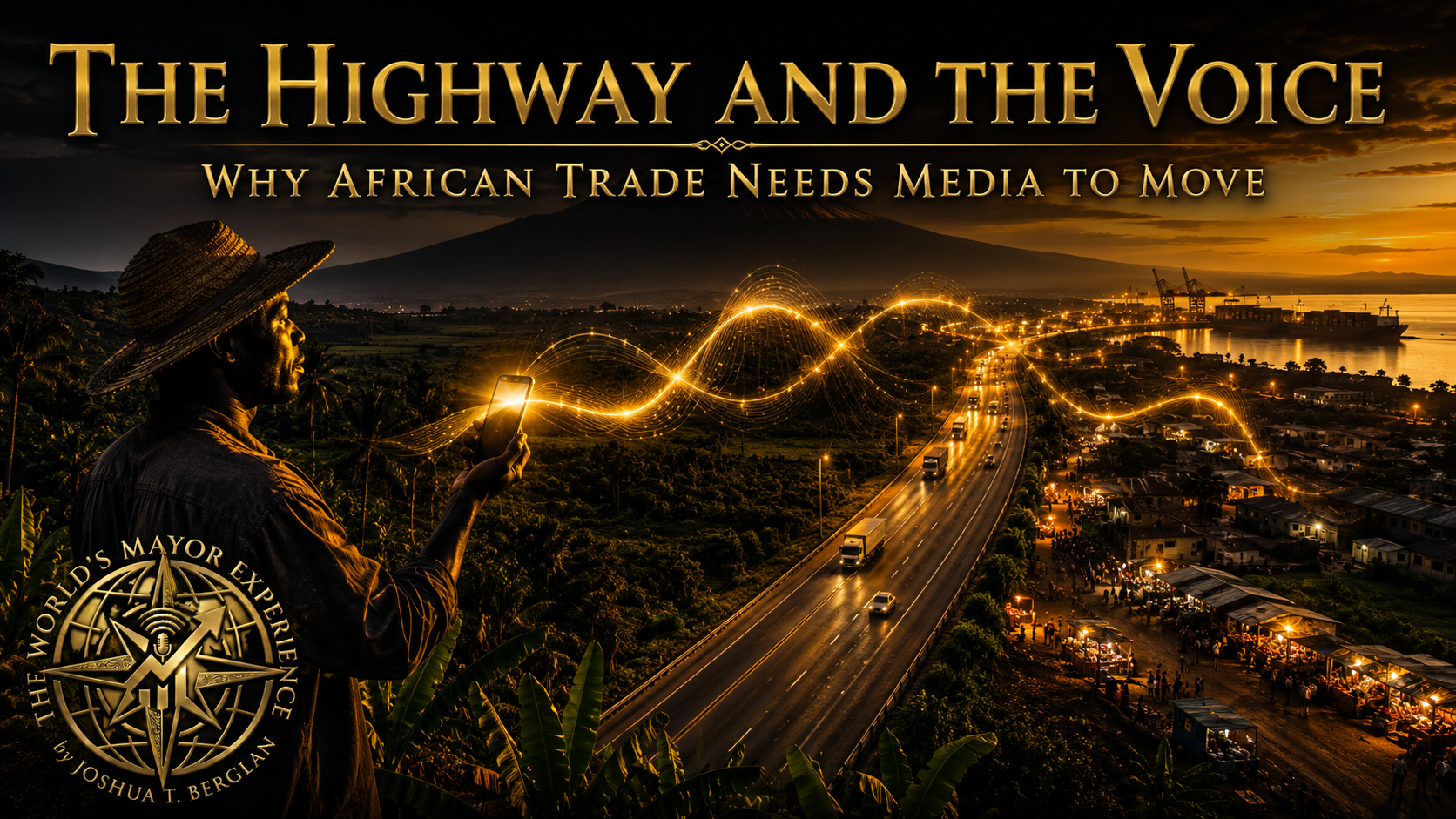
The Highway and the Voice
Why African Trade Needs Media to Move
The highway moves the product. The voice moves the people. Africa needs both.
Watch the Episode
Episode Chapters
Tap any timestamp to jump to that moment in the video.
- 00:01 — Why trust is the most important infrastructure in trade
- 01:17 — Welcome to The World's Mayor Experience in Limbe, Cameroon
- 02:07 — The Highway and the Voice: Why media is crucial for African trade
- 03:13 — Trade is the movement of confidence, not just products
- 05:40 — Building a virtual world around farming
- 07:35 — Farming is a talent that deserves visibility and branding
- 09:47 — How storytelling adds value: The two bags of coffee example
- 11:34 — Why African trade needs African media ownership
- 14:21 — How technology empowers farmers to become broadcasters
- 17:37 — Why agricultural trade platforms fail without emotional connection
- 20:29 — Why every African trade platform needs a media division
- 21:28 — A direct message to farmers: Show your work and process
- 22:18 — A call to action for youth: Bring digital media skills to agriculture
- 25:13 — The future of trade is digital, emotional, and human
- 27:08 — Final challenge: Build the road, but also build the voice
Listen to the Podcast
Executive Summary
Bottom line: Media is not decoration added at the end of African trade. Media is infrastructure — as essential as the road, the port, the warehouse, and the financing.
A trade platform can be technically brilliant and still fail emotionally, because trade is not only the movement of products. Trade is the movement of confidence.
Farmers must trust the platform is fair. Buyers must trust the product is real. Investors must trust the system is organized. Communities must trust the opportunity is not another promise that disappears when the cameras leave. Building that confidence is media's job.
In Episode Five, Joshua T. Berglan makes the case that every farmer, cooperative, shopkeeper, and trade platform in Africa can build a virtual world around real value — owned media, owned audiences, owned stories — because perception affects price, and whoever owns the story controls the opportunity.
Catch Up on This Series
Episode Five builds on the agriculture, ownership, and trade series from The World's Experience. Start here:
Series · The Farmer Is the First Investor The Farmer Is the First Investor: Africa's Wealth Truth Before chocolate, coffee, or cocoa profits — there is a farmer. Why African farmers are investors, not charity cases. Series · The Hidden Math Cocoa, Coffee and the Hidden Math of African Trade How cocoa and coffee prices reveal trade power, value chains, and ownership opportunities for farmers, youth, and communities. Episode Four · The Shopkeeper Revolution The Shopkeeper Revolution: How Local Retail Can Rebuild African Communities The shopkeeper is the last mile of food sovereignty. Feeding the communities that feed the world.Deep-Dive Chapters
1. Only Trust Can Move People
A road can move a product. A port can move a shipment. A bank can move money. But only trust can move people — and trust is built, explained, documented, repeated, and earned.
2. Media Is Infrastructure
Not extra. Not decoration. Not promotion added at the end. What good is a highway if nobody knows where it leads? What good is a market if buyers do not trust what they are buying?
3. Trade Is the Movement of Confidence
A trade platform can be technically brilliant and still fail emotionally. Farmers, buyers, investors, shopkeepers, banks, and communities all need confidence — and building it is media's job.
4. Every Trade Platform Needs a Media Engine
Not one press release. Not one launch event. A system that tells the story every day, explains the process, shows the farmer, follows the product, and builds proof over time.
5. Build a Virtual World Around the Farm
If a musician can build an audience around a song, a farmer can build an audience around a harvest. The farm is not just a farm. It is a story world.
6. Farming Is Talent
Knowing the soil is talent. Reading weather is talent. Feeding people is talent. Some of the greatest talent on earth is standing in fields — but talent without visibility is often underpaid.
7. The Two Bags of Coffee
Same weight, same quality, same origin. One has no story. The other shows the farmer, the land, the process, and where the money goes. The story does not replace the product — it reveals it.
8. Perception Affects Price
The same raw material can be underpaid in one place and sold as luxury in another. Fair trade is not only about price. It is about who controls perception, story, audience, and data.
9. Owned Attention vs. Borrowed Attention
Borrowed attention disappears when the algorithm changes. Owned attention stays connected to the people. A farmer with a contact list has power.
10. The Highway and the Voice
A highway without a voice moves products into confusion. A voice without a highway inspires people without delivering anything. The future needs both.
Key Takeaways
Media Is Infrastructure
Roads connect places. Media connects meaning. Logistics move goods. Media moves belief. You need both.
Trade Moves Confidence
Adoption fails without trust. Media explains, educates, documents, proves, and turns transactions into relationships.
Farming Is Talent
Talent without visibility is underpaid. Talent without ownership is exploited. Visibility protects the farm.
Own the Audience
If someone else owns the audience, they control the opportunity. Farmers and platforms need owned media, not borrowed attention.
Perception Affects Price
Who tells the story frames the value. African trade needs African storytelling and African media ownership.
Build a World, Not Posts
The goal is not to post more. The goal is to build a world people can enter — around the cocoa, the coffee, the cassava, the community.
Full Episode Transcript
The World's Experience with Joshua T. Berglan · Episode Five · Recorded in Limbe, Cameroon
Only Trust Can Move People
A road can move a product. A port can move a shipment. A truck can move a harvest. A bank can move money. But only trust can move people.
And trust does not appear because a platform exists. Trust does not appear because a website was launched. Trust does not appear because an app was built. Trust does not appear because an investor gave money. Trust is built. Trust is explained. Trust is documented. Trust is repeated. Trust is earned.
And that is why media may be one of the most important pieces of infrastructure in African trade. Not extra. Not decoration. Not promotion added at the end. Infrastructure.
Because what good is a highway if nobody knows where it leads? What good is a market if buyers do not trust what they are buying? What good is a trade platform if farmers do not understand how it works? What good is financing if nobody believes the system will protect them? What good is a product if the world never learns the story behind it?
Welcome to The World's Experience
What's up everyone? This is Joshua T. Berglan, The World's Mayor, coming to you from Limbe, Cameroon. And this is The World's Experience. Not just a podcast. Not just a broadcast. Not just a website. The World's Experience is the life I live, the people I meet, the places I go, the stories I document, and the truth I am committed to carrying. It is also where these stories live digitally at joshuatberglan.com.
This is Episode Five in this series on agriculture, ownership, farmers, food systems, local trade, and the future of African production. And today, I want to talk about something that is too often treated like an afterthought. Media.
Today's episode is called: The Highway and the Voice. Why African Trade Needs Media to Move.
Because roads matter. Ports matter. Financing matters. Logistics matter. Pricing matters. Warehousing matters. Documentation matters. Processing matters. Distribution matters. Technology matters. But if people do not trust the platform… If farmers do not understand the system… If buyers cannot see the proof… If investors cannot follow the story… If communities do not know what is happening… Then adoption will be slow. Participation will be weak. Fear will grow. Rumors will spread. And good ideas will die in silence.
That is the part most people miss. A trade platform can be technically brilliant and still fail emotionally.
Trade Is the Movement of Confidence
Because trade is not only the movement of products. Trade is the movement of confidence. Let me say that again. Trade is not only the movement of products. Trade is the movement of confidence.
A farmer must have confidence that the platform is fair. A buyer must have confidence that the product is real. An investor must have confidence that the system is organized. A shopkeeper must have confidence that the supply will come. A bank must have confidence that the documentation is credible. A community must have confidence that the opportunity is not another promise that disappears after the cameras leave.
That confidence is media's job.
Media explains. Media educates. Media documents. Media proves. Media humanizes. Media creates emotional connection. Media builds memory. Media turns a transaction into a relationship.
And in African trade, that matters more than many people realize. Because people do not only buy products. People buy belief. They buy confidence. They buy familiarity. They buy meaning. They buy identity. They buy the story they understand.
Every Trade Platform Needs a Media Engine
That is why every serious trade platform needs a media engine. Not one press release. Not one launch event. Not one promotional video. A media engine.
A system that tells the story every day. A system that explains the process. A system that shows the farmer. A system that follows the product. A system that answers questions. A system that documents success. A system that exposes problems. A system that builds proof over time.
Because media is not what you do after the work. Media is how people learn to trust the work.
And this is where I fit. This is what I have spent years talking about. The future of media is not just studios. It is not just television networks. It is not just celebrities. It is not just filmmakers. It is not just influencers. The future of media belongs to anyone with value, a story, a skill, a product, a mission, or a community.
A musician needs a virtual world around their talent. A speaker needs a virtual world around their message. A business needs a virtual world around its value. And a farmer can build a virtual world around the farm.
The Farm Is a Story World
That may sound unusual to some people. But it should not.
If a musician can build an audience around a song… A farmer can build an audience around a harvest. If an artist can show the creative process… A farmer can show the growing process. If a fashion brand can show where a product is made… A farmer can show where food is grown. If a celebrity can build a community around a lifestyle… A farmer can build a community around soil, seed, health, food, culture, and land.
The farm is not just a farm. It is a story world.
The seed has a story. The soil has a story. The farmer has a story. The family has a story. The village has a story. The weather has a story. The harvest has a story. The buyer has a story. The product has a story. The community has a story.
And when those stories are connected, documented, and shared consistently, the farmer becomes more than a supplier. The farmer becomes a brand. The farm becomes a platform. The harvest becomes content. The process becomes proof. The community becomes an audience. The buyer becomes part of the story.
This is what I mean by building a virtual world around the talent.
Farming Is Talent
And yes, farming is talent.
Knowing the soil is talent. Understanding seasons is talent. Protecting seed is talent. Reading weather is talent. Growing food is talent. Managing land is talent. Producing consistently is talent. Feeding people is talent.
We have to stop acting like talent only belongs on stages. Some of the greatest talent on earth is standing in fields.
But talent without visibility is often underpaid. Talent without documentation is often ignored. Talent without branding is often replaced. Talent without ownership is often exploited.
That is why virtual worlds matter.
What a Virtual World Includes
A virtual world is not a fantasy world. It is a digital ecosystem built around real value.
It can include: A website. A podcast. A YouTube channel. Short videos. Farmer profiles. Digital product catalogs. Virtual farm tours. Buyer education. Crop updates. Harvest reports. Behind-the-scenes content. Customer testimonials. Transparent pricing. Distribution information. Community stories. Live streams. Digital marketplaces. QR codes. Email lists. WhatsApp communities. Training. Documentation.
All of that can exist around one farmer, one cooperative, one village, one shopkeeper, one processor, or one trade platform.
And when it does, something powerful happens. The farmer stops being invisible. The buyer stops feeling disconnected. The investor sees evidence. The community understands the system. The product becomes more than a commodity. It becomes traceable. It becomes memorable. It becomes trusted.
This is how media adds value.
The Two Bags of Coffee
Let me give you a simple example. Imagine two bags of coffee. Same weight. Same quality. Same origin. One has no story. No documentation. No farmer profile. No traceability. No media. No explanation. No emotional connection.
The other bag shows the farmer. Shows the land. Shows the growing process. Shows the community. Shows how the farmer protects the soil. Shows how the beans are harvested. Shows where the money goes. Shows why the product matters.
Which one feels more valuable?
The story does not replace the product. The story reveals the product. That is the power of media. Media does not create fake value. Good media reveals real value that was already there.
And African agriculture is full of real value that the world rarely sees. The knowledge of elders. The strength of women farmers. The creativity of young entrepreneurs. The biodiversity of the land. The wisdom of indigenous practices. The resilience of communities. The quality of crops. The beauty of the environment. The faith it takes to plant before the rain.
Who Tells Africa's Story?
The problem is not that Africa has no story. The problem is that too many of Africa's stories are told by people who do not own the land, do not grow the food, do not live in the community, and do not carry the risk.
That has to change.
African trade needs African storytelling. African farmers need African media ownership. African communities need digital platforms they control. African products need narratives that do not begin with poverty and end with charity.
Because if the only story the world sees is struggle, the world will keep treating African producers like charity cases. But when the world sees skill… When the world sees quality… When the world sees innovation… When the world sees proof… When the world sees discipline… When the world sees production… When the world sees ownership… Then the value changes.
Perception Affects Price
Perception affects price. That is one of the most important truths in business. Perception affects price.
The same raw material can be underpaid in one place and sold as luxury in another. The difference is often processing, packaging, branding, trust, access, and story.
So when we talk about fair trade, we cannot only talk about price. We also have to talk about perception. Who controls the perception? Who tells the story? Who frames the value? Who introduces the farmer to the world? Who owns the audience? Who owns the data? Who owns the customer relationship?
Because if someone else owns the audience, they can control the opportunity.
Owned Attention vs. Borrowed Attention
That is why farmers and trade platforms need their own media. Not borrowed attention. Owned attention.
Borrowed attention disappears when the algorithm changes. Owned attention stays connected to the people.
A farmer with a contact list has power. A cooperative with an audience has power. A shopkeeper with a loyal digital community has power. A trade platform with trusted media has power.
And that is why media is infrastructure.
Roads connect places. Media connects meaning. Ports connect markets. Media connects trust. Logistics move goods. Media moves belief. Documentation protects transactions. Media explains why the transaction matters.
You need both. A highway without a voice can move products into confusion. A voice without a highway can inspire people without delivering anything. The future needs both. The highway and the voice.
The Tools Already Exist
And this is where technology becomes powerful for farmers.
A farmer no longer needs a television network to have a channel. A farmer no longer needs a newspaper to tell a story. A farmer no longer needs a major studio to document the land. A smartphone can become a broadcast studio. A WhatsApp group can become a buyer community. A website can become a marketplace. A podcast can become an education center. A QR code can become a digital passport for a product. A video can become proof of production. A live stream can become a virtual farm tour.
The tools already exist.
The question is whether farmers, cooperatives, shopkeepers, distributors, and trade platforms will be trained to use them. Because technology without training becomes another unused tool. And media without strategy becomes noise.
Build a World People Can Enter
The goal is not to post more. The goal is to build a world people can enter. Let me say that again. The goal is not to post more. The goal is to build a world people can enter.
A virtual world should help people understand: Who you are. What you grow. Why it matters. How you work. What you believe. Who you serve. Where the product comes from. How the product moves. What makes it different. How people can participate.
That is what strong artists do. That is what great brands do. That is what successful musicians do. They do not only release a song. They build an experience around the song.
Farmers can do the same.
Do not only sell cocoa. Build a world around the cocoa. Do not only sell coffee. Build a world around the coffee. Do not only sell cassava. Build a world around the cassava. Do not only sell palm oil. Build a world around the process, the people, the culture, the land, the health, the uses, and the community.
The product is the doorway. The world around it is what builds loyalty.
Where Trade Platforms Fail
This is where trade platforms often fail. They build the technology. They build the database. They build the marketplace. They build the transaction process. But they do not build the emotional experience.
They assume people will use the platform because it exists. That is not how adoption works.
People use what they understand. People support what they trust. People share what they feel connected to. People return to what gives them value.
So every trade platform needs content that answers real questions. How are prices set? Who controls the data? How are farmers protected? How are disputes handled? How are products verified? How are buyers screened? How are payments made? What happens if a shipment is delayed? What happens if a harvest is smaller than expected? What happens if quality changes? Who is accountable?
If the platform cannot answer those questions clearly, media must. Not with slogans. With education.
A five-minute explainer can save months of confusion. A farmer testimony can create more trust than a corporate presentation. A transparent failure report can build more credibility than pretending everything is perfect. A short documentary can help an investor understand what a spreadsheet never will.
That is the emotional intelligence of media.
Media Gives Data a Face
Media gives data a face.
A number says ten thousand farmers. A story introduces you to one. A report says crop loss. A video shows the family affected by it. A spreadsheet says market expansion. A documentary shows the shopkeeper whose business changed because supply became reliable.
Data matters. But people remember stories. And trade depends on memory.
If buyers remember the farmer, they return. If investors remember the mission, they pay attention. If communities remember the proof, they participate. If young people remember the opportunity, they join.
This is why media creates movement.
Transparency Protects Everyone
And we cannot talk about this without talking about transparency. Media should not only show success. Media should show process.
Where did the product come from? Who touched it? How was it grown? How was it processed? How was it stored? How was it priced? How was the farmer paid? How did it arrive at the shop?
Transparency protects everyone. It protects the farmer from being erased. It protects the buyer from deception. It protects the investor from false claims. It protects the platform from rumors. It protects the community from manipulation.
And when people can see the process, trust grows.
That is why I believe every major trade platform in Africa should have: A media division. A farmer education channel. A buyer education channel. A documentation team. A transparency series. A podcast. A video platform. A library of proof. A storytelling system. A crisis communication plan. A clear digital identity.
Not because it looks good. Because trade depends on trust. And trust depends on communication.
The future of African trade will not be built by logistics alone. It will be built by logistics plus story. Technology plus trust. Markets plus meaning. Products plus proof. Farmers plus visibility. That combination is powerful.
To the Farmers
And I want to speak directly to farmers for a moment.
You do not need to become a celebrity. You do not need to dance for the algorithm. You do not need to pretend to be someone you are not. You do not need to become an entertainer.
You only need to become visible.
Show your work. Show your land. Show your process. Show your knowledge. Show what you grow. Show what makes it different. Show what challenges you face. Show what support would change. Show what the harvest means to your family.
Your story is not a distraction from the farm. Your story can help protect the farm.
To the Young People
And to the young people listening: This is where you fit.
You may not own land. You may not know how to farm. But you know phones. You know video. You know social media. You know design. You know storytelling. You know websites. You know editing. You know how to communicate.
The farmer needs you.
There is a new category of work waiting to be built. Agricultural media. Farm storytelling. Trade documentation. Digital marketplaces. Virtual farm experiences. Product branding. Buyer education. Community media.
You do not have to leave agriculture to work in the future. You can bring the future into agriculture. That is a viral truth right there. You do not have to leave agriculture to work in the future. You can bring the future into agriculture.
To Platforms, Investors, and Governments
And to trade platforms: Do not treat media like decoration. Build it into the architecture. Do not wait until launch day to tell the story. Tell the story while the system is being built.
Show the people behind it. Show the questions. Show the disagreements. Show the solutions. Show the farms. Show the routes. Show the shops. Show the process. Show the proof.
Because people trust what they can follow. If they only see the final announcement, they may see marketing. If they see the journey, they see truth.
And to investors: Do not only ask for numbers. Ask whether the platform has trust. Ask whether farmers understand it. Ask whether buyers believe it. Ask whether communities are participating. Ask whether media is documenting the truth. Because a platform with technology but no trust is fragile.
And to governments: Infrastructure is not only concrete. Infrastructure is also communication.
A road nobody trusts can become another route for extraction. A market nobody understands can become another system of exclusion. A platform without transparency can become another place where the powerful win and the farmer disappears.
Build the road. Build the port. Build the warehouse. Build the technology. But build the media too. Build the voice.
Because the highway moves the product. But the voice moves the people.
The Message of This Episode
That is the message of this episode.
The future of trade is not just physical. It is digital. It is emotional. It is relational. It is visual. It is educational. It is human.
And every farmer, every cooperative, every shopkeeper, every distributor, and every trade platform can build a virtual world around real value.
A world where buyers understand. A world where farmers are visible. A world where investors see proof. A world where communities participate. A world where young people discover opportunity. A world where the story belongs to the people who create the value.
That is what media can build.
And that is why The World's Experience will continue to document agriculture, farmers, food systems, trade, local ownership, and the people building Africa's future.
Because I do not believe media should only cover the world. I believe media should help build it. Let me say that again. Media should not only cover the world. Media should help build it.
Media can build confidence. Media can build markets. Media can build visibility. Media can build trust. Media can build value. Media can build movements. Media can build opportunity. Media can build ownership.
And when it is placed in the hands of farmers, shopkeepers, youth, communities, and builders… Media can become one of the most powerful forms of infrastructure Africa has ever seen.
The Challenge
So let this episode be a challenge.
To farmers: Build the farm. But also build the story. To musicians and creators: Do not keep your knowledge inside entertainment. Bring it into agriculture. To young people: Use your phone to document value, not just consume content. To trade platforms: Build the marketplace. But also build the media engine. To governments: Build roads. But also build trust. To investors: Fund logistics. But also fund visibility. To buyers: Do not only ask what the product costs. Ask who created it. To media creators: Do not only chase fame. Go where value is invisible.
Because the next great media empire may not begin in Hollywood. It may begin on a farm. The next global brand may not begin in a boardroom. It may begin with a seed. The next powerful creator may not be standing on a stage. They may be standing in soil.
And the next virtual world that changes lives may not be built around a celebrity. It may be built around a farmer who finally learned how to show the world what was already there.
Closing
This is Joshua T. Berglan, The World's Mayor, coming to you from Limbe, Cameroon. And this is The World's Experience.
Today, I do not want to leave you with a slogan. I want to leave you with a responsibility. Build the road. Build the platform. Build the marketplace. Build the technology. But do not forget the voice.
Show the farmer. Explain the system. Document the proof. Tell the truth. Build the audience. Own the story. Create the virtual world.
Because a product can travel across the world… And still remain invisible. But when the product has a voice… When the farmer has a platform… When the story has ownership… Trade becomes more than movement. It becomes relationship. It becomes confidence. It becomes opportunity. It becomes power.
The highway moves the product. The voice moves the people. Africa needs both.
God bless Cameroon. God bless Afrique. God bless every farmer building value in silence. God bless every young creator willing to make that value visible. And God bless every community ready to build the highway and own the voice.
Why This Conversation Matters
Billions are being invested in African roads, ports, logistics corridors, and digital trade platforms. Almost nothing is being invested in the communication infrastructure that makes people trust and use those systems.
A trade platform without trust is fragile. A market without understanding excludes the very people it was built for. And a farmer without visibility remains underpaid no matter how good the harvest is.
This episode reframes media from marketing expense to core infrastructure — and hands farmers, shopkeepers, young creators, trade platforms, investors, and governments a specific role in building the voice alongside the highway.
How to Build a Virtual World Around a Farm
From the episode: a virtual world is not a fantasy world. It is a digital ecosystem built around real value. Here is the framework, step by step:
Step 1 — Establish your home base.
Create a website that you own. This is where your story, products, and proof live permanently — not on borrowed platforms controlled by algorithms.
Step 2 — Document the process.
Use a smartphone to capture the soil, the seed, the planting, the harvest, and the people. A phone is a broadcast studio. A video is proof of production.
Step 3 — Create farmer profiles and product stories.
Show who grows the food, where it comes from, and what makes it different. The story does not replace the product — it reveals it.
Step 4 — Build owned audience channels.
Start an email list and a WhatsApp community. Borrowed attention disappears when the algorithm changes. Owned attention stays connected to the people.
Step 5 — Educate buyers and answer real questions.
Publish explainers on how prices are set, how products are verified, and how payments work. A five-minute explainer can save months of confusion.
Step 6 — Make products traceable.
Add QR codes that act as digital passports — linking each product back to the farm, the farmer, and the process.
Step 7 — Publish consistently and build a library of proof.
Crop updates, harvest reports, testimonials, live streams, virtual farm tours. The goal is not to post more. The goal is to build a world people can enter.
Résumé en Français
L'Autoroute et la Voix : Pourquoi le commerce africain a besoin des médias pour avancer.
Dans cet épisode enregistré à Limbé, au Cameroun, Joshua T. Berglan explique pourquoi les médias ne sont pas une décoration, mais une véritable infrastructure du commerce africain — aussi essentielle que la route, le port et le financement.
Le commerce n'est pas seulement le mouvement des produits. C'est le mouvement de la confiance. L'agriculteur doit avoir confiance que la plateforme est juste. L'acheteur doit avoir confiance que le produit est authentique. L'investisseur doit avoir confiance que le système est organisé.
Chaque agriculteur, chaque coopérative, chaque commerçant peut construire un « monde virtuel » autour de sa valeur réelle : un site web, un podcast, des vidéos, des profils d'agriculteurs, des communautés WhatsApp et des codes QR qui rendent chaque produit traçable. La perception influence le prix — et celui qui possède l'histoire contrôle l'opportunité.
L'autoroute transporte le produit. La voix transporte les gens. L'Afrique a besoin des deux.
Frequently Asked Questions
What does "The Highway and the Voice" mean?
Bottom line: The highway is physical trade infrastructure — roads, ports, logistics, platforms. The voice is media — the storytelling, education, and documentation that builds trust. African trade needs both, because the highway moves the product but the voice moves the people.
Why is media considered infrastructure for African trade?
Bottom line: Because trade is the movement of confidence, not just products. Without media that explains, documents, and proves, adoption is slow, rumors spread, and good platforms fail emotionally even when they work technically.
What is a virtual world around a farm?
Bottom line: A digital ecosystem built around real value — a website, podcast, videos, farmer profiles, virtual farm tours, WhatsApp communities, QR product passports, and documentation — that makes the farmer visible, the product traceable, and the buyer connected.
Do farmers need to become influencers or entertainers?
Bottom line: No. Farmers do not need to dance for the algorithm. They only need to become visible — showing their work, land, process, and knowledge. Visibility protects the farm.
What is the difference between owned attention and borrowed attention?
Bottom line: Borrowed attention lives on someone else's platform and disappears when the algorithm changes. Owned attention — contact lists, email lists, communities, websites — stays connected to the people. Whoever owns the audience controls the opportunity.
How does perception affect price in African trade?
Bottom line: The same raw material can be underpaid in one place and sold as luxury in another. Processing, packaging, branding, trust, and story frame value — so fair trade must address who controls perception, not only price.
What media should a trade platform build?
Bottom line: A media engine, not a press release: a media division, farmer and buyer education channels, a documentation team, a transparency series, a podcast, a video platform, a library of proof, and a crisis communication plan.
How can young Africans work in agricultural media?
Bottom line: A new category of work is waiting to be built: farm storytelling, trade documentation, digital marketplaces, virtual farm experiences, product branding, and buyer education. You do not have to leave agriculture to work in the future — you can bring the future into agriculture.
About Joshua T. Berglan
Joshua T. Berglan is known as The World's Mayor and is the creator of The World's Experience. He is a 4x international bestselling author, award-winning producer, and the architect of Media Company in a Box, The Sovereign Franchise, and The Sovereign Protocol — creator-owned media infrastructure deployed to underserved communities.
His work documents stories, communities, creators, food systems, media, agriculture, and the people building new futures from the ground up. It is not aid. It is architecture.
Build the Highway. Own the Voice.
Show the farmer. Explain the system. Document the proof. Tell the truth. Build the audience. Own the story.
The World's Experience · Recorded in Limbe, Cameroon · joshuatberglan.com