Before I tell you about agriculture, financing, farming systems, food security, or the future of Africa, I want to ask a question that should disturb every nation on the continent. How can a place grow the world’s food, feed the world’s industries, supply the world’s luxury products, and carry the world’s raw materials — and still have farmers who cannot afford the seeds for the next season?
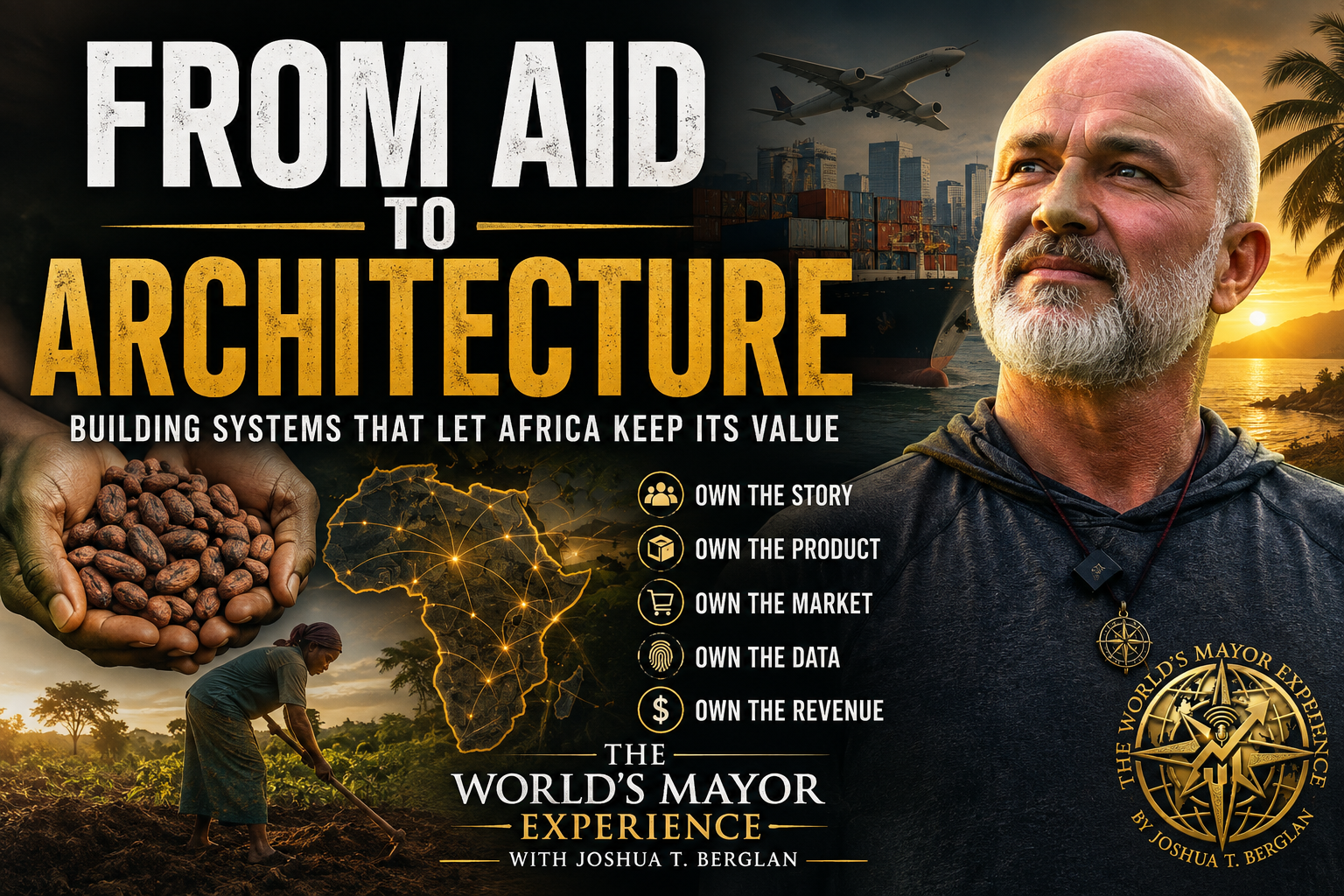
How can a farmer grow cocoa and still not control chocolate? Grow coffee and still not control the café? Grow cotton and still not control the cloth? Grow sugar cane and still not control the sugar? Grow palm and still not control the finished product? How can a continent produce so much value and receive so little ownership?
What’s up, everyone. This is Joshua T. Berglan, The World’s Mayor, coming to you from Limbe, Cameroon. And this is The World’s Experience — not just a podcast, not just a show, not just a digital platform. The World’s Experience is the life I live, the work I do, the places I go, the people I meet, the stories I document, and the truth I am committed to carrying. It’s also where these stories live online, at joshuatberglan.com.
Today I want to talk about something bigger than farming. This is about freedom. This is about ownership. This is about whether Africa will keep being treated as the place where value begins — but not the place where value is finished.
01 — What changed in me Africa is where value begins. It’s rarely where value is finished.
I came to Cameroon deeply passionate about media, and I still am. I’m passionate about youth, about single mothers, about people battling addiction, about helping people recover, rebuild, own their voice, and create something meaningful from their story. But the more time I’ve spent here — meeting farmers, learning about agriculture, regenerative systems, land, soil, markets, and the people who actually feed communities — the more I’ve realized this may be one of the most important conversations we can focus on right now. Not just in Cameroon. Not just across Afrique. Around the world.
Because agriculture is not just about food. It is about survival, health, economics, sovereignty, land, and dignity. It is about whether communities control their future or remain dependent on systems that do not serve them.
Most people celebrate the harvest. But they ignore the crisis before planting.
02 — The crisis before planting Everyone wants the harvest. Almost no one funds the planting.
The world wants the food. The buyer wants the supply. The market wants the crop. The exporter wants the volume. The processor wants the raw material. The government wants production numbers. The consumer wants a full plate. But the farmer is too often expected to perform miracles with empty pockets. That is not agriculture. That is pressure. That is not partnership. That is extraction with polite language.
Farmers need real things, and they need them before the season begins — not after they’re already struggling:
- Improved seeds and fertilizer
- Crop protection and irrigation
- Tractors, harvesters, machinery, and tools
- Training, access, and storage
Before the sale. Before the income. Before the proof. Before the harvest even exists. If the world is going to demand production from farmers, then the world must care about what farmers need before production begins.
03 — The Munroe warning The architecture of dependency.
This is where the message of Dr. Myles Munroe hits so hard. In one of his teachings, he explains one of the deepest economic traps ever created: oppressed people were taught how to grow cane and pick cotton — but they were not taught how to turn cane into sugar, or cotton into cloth. That isn’t just history. That is a system. That is the architecture of dependency.
Teach a people to produce raw material, but do not teach them conversion. Do not teach them processing, pricing, manufacturing, branding, distribution, or how the money really moves. Then one day, tell them they’re free. Give them the land, the crop, the raw material — but keep the factory, the financing, the machinery, the shipping, the branding, the market access, the contracts, and the price-setting power.
Now they are not physically chained. But economically, they are still trapped.
04 — The real diagnosis The farmer is not poor. The system is poorly designed.
Many African farmers are not poor because they fail to create value. They are poor because they are locked out of the systems that multiply value. They grow the crop. Someone else finances it, buys it, processes it, brands it, exports it, sells it, sets the price, and tells the story. And then the world has the nerve to call the farmer poor.
No. The farmer is not poor. The system around the farmer is poorly designed. Or maybe worse — maybe it was designed perfectly. Just not for the farmer.
So the farmer doesn’t only need sympathy. The farmer needs infrastructure, access, fair financing, tools, ownership, and visibility — systems that recognize them as the beginning of the value chain, not the weakest part of it. Many farmers don’t need another loan that treats them like a risk. They need partnerships that recognize them as producers: inputs before the income exists, machinery before the yield is expected, trust before the harvest proves itself.
05 — Who carries the first risk The farmer believes before everyone else believes.
The farmer plants when there is nothing to show. The farmer risks before the buyer arrives, works before the market applauds, and invests before the profit is visible. So if the farmer already carries the first risk, why is the farmer the last to receive support?
That question should bother banks, governments, investors, churches, NGOs, media companies, and consumers. It should bother anyone who eats food and calls themselves civilized. Because every meal is connected to somebody’s risk. Somebody planted before you purchased. Somebody labored before you tasted. Somebody trusted the season before you trusted the product.
06 — Media is infrastructure A road moves crops. Media moves trust.
This is where media becomes essential — not optional. Media is not just cameras, interviews, or social posts. Media is how trust becomes visible. Farmers carry real questions: What system can I trust? Who sets the price? What do I owe? What am I signing? What happens if the harvest fails? Will this help me grow — or take control from me? Those questions aren’t resistance. They’re wisdom. People who have been exploited are not wrong for being cautious.
So media must educate and explain. It must show the process and document the truth — the land, the inputs, the harvest, the success, and the problems. Not propaganda. Truth. If something works, show it. If something breaks, tell the truth and fix it. If farmers are winning, let them speak. If terms are confusing, explain them. If banks need proof, build the proof.
A tractor prepares land. A harvester saves labor. But media moves trust.
Without trust, farmers won’t participate, banks won’t fund, suppliers won’t extend support, buyers will hesitate, and communities will resist. Good ideas can’t scale. Trust may be one of the most important currencies in African agriculture right now.
07 — What freedom actually is Freedom is controlling more of the chain.
Connect this back to what Munroe was teaching. Freedom is not just having access to raw material — it’s knowing what to do with it. Freedom is not just growing cotton; it’s turning cotton into cloth. Not just growing cocoa; it’s turning cocoa into chocolate, cosmetics, products, brands, and global value. Not just growing cassava; it’s turning it into flour, starch, packaged foods, and exportable products. Not just growing palm; it’s building soaps, oils, cosmetics, and industrial goods.
And that is exactly why inputs matter. You cannot talk about processing if farmers can’t afford the seeds. You cannot talk about export if the farmer can’t access fertilizer. You cannot talk about food security if the farmer can’t irrigate the land. You cannot talk about agricultural transformation if the farmer is still using yesterday’s tools while the market demands tomorrow’s volume. That is the hypocrisy: the world wants African production but often refuses to finance African capacity — then blames the farmer when the yield is low.
08 — For the young people Agriculture is technology. Agriculture is sovereignty.
Young people of Cameroon and Africa — hear this clearly. Agriculture is not backward, not punishment, not something to be ashamed of. Agriculture is technology, media, finance, logistics, science, data, branding, and sovereignty. The problem is not farming. The problem is that too many people have only ever seen farming at the lowest-paid level of the chain.
Add machinery, processing, media, data, e-commerce, packaging, storytelling, and direct market access, and farming becomes one of the most powerful business platforms on earth. Africa’s agricultural future doesn’t have to look like survival. It can look like ownership: young people building agri-media companies, cooperatives with websites and buyer portals, farmers with QR codes telling the story of the field, local crops becoming local brands, villages becoming production ecosystems — Cameroon feeding itself and exporting with power.
Potential without infrastructure becomes frustration.
So let’s stop romanticizing struggle. The farmer doesn’t need applause while lacking tools, or sympathy while lacking access, or another speech about potential while standing in front of unfunded land.