Why Does the Farmer Receive a Different Price Than the Global Market Price?
The farmer receives a different price because the global market price usually reflects a later stage in the value chain.
The farmgate price is often the amount paid near the farm or local buying point. The international price may include expectations, contracts, currency movements, export costs, shipping realities, and global demand.
Both numbers can be true. They are just not describing the same point in the trade journey.
| Price Level | What It Usually Represents | Why It Matters |
|---|---|---|
| Farmgate price | What the farmer receives near the farm or local buying area | Shows the producer’s immediate income |
| Domestic buyer price | What a buyer pays or calculates inside the local market | Reflects local aggregation and trade costs |
| DLA / local pricing | Local arrival or domestic market context before export | Helps explain national market movement |
| FOB price | Value when goods are ready for export at the port | Includes more costs than farmgate pricing |
| International price | Global market reference price | Reflects broader market conditions |
What Do CAF, FOB, and DLA Mean in Simple Language?
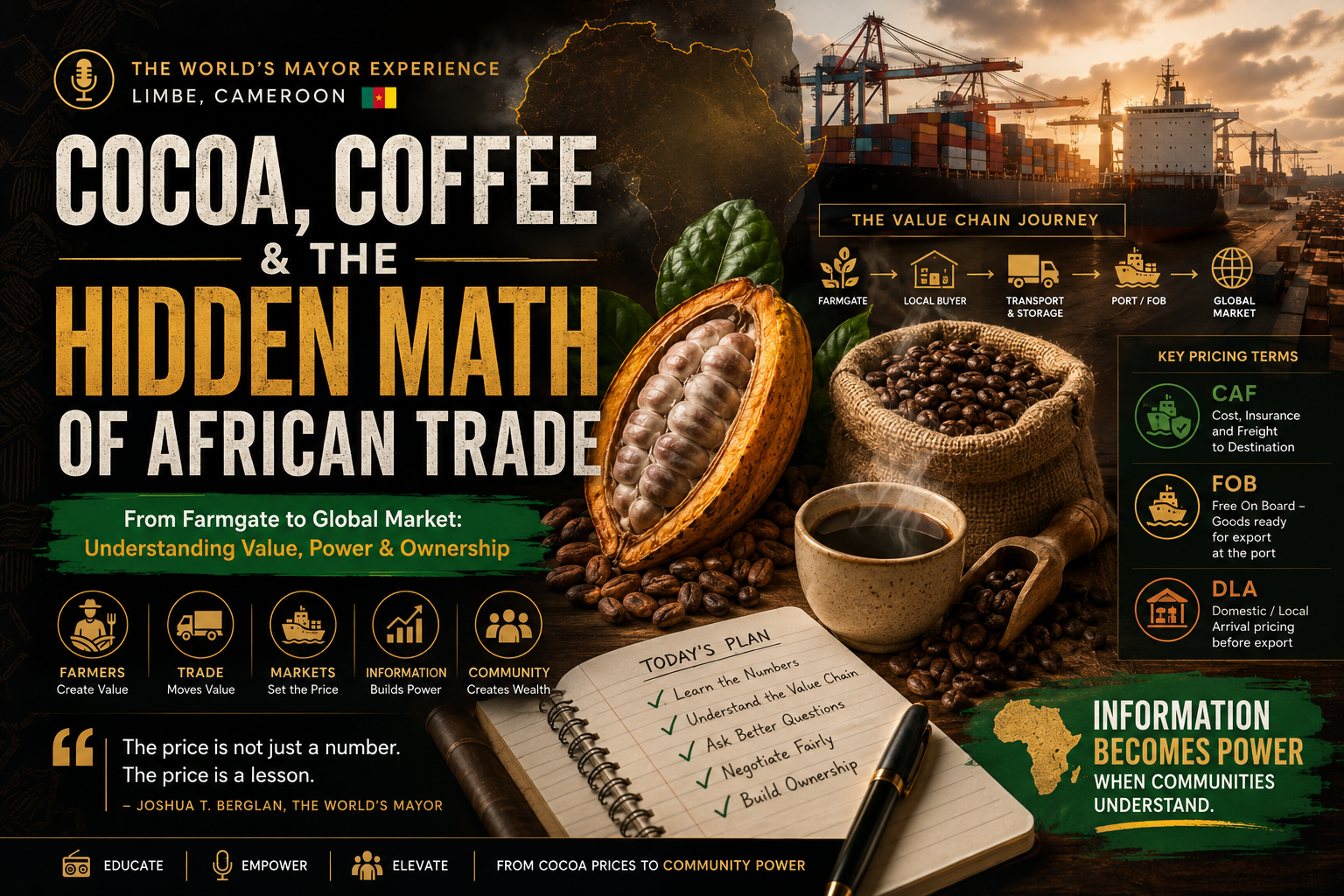
These terms can feel technical, but the concept is simple. They describe different points in the trade journey.
Do not get trapped by the letters. Focus on the economic location of the price.
CAF: What Is CAF Pricing?
CAF often refers to a price that includes cost, insurance, and freight connected to moving goods toward a destination.
In simple language, CAF asks: what is the crop worth when certain movement costs are included?
CAF is not just the raw crop value. It is a price connected to logistics, risk, and delivery context.
FOB: What Is FOB Pricing?
FOB means Free On Board.
In simple language, FOB usually refers to the value of goods when they are ready to leave through the port, loaded for export, before the next major international shipping leg.
FOB is not the same as the farmgate price. It may include more steps, more handling, more preparation, and more costs.
- Transport from farm areas to collection points
- Storage
- Sorting
- Quality control
- Export preparation
- Documentation
- Port-related costs
- Handling and loading
DLA: What Is DLA Pricing?
DLA can refer to domestic or local arrival pricing depending on the specific market report or local trade context.
In simple language, DLA helps communities think about the local market reality before export.
It points attention to what happens between the farm, the buyer, the warehouse, the transport route, the local market, and the export system.
Why Is Cocoa and Coffee Pricing a Community Power Issue?
Cocoa and coffee pricing is a community power issue because information affects negotiation.
When people do not understand pricing, they are easier to confuse. When people do not understand costs, they are easier to underpay.
This is not about blaming farmers, buyers, exporters, or government agencies. It is about education.
Confusion weakens communities. Shared understanding strengthens them.
The Community Power Framework
| Power Layer | What It Means | Community Action |
|---|---|---|
| Information power | Knowing the current prices and pricing terms | Share weekly price education |
| Market power | Understanding how crops move through the value chain | Teach farm-to-port economics |
| Negotiation power | Knowing what questions to ask before selling | Train farmers and cooperatives |
| Ownership power | Capturing more value locally | Build processing, branding, and distribution |
| Media power | Translating complex reports into simple education | Use radio, podcasts, WhatsApp, and YouTube |
How Does Media Turn Cocoa Prices Into Financial Literacy?
Media turns cocoa prices into financial literacy by translating technical information into simple, repeatable education.
A market report sitting on a website is not enough. A price board in an office is not enough.
Information becomes power only when people can access it, understand it, use it, and share it.
Media Can Teach the Market Through:
- Local radio segments
- Community podcasts
- YouTube explainers
- WhatsApp voice notes
- School lessons
- Cooperative meetings
- Church and community gatherings
- Posters and visual price boards
- Short videos in local languages
- Weekly farmgate-to-FOB breakdowns
Why Should Cameroon’s Youth Study Cocoa and Coffee Value Chains?
Cameroon’s youth should study cocoa and coffee value chains because agriculture is not the past.
Agriculture is data, logistics, branding, digital commerce, media, export strategy, and entrepreneurship.
Many young people are taught to see farming as labor only. That is too small.
Cocoa Is Not Just Cocoa
- Chocolate
- Cocoa butter
- Cocoa powder
- Cosmetics
- Health products
- Luxury goods
- Tourism experiences
- Educational content
- Documentaries
- Community-owned brands
- Digital marketplaces
Coffee Is Not Just Coffee
- Roasted brands
- Cafés
- Subscription products
- Export relationships
- Cultural storytelling
- Barista training
- Tourism experiences
- Youth entrepreneurship
- Digital commerce
What Is the Real Problem With Selling Only Raw Materials?
The real problem with selling only raw materials is that the lowest level of the value chain usually captures the smallest share of total wealth.
Production matters. But production alone is not power.
- Production without ownership can become exhaustion.
- Production without pricing knowledge can become exploitation.
- Production without processing can limit wealth.
- Production without branding can make the producer replaceable.
- Production without media can make the origin invisible.
- Production without data can make the community powerless.
The Better Question
Instead of only asking, “How much cocoa did we grow?” Cameroon can also ask:
- How much value did we keep?
- How much was processed locally?
- How much was branded locally?
- How much was sold through local companies?
- How much knowledge stayed with the youth?
- How much profit returned to the people closest to the land?
- How many farmers understood the price before accepting the deal?
- How many communities understood the difference between farm price and export price?
What Should Farmers Know Before Selling Cocoa or Coffee?
Farmers should know the current market context, the quality of their crop, the local buyer price, and the difference between farmgate, domestic, port, and international pricing.
This does not mean every farmer must master global finance. It means every farmer should understand enough to ask better questions.
Farmer Pricing Checklist
- What is the current local price?
- What is the current national or domestic market price?
- What is the current international reference price?
- What quality grade is being assigned to my crop?
- How is moisture content being measured?
- What deductions are being made?
- What costs are real?
- What margin is being added?
- Is the price written down?
- Can the cooperative compare offers?
- Do I understand the difference between the price I receive and the export price?
What Should Young Entrepreneurs Build Around Cocoa and Coffee?
Young entrepreneurs can build businesses around the gaps in the value chain.
The opportunity is not only in farming. It is also in education, media, branding, logistics, processing, quality control, packaging, digital commerce, tourism, and community data.
Youth Opportunity Map
| Opportunity Area | Business Idea |
|---|---|
| Media | Weekly cocoa and coffee price explainers |
| Education | Trade literacy workshops for farmers |
| Technology | WhatsApp price alert groups |
| Branding | Local cocoa and coffee product identity |
| Processing | Small-batch chocolate or roasted coffee |
| E-commerce | Online marketplaces for local products |
| Tourism | Farm-to-cup or farm-to-chocolate experiences |
| Data | Community price tracking dashboards |
| Training | Youth-led cooperative education |
| Storytelling | Documentary content about farmers and origin communities |
Why Media Is Economic Infrastructure
Media is economic infrastructure because it connects value creators to information, markets, trust, and visibility.
A camera is not just a camera. A podcast is not just a podcast. A YouTube channel is not just entertainment.
When used correctly, media can help:
- A farmer understand the market
- A cooperative build trust
- A buyer become more transparent
- A young entrepreneur identify opportunity
- A community negotiate better
- A nation see wealth hiding in plain sight
The Ownership Shift: From Raw Production to Informed Power
The mission is not only to produce more cocoa or coffee.
The mission is to help communities keep more value, understand more of the system, and build more ownership.
Cameroon has the land. Cameroon has the farmers. Cameroon has the youth. Cameroon has the products. Cameroon has the creativity. Cameroon has the story.
The next question is whether Cameroon can build the media, education, processing, branding, and ownership systems that help more value stay with the people who create it.
The value chain is not just economics. It is a map of power.
From Hidden Math to Visible Opportunity
Cocoa prices can become community education. Coffee prices can become youth entrepreneurship. Trade literacy can become ownership.
Explore More from Joshua T. BerglanDeep-Dive FAQ
What is the hidden math of African trade?
The hidden math of African trade is the difference between the value created at the farm and the value captured across the supply chain. It includes farmgate pricing, transport, storage, quality control, export preparation, port costs, international pricing, processing, branding, and retail margins.
Who needs to understand cocoa and coffee pricing?
Farmers, students, cooperatives, local buyers, traders, transporters, teachers, policymakers, media creators, and young entrepreneurs need to understand cocoa and coffee pricing. The more people understand the price journey, the harder it becomes for confusion or exploitation to control the market.
Why is the international cocoa price different from the farmer’s price?
The international cocoa price is different from the farmer’s price because it often refers to a later stage in the value chain. The farmer’s price may not include transport, storage, documentation, quality handling, taxes, port preparation, export margins, currency movement, or international shipping factors.
What does FOB mean in cocoa and coffee trade?
FOB means Free On Board. In cocoa and coffee trade, it usually refers to the value of goods when they are ready to leave through the port for export, after several domestic costs and preparation steps have already been added.
What does CAF mean in trade pricing?
CAF often refers to pricing that includes cost, insurance, and freight connected to moving goods toward a destination. In simple terms, CAF helps explain how the price changes when movement, risk, and delivery-related costs are included.
What does DLA mean in local market pricing?
DLA can refer to domestic or local arrival pricing depending on the trade context or market report. It helps explain the local market reality between the farm, local buyer, warehouse, transport system, and export pipeline.
Where should cocoa and coffee price education be taught?
Cocoa and coffee price education should be taught in schools, agricultural programs, cooperatives, community media hubs, churches, local radio programs, podcasts, WhatsApp groups, and training centers. The goal is to make trade language understandable to the people closest to the products.
How can media help farmers and communities?
Media can help farmers and communities by translating market reports into simple language, sharing weekly price updates, explaining trade terms, documenting farmer stories, and exposing where value is created or lost. Media becomes financial literacy when it helps people understand and use economic information.
Why should young people in Cameroon care about agriculture?
Young people in Cameroon should care about agriculture because it can become a modern business platform. Cocoa and coffee can connect to branding, e-commerce, artificial intelligence, logistics, tourism, education, media, processing, and export entrepreneurship.
How can communities turn information into ownership?
Communities can turn information into ownership by learning pricing terms, tracking market changes, organizing cooperatives, processing more products locally, building brands, documenting their value, and using media to educate members. Shared understanding becomes community power when people act together.